Quechua: The Legacy and Structure of the Andes' Primary Indigenous Language
Quechua, also known as Runa simi (meaning "people's language" in Southern Quechua), is a prominent indigenous language family that originated in central Peru. Over centuries, it spread across the Andean region, becoming the most widely spoken pre-Columbian language family in the Americas. Today, it remains a vital symbol of cultural identity for millions of people across South America.
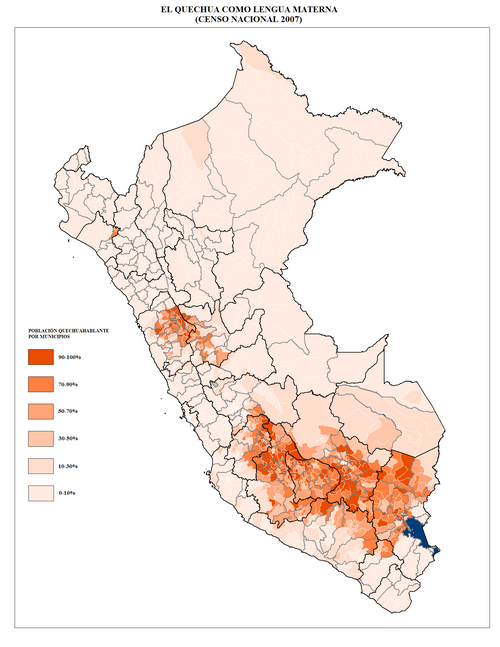
The language evolved from a common ancestral tongue known as Proto-Quechuan. While estimates of its speaker population vary, recent data suggests there are approximately 7.2 million native speakers, with a significant presence in Peru, where roughly 13.9% (3.7 million) of the population speaks a Quechua variety.
Key Facts
- Native Speakers: Approximately 7.2 million.
- Origin: Central Peru, later spreading throughout the Andes.
- Official Status: Recognized as an official language in Peru (1975), Ecuador (2006), and Bolivia (2009).
- Classification: Divided primarily into Quechua I (Central) and Quechua II (Peripheral).
- Terminology: Often referred to as Runa simi or Kichwa depending on the region.
Historical and Legal Status
Quechua has transitioned from the administrative language of the Inca Empire to a recognized national language in several modern states. Peru led the way in 1975 by granting Quechua official status. This was followed by Ecuador in 2006 and Bolivia in 2009, the latter of which recognized Quechua alongside several other indigenous languages.
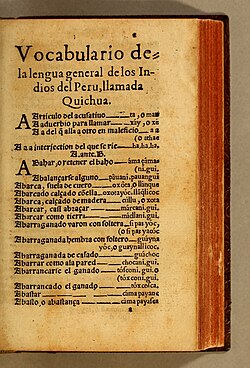
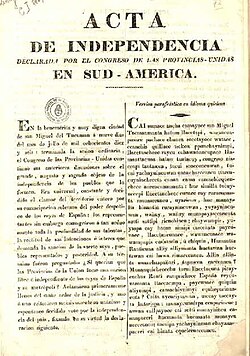
The written history of the language is documented in early colonial texts, such as the 1560 vocabulary by Domingo de Santo Tomás, and later in significant political documents like the 1816 Act of Argentine Independence, which was written in both Spanish and Quechua.
Geographic Distribution and Speaker Population
Measuring the exact number of Quechua speakers is challenging due to under-reporting in censuses and varying estimation methods. While some sources like Ethnologue have previously estimated up to 10 million speakers, census data provides a more conservative but localized view.
| Country | Estimated Speakers | Source/Year |
|---|---|---|
| Peru | 3,800,000 | 2017 Census |
| Bolivia | 2,100,000 | 2001 Census |
| Ecuador | 2,300,000 | Adelaar 1991 |
| Argentina | 900,000 | 1971 |
| Colombia | 4,402 to 16,000 | Various |
| Chile | Few (8,200 in ethnic group) | 2002 Census |
Linguistic Classification
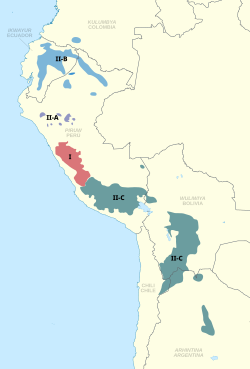
Linguists, most notably Alfredo Torero, classify the Quechuan family into two primary branches based on their evolution from Proto-Quechua.
Quechua I (Central)
This branch is primarily found in central Peru. Key varieties include Ancash (Huaylas–Conchucos), Wanka, and Yauyos–Chincha.
Quechua II (Peripheral)
Also known as Wanp'una ("Traveler"), this branch is more geographically widespread and is further subdivided:
- Quechua II-A: Includes reduced varieties like Cajamarca–Cañaris.
- Quechua II-B (Northern): Spoken in Ecuador (as Kichwa), northern Peru, and Colombia (Inga Kichwa).
- Quechua II-C (Southern): The most widespread group, including Ayacucho, Cusco, Puno, and varieties in Bolivia and Argentina.
Grammar and Linguistic Features
Quechua is an agglutinative language, meaning it builds complex words by adding multiple suffixes to a root. This is most evident in its noun and verb systems.
Noun Suffixes
Nouns use suffixes to indicate plurality, possession, and case. For example, the suffix -kuna is used to indicate a plural (e.g., wasi "house" becomes wasi kuna "houses"). Case suffixes define the role of the noun, such as -pi for locative ("at the house") or -manta for ablative ("from the house").
The Evidentiality System
One of the most distinctive features of Quechua is evidentiality—the requirement to specify the source of the information being shared through specific suffixes:
- -m(i): Direct evidence; the speaker witnessed the event.
- -chr(a): Inference or conjecture; the speaker is making an educated guess.
- -sh(i): Hearsay; the information was reported by someone else.

Frequently Asked Questions
What is the difference between Quechua and Kichwa?
Kichwa is the term generally used for the Northern Quechua (Quechua II-B) varieties spoken primarily in Ecuador.
Is Quechua still spoken today?
Yes, it is spoken by millions of people across the Andes, with official status in Peru, Ecuador, and Bolivia.
What does "Runa simi" mean?
Runa simi translates to "people's language," reflecting the identity of the speakers as Runakuna (people).
How does the Quechua evidential system work?
It requires speakers to add a suffix to a sentence to indicate whether they saw the event themselves, inferred it, or heard about it from another source.
Which country has the most Quechua speakers?
Peru has the largest population of Quechua speakers, with approximately 3.8 million according to the 2017 census.