Skuas: The Predatory Pirates of the Polar Skies
The skuas are a group of formidable predatory seabirds known for their aggression, intelligence, and opportunistic feeding habits. Belonging to the genus Stercorarius—the sole genus in the family Stercorariidae—these birds are found across temperate, Arctic, and Antarctic regions. While they may resemble large gulls at a distance, their behavior and biological traits set them apart as some of the most daring aviators in the animal kingdom.
The terminology used to describe these birds varies by region. In North American English, the three smaller species—the Arctic, long-tailed, and pomarine skuas—are referred to as jaegers, a word derived from the German term for "hunter." The word "skua" originates from the Faroese skúgvur, named after the island of Skúvoy. Interestingly, their scientific genus name, Stercorarius, is Latin for "of dung," stemming from an early misconception that the food skuas forced other birds to disgorge was excrement.
Key Facts
- Feeding Strategy: Many species practice kleptoparasitism, stealing food from other birds.
- Global Range: They are long-distance migrants found in both polar regions and have been sighted as far south as the South Pole.
- Physical Traits: Characterized by hooked bills, webbed feet with sharp claws, and a fleshy cere above the upper mandible.
- Diversity: The genus consists of seven distinct species ranging from 310 grams to 1.63 kg.
- Behavior: Highly aggressive protectors of their ground nests, often "divebombing" intruders.
Biology and Survival Tactics
Skuas are medium to large birds typically sporting grey or brown plumage with white wing markings. Their size varies significantly across the genus; the long-tailed skua (S. longicaudus) is the smallest at 310 grams (0.68 lbs), while the brown skua (S. antarcticus) is the largest, reaching up to 1.63 kg (3.6 lbs). On average, they measure 56 cm (22 in) in length with a wingspan of 121 cm (48 in).
These birds are acrobatic fliers and opportunistic feeders. Outside of the breeding season, their diet consists of fish, offal, and carrion. However, they are most famous for kleptoparasitism—the act of stealing food from other animals. This method accounts for up to 95% of the winter diet for some skuas, who chase gulls and terns to seize their catch, even when the victim is three times heavier than the attacker.
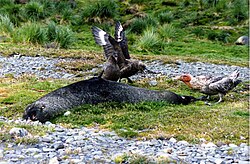
Dietary habits shift during the breeding season. In the north, slender species often hunt lemmings. In the southern oceans, they rely on fish, penguin eggs, and chicks. Some species, particularly the south polar skua, scavenge carcasses of pinnipeds (seals) and penguins. They have even been observed stealing milk directly from the teats of elephant seals. Despite their dominance, skuas often lose their prizes to the larger and more aggressive giant petrels.
Nesting and Defense
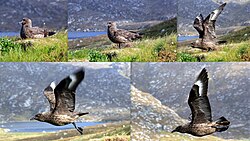
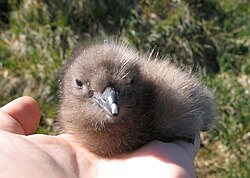
Skuas nest on the ground. To protect their offspring, parents employ a defensive tactic known as "divebombing," where they launch rapid aerial attacks targeting the heads of potential predators.
Taxonomy and Evolution
The genus Stercorarius was established by French zoologist Mathurin Jacques Brisson in 1760. While skuas are related to auks, waders, gulls, and skimmers, they possess unique evolutionary markers. For a time, taxonomists split the group into two genera: Stercorarius for the smaller Holarctic species (which feature elongated central tail feathers) and Catharacta for the larger Southern Hemisphere species.
Modern genetic analysis, along with studies of behavior and feather lice, suggests that a single genus is more accurate. Mitochondrial DNA reveals that the pomarine and great skuas are more closely related to each other than to other northern species, suggesting that hybridization played a significant role in their evolution.
Species Overview
There are seven recognized species of skuas, all currently listed as Least Concern (LC) on the IUCN Red List.
| Common Name | Scientific Name | Primary Breeding Range | Wintering Range |
|---|---|---|---|
| Chilean Skua | S. chilensis | Southern Chile & Argentina | Pacific & Atlantic coasts of S. America |
| South Polar Skua | S. maccormicki | Antarctica coast | North Atlantic & North Pacific |
| Brown Skua | S. antarcticus | Southern Ocean | Southern Ocean |
| Great Skua | S. skua | Northeast Atlantic coast | North Atlantic |
| Pomarine Jaeger | S. pomarinus | Arctic coastline | Tropical & subtropical oceans |
| Arctic Skua | S. parasiticus | Arctic coastline | Southern Hemisphere |
| Long-tailed Jaeger | S. longicaudus | Arctic | Southern Ocean |
Frequently Asked Questions
What is kleptoparasitism in skuas?
Kleptoparasitism is a feeding behavior where skuas harass and chase other seabirds, such as gulls or terns, to force them to drop or regurgitate their catch so the skua can steal it.
Why are some skuas called jaegers?
In North America, the three smaller species (Arctic, long-tailed, and pomarine) are called jaegers, which is the German word for "hunter."
Do skuas eat other birds?
Yes. While they often steal food, larger species like the great skua regularly kill and eat adult seabirds, including puffins and gulls, and have even been known to kill birds as large as the grey heron.
Where do skuas nest?
Skuas nest on the ground in temperate, Arctic, and Antarctic regions. They are highly protective of these nests and will attack intruders by divebombing their heads.
How do skuas differ from gulls?
Although they look similar, skuas have a fleshy cere above the upper mandible, a more hooked bill tip, and exhibit much more aggressive predatory and parasitic behaviors than most gulls.