Kleptoparasitism: The Evolutionary Strategy of Food Theft in Nature
In the natural world, survival often depends on the ability to acquire energy efficiently. While most animals hunt or forage for their own meals, some have evolved a more opportunistic approach known as kleptoparasitism. Derived from the Greek word kléptō (meaning "steal"), kleptoparasitism is a feeding behavior where one animal—the kleptoparasite—deliberately takes food from another, often through aggressive confrontation or stealth.
This strategy is not merely random theft; it is an evolutionarily stable behavior. This means it provides a selective advantage when the energy cost of stealing is lower than the cost of direct predation. Such a shift typically occurs when food is scarce or when the parasite can easily target victims that are physically weaker or less assertive.
Key Facts
- Definition: A form of parasitism where one animal steals food or resources from another.
- Stability: Becomes advantageous when food abundance falls below a critical level, making stealing more efficient than hunting.
- Emery's Rule: The observation that insect social parasites, including many kleptoparasites, tend to be closely related to their hosts.
- Diversity: Occurs across a wide range of taxa, from insects (bees, wasps, flies) to vertebrates (birds, mammals, dolphins).
- Types: Can be intraspecific (within the same species) or interspecific (between different species).
The Mechanics of the Stealing Strategy
Kleptoparasitism is a calculated risk. The parasite spends time and energy pursuing a victim, which could otherwise be used for direct feeding. Therefore, the energy gained from the stolen meal must outweigh the energy spent in the theft. Mathematical models indicate that when food is abundant, direct feeding is the superior strategy. However, as food levels drop, aggressive interactions and theft become more common.
The success of this strategy also depends on frequency-dependent selection. If potential victims are too rare or widely dispersed, the time spent searching for them exceeds the value of the food that might be stolen, rendering the strategy unsustainable.
Kleptoparasitism in Arthropods
Bees and Wasps
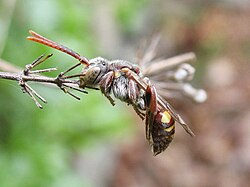
Many arthropods, particularly bees and wasps, have specialized in this behavior. Cuckoo bees are prime examples; they lay their eggs in the nest cells of other bees, stealing the pollen masses intended for the host's own larvae. This often follows Emery's rule, as seen in the genus Bombus, where Bombus bohemicus parasitizes other species within its own genus.
Similarly, cuckoo wasps (Chrysididae) target the nests of mud dauber and potter wasps. Some species are classified as kleptoparasitoids—parasitoids that target hosts already parasitized by another female, sometimes using existing punctures or trails to locate their victim. This specific behavior is known as pirate parasitism.
Flies, Beetles, and Spiders
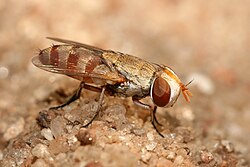
Other insects employ diverse theft tactics. Miltogrammine flies deposit larvae on food reserved for sand wasp larvae, while certain Bengalia flies steal pupae transported by ants. In the world of beetles, smaller Onthophagus species may enter dung balls while Scarabeus beetles are still constructing them.
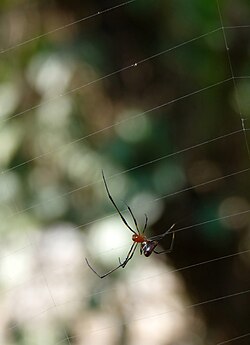
Even spiders engage in this behavior. Species from five different families, including Argyrodes (Theridiidae), steal prey captured by other spiders.
True Bugs
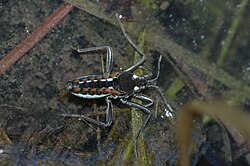
Some semiaquatic bugs exhibit intraspecific kleptoparasitism. For instance, the water cricket Velia caprai will join a member of its own species to steal parts of a prey item if that prey weighs more than 7.9 mg.
Kleptoparasitism in Vertebrates
Avian Pirates
Birds are among the most visible practitioners of food theft. Specialist kleptoparasites like skuas and frigatebirds rely heavily on this method. Frigatebirds, often called "pirates of the sea," soar above colonies and vigorously pursue other seabirds, forcing them to disgorge their catch.
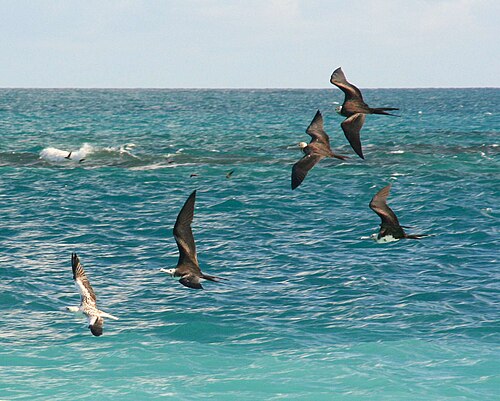
Many other birds are opportunistic. Bald eagles may attack ospreys to steal fish, and gulls frequently target other birds—or humans at seaside resorts—to acquire food. In some cases, such as with the roseate tern, parents who steal food are more successful in raising their broods than those who do not.
Mammals and Marine Life
In the African savannah, the relationship between lions and spotted hyenas is a classic example of mutual kleptoparasitism, as both species routinely rob kills from each other and from cheetahs. Other opportunistic thieves include bears, wolves, and coyotes.
Interestingly, this behavior extends to the ocean. Risso's dolphins have been observed charging sperm whales head-on, potentially causing the whales to regurgitate food that the dolphins then consume.
| Parasite | Host/Victim | Method of Theft |
|---|---|---|
| Cuckoo Bee (Nomadinae) | Other Bees | Laying eggs on pollen masses |
| Frigatebird | Tropicbirds/Seabirds | Aggressive aerial pursuit to force regurgitation |
| Spotted Hyena | Lion/Cheetah | Driving the predator away from a kill |
| Argyrodes Spider | Other Spiders | Stealing prey from another's web |
| Risso's Dolphin | Sperm Whale | Head-on charging to induce regurgitation |
Frequently Asked Questions
What is the difference between a kleptoparasite and a predator?
A predator kills and eats its prey directly. A kleptoparasite does not hunt the primary prey itself but instead steals the food that has already been caught or gathered by another animal.
Why would an animal steal food instead of hunting?
Stealing becomes an advantageous strategy when food is scarce or when the energy required to hunt is greater than the energy required to steal from a weaker or less assertive victim.
What is Emery's rule in the context of kleptoparasitism?
Emery's rule suggests that social parasites, such as cuckoo bees, tend to be closely related to the hosts they parasitize, often belonging to the same family or genus.
Can kleptoparasitism happen within the same species?
Yes, this is called intraspecific kleptoparasitism. An example is the water cricket Velia caprai, which steals prey from other members of its own species.
Are all frigatebirds specialist kleptoparasites?
While many rely heavily on stealing food from other seabirds, research suggests that for some, such as the magnificent frigatebird, the amount of food obtained through this method may be marginal.