Exploring Salvia: The Diverse and Fascinating World of Sage
From the aromatic leaves in a kitchen pantry to the vibrant spikes of color in a botanical garden, the genus Salvia is one of the most versatile and widespread groups of plants on Earth. As the largest genus within the mint family (Lamiaceae), Salvia encompasses nearly 1,000 species, ranging from delicate annuals and herbaceous perennials to hardy woody shrubs.
While many people associate "sage" specifically with the culinary herb used in cooking, the genus actually includes a vast array of plants, including the well-known rosemary (Salvia rosmarinus). These plants are found across the Americas and the Old World, adapting to a variety of environments through remarkable evolutionary innovations.
Key Facts
- Genus Size: Just under 1,000 species of shrubs, perennials, and annuals.
- Family: Lamiaceae (the sage or mint family), specifically the tribe Mentheae.
- Global Distribution: Most diverse in the Americas (approx. 600 species), followed by Central Asia and the Mediterranean (250 species), and Eastern Asia (90 species).
- Defining Feature: A unique staminal lever mechanism used for pollination.
- Etymology: Derived from the Latin salvus, meaning "safe," "healthy," or "to heal."
Botanical Characteristics
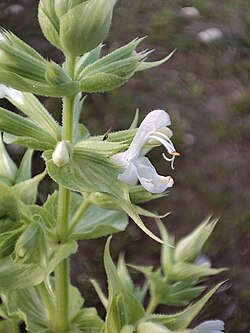
Salvia species are easily recognized by several distinct physical traits. Like other members of the Lamiaceae family, they typically possess angled stems. Their leaves vary from entire (smooth edges) to toothed or pinnately divided. The plants produce flowers in clusters known as racemes or panicles, creating striking displays of color—most commonly in shades of blue and red, though white and yellow occur less frequently.
The flowers themselves are two-lipped. The calyx (the outer protective layer of the flower) is usually bell-shaped or tubular. A fascinating biological feature of many Salvia species is the presence of trichomes—tiny hairs on the leaves, stems, and flowers. These trichomes help the plant reduce water loss and often contain glandular cells that secrete volatile oils. These oils provide the characteristic aroma of sage and serve as a defense mechanism to deter grazing animals and insects.
The Ingenious Staminal Lever Mechanism
The most defining characteristic of the genus is its unusual pollination system, known as the staminal lever mechanism. Unlike most members of the Mentheae tribe, which have four stamens, Salvia has only two. These stamens feature an elongated connective tissue that acts as a physical lever.
This system facilitates nototribic pollination (dorsal pollination). When a pollinator, such as a bee or bird, probes the flower for nectar, it pushes against the posterior part of the stamen. This action triggers the lever, causing the pollen to be deposited precisely on the pollinator's back. As the pollinator visits older, female-stage flowers, the stigma is positioned to brush against the exact spot where the pollen was deposited, ensuring successful fertilization.
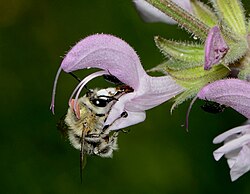
This mechanism is not one-size-fits-all; the length of the lever arm can vary between species. This specialization allows different plants to deposit pollen on different parts of a pollinator's body, which can lead to reproductive isolation and the creation of new species.
Taxonomy and Evolutionary History
The classification of Salvia has evolved significantly as scientific tools have improved. In the 19th century, George Bentham organized the genus into twelve sections and four subgenera based on the morphology of the calyx, corolla, and stamens. However, modern DNA sequencing has revealed a more complex story.
Research shows that Salvia is not monophyletic (meaning it did not evolve from a single common ancestor). Instead, it consists of three separate clades. This discovery proves that the famous staminal lever mechanism evolved at least twice through convergent evolution—a process where unrelated species independently evolve similar traits to solve the same biological problem.
To resolve these taxonomic inconsistencies, scientists proposed a recircumscription in 2017. This move subsumed five smaller genera—Rosmarinus, Perovskia, Dorystaechas, Meriandra, and Zhumeria—into a broadly defined Salvia genus to better reflect their genetic relationships.
Notable Species and Their Uses
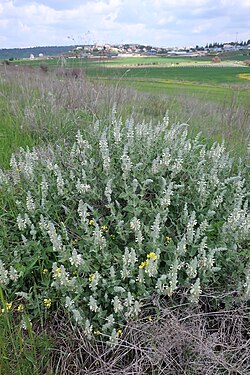
Salvia species are cultivated globally for culinary, medicinal, and ornamental purposes. Some are prized for their seeds, while others are used in sacred ceremonies or as fragrance oils.
| Scientific Name | Common Name | Primary Use or Feature |
|---|---|---|
| Salvia officinalis | Common Sage | Culinary herb and herbal medicine |
| Salvia rosmarinus | Rosemary | Aromatic woody shrub used in cooking |
| Salvia hispanica | Chia | Edible seeds high in protein and omega-3 |
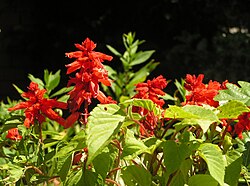
| Salvia splendens | Scarlet Sage | Popular red ornamental bedding plant |
| Salvia divinorum | Diviner's Sage | Cultivated for hallucinogenic effects |
| Salvia miltiorrhiza | Red Sage (Danshen) | Chinese medicinal herb |
Hybrids and Garden Cultivars
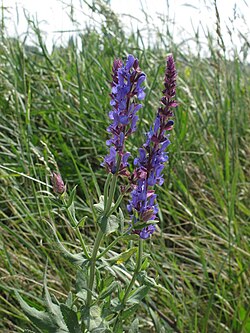
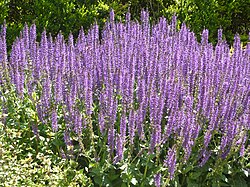
Because Salvia species have a high degree of crossability, many natural and intentional hybrids exist. For example, the cross between Salvia longispicata and Salvia farinacea has produced popular ornamental varieties like 'Indigo Spires' and 'Mystic Spires Blue'.
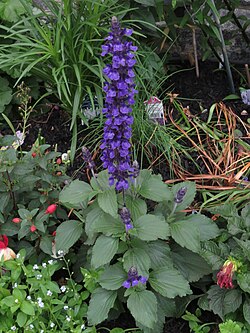
Many cultivars have earned the Royal Horticultural Society's Award of Garden Merit for their excellence. These include the deep blue/purple 'Amistad', the red and white 'Hot Lips', and the compact, deep violet Salvia × sylvestris 'Mainacht'.
Frequently Asked Questions
What does the name "Salvia" mean?
The name comes from the Latin word salvia, which is derived from salvus, meaning "safe," "secure," or "healthy." This refers to the plant's historical association with healing and well-being.
Is rosemary actually a type of sage?
Yes. While it was previously classified in its own genus (Rosmarinus), modern phylogenetic analysis has led botanists to reclassify it as Salvia rosmarinus.
How does the staminal lever mechanism work?
It is a mechanical system where a pollinator pushing for nectar triggers a lever in the stamen, which then deposits pollen onto the pollinator's back. This ensures the pollen is placed exactly where the stigma of a female-stage flower can reach it.
Where are Salvia plants most common?
The genus is distributed across the Americas and the Old World. The highest diversity is found in Central and South America, which host approximately 600 of the nearly 1,000 species.
What are trichomes and why are they important?
Trichomes are tiny hairs found on the leaves, stems, and flowers. They help the plant conserve water and often secrete aromatic volatile oils that protect the plant from insects and grazing animals.