Exploring the Genus Coleus: From Ornamental Beauty to Edible Tubers
The genus Coleus encompasses a diverse group of plants, ranging from annual and perennial herbs to shrubs. Some species even exhibit succulent characteristics, while others possess fleshy or tuberous rootstocks. Primarily found in the tropical and subtropical regions of Afro-Eurasia, these plants have captured human interest for both their striking visual appeal and their practical uses.
Key Facts
- Common Names: Spurflower, flybush, hedgehog flower, and hullwort.
- Primary Uses: Ornamental gardening and edible root tubers.
- Habitat: Tropical and subtropical regions of Afro-Eurasia.
- Species Diversity: Approximately 302 species are recognized as of April 2024.
- Scientific Family: Lamiaceae.
A Complex Taxonomic History
The scientific classification of Coleus has undergone significant changes due to evolving botanical understanding. The genus was first described by João de Loureiro in 1790. Historically, botanists distinguished Coleus from the genus Plectranthus by looking at their stamens—the male reproductive organs of a flower. In Coleus, these four stamens are fused together, whereas in Plectranthus, they are free to the base.
In 1962, researcher J.K. Morton suggested that fused stamens were more common than previously believed, leading to the merging of Coleus into Plectranthus. For many years, the relationship between Coleus, Solenostemon, and Plectranthus remained a subject of confusion among scientists.
However, modern phylogenetic analysis—the study of evolutionary relationships through genetic data—has cleared the air. Studies in 2004 and 2018 revealed that the broadly defined Plectranthus was paraphyletic, meaning it did not include all the descendants of its common ancestor. To correct this, taxonomists resurrected the genus Coleus. This recent restructuring resulted in 212 names being changed from previous combinations in Plectranthus, Pycnostachys, and Anisochilus. Additionally, the genus Equilabium was established to recognize a distinct group of species primarily from tropical Africa.
Uses of Coleus: Ornamentals and Food
Coleus species serve two very different but equally important roles in human culture. Many are highly valued as ornamental plants. The most famous among these is Coleus scutellarioides, which is widely grown in gardens for its vibrant, brightly colored foliage.
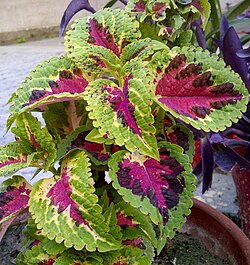
Beyond their beauty, certain species are cultivated for food. Plants such as Coleus esculentus, Coleus rotundifolius, and Coleus maculosus subsp. edulis are grown specifically for their edible root tubers.
Scientific Classification Summary
| Rank | Classification |
|---|---|
| Kingdom | Plantae |
| Clade | Embryophytes, Tracheophytes, Angiosperms, Eudicots, Asterids |
| Order | Lamiales |
| Family | Lamiaceae |
| Subfamily | Nepetoideae |
| Tribe | Ocimeae |
| Genus | Coleus |
Diverse Species within the Genus
With over 300 species recognized by Plants of the World Online, the diversity within the genus is vast. Some notable species include:
- Coleus amboinicus (formerly Plectranthus amboinicus)
- Coleus comosus (often sold as the "scaredy cat plant")
- Coleus rotundifolius (an edible tuber species)
- Coleus argentatus
- Coleus caninus
Frequently Asked Questions
What are the most common names for Coleus?
Coleus is known by several common names, including spurflower, flybush, hedgehog flower, and hullwort.
Why was the classification of Coleus changed recently?
Recent phylogenetic studies showed that the genus Plectranthus was paraphyletic, meaning it didn't accurately represent evolutionary lineages. This led scientists to resurrect Coleus as a distinct genus to ensure taxonomic accuracy.
Can Coleus be eaten?
Yes, while many are grown for decoration, certain species like Coleus esculentus and Coleus rotundifolius are cultivated for their edible root tubers.
What is the "scaredy cat plant"?
The "scaredy cat plant" is a common name used for Coleus comosus (also known as Plectranthus ornatus).
How many species of Coleus exist?
While different studies have provided different numbers, as of April 2024, Plants of the World Online lists 302 species within the genus.