Salt Creek Urbanization and Water Quality Management
The transformation of Salt Creek reflects the complex challenges of balancing urban development with environmental preservation. Once characterized by a small marshy wetland at its source, the creek has undergone significant structural changes since the 1990s to accommodate the growth of surrounding communities.
The Impact of Urban Development
Urbanization led to channelization—the process of straightening or confining a stream into a man-made channel—which fundamentally altered the creek's natural path. Consequently, the original source of Salt Creek no longer exists in its natural state. Water that once flowed through wetlands is now diverted into storm drain K01P07 before reaching the Salt Corridor Regional Park.
The Orange County Department of Public Works manages these systems, defining the modern "Salt Creek Channel" as starting from Chapparosa Park in Laguna Niguel, an area that includes part of what the USGS identifies as San Juan Canyon. Other natural tributaries have also been integrated into the storm drain network: the tributary within the Monarch Beach golf course is now known as K01P01 (Niguel Shores Storm Drain), and the Arroyo Salada has become K01S02 (Arroyo Salada Storm Channel).
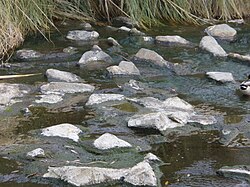
Water Quality and Environmental Challenges
During the dry season, the flow of Salt Creek consists almost entirely of urban runoff, which is rainwater or irrigation water that flows over paved surfaces, picking up pollutants and bacteria. This contaminated water eventually reaches the coastal waters of Monarch Beach and Salt Creek Beach, two popular recreational destinations.
In 2007, dry season flow was estimated to be between 500 and 900 US gallons (1.9 to 3.4 m³) per minute. To combat this, the cities of Laguna Niguel and Dana Point implemented several mitigation strategies, including:
- Stream and wetland restoration projects.
- Installation of drain filters.
- Reduction of irrigation runoff.
Despite these efforts, the beaches continued to face persistent water quality issues, necessitating a more robust technological solution.
The Salt Creek Ozone Treatment Plant
To address the bacterial levels in the water, the city of Dana Point completed the Salt Creek Ozone Treatment Plant in 2004. This $6.7 million facility is located near the Pacific Coast Highway, positioned just above the creek's outlet to the ocean.
The plant employs a multi-stage process to clean dry weather runoff: first, the water is filtered to remove garbage and coarse solids; then, it undergoes filtration and ozonation—a process using ozone gas to disinfect water and reduce bacteria. The facility is designed to treat 1,000 US gallons (3.8 m³) per minute.
While the plant was originally intended to operate only during the dry season from April to October, the city now operates the facility year-round, pausing operations only when excessive storm flows are anticipated.
Key Facts
- Source Change: The original marshy wetland source was lost due to 1990s development.
- Infrastructure: Key storm drains include K01P07, K01P01 (Niguel Shores), and K01S02 (Arroyo Salada).
- Pollution Source: Dry season flow is almost entirely composed of urban runoff.
- Treatment Capacity: The Ozone Treatment Plant can process 1,000 US gallons per minute.
- Investment: The treatment plant cost $6.7 million to complete.
| Feature | Details |
|---|---|
| Management Agency | Orange County Department of Public Works |
| Treatment Technology | Filtration and Ozonation |
| Dry Season Flow (2007) | 500 to 900 US gallons per minute |
| Plant Operation | Year-round (except during excessive storm flows) |
Frequently Asked Questions
What happened to the original source of Salt Creek?
Due to channelization during urban development in the 1990s, the original small marshy wetland source was replaced by storm drain K01P07.
What is urban runoff and why is it a problem here?
Urban runoff is water from streets and lawns that carries pollutants and bacteria into the creek, which then flows into the recreational waters of Salt Creek and Monarch Beaches.
How does the Salt Creek Ozone Treatment Plant work?
The plant captures dry weather runoff, filters out garbage and coarse solids, and then uses filtration and ozonation to lower bacterial levels before the water enters the ocean.
When does the treatment plant operate?
Although originally designed for use between April and October, the plant now operates year-round, shutting down only during periods of excessive storm flows.
What measures were taken besides the treatment plant to reduce pollution?
Laguna Niguel and Dana Point implemented wetland and stream restoration, installed drain filters, and worked to reduce irrigation runoff.