Saladin: The Kurdish Sultan Who Unified Egypt and Syria
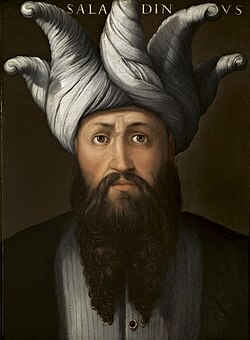
Yusuf ibn Ayyub, known to history as Saladin, stands as one of the most iconic figures of the medieval world. A Kurdish military leader and the founder of the Ayyubid dynasty, Saladin rose from a mercenary commander to become the Sultan of Egypt and Syria. He is most remembered for his strategic brilliance in unifying Muslim territories and his successful recapture of Jerusalem from the Crusaders.
Saladin's journey was defined by a transition from service under the Zengid dynasty to the establishment of his own empire. His reign was marked by a commitment to Sunni Islam and a lifelong struggle against the Crusader states in the Levant.
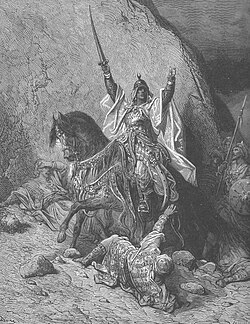
Key Facts
![Ayyubid or Zengid soldiers in Seljuk-type clothes[36] and sharbush hats[37][38] on the Palmer Cup (1200–1215)[39]](/images/31/06/31063bbb56ce51a5fc22f4d4186aba1c123961372a43d46f62343046cf666701.jpg)
- Full Name: Yusuf ibn Ayyub.
- Dynasty: Founder of the Ayyubid Dynasty.
- Titles: Sultan of Egypt and Syria, Custodian of the Two Holy Mosques.
- Major Achievement: Recaptured Jerusalem in 1187 following the Battle of Hattin.
- Religious Alignment: Sunni Muslim; abolished the Isma'ili Fatimid Caliphate in Egypt.
- Death: Died March 4, 1193, in Damascus.
Rise to Power in Egypt
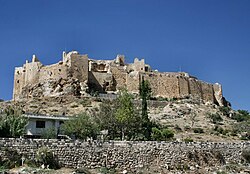
Saladin's military career began under the tutelage of his uncle, Shirkuh, a commander serving Nur ad-Din, the Zengid emir of Damascus and Aleppo. In 1164, Saladin accompanied Shirkuh to Egypt to assist the Fatimid vizier Shawar in a power struggle against a rival. Through military success and a close relationship with the teenage Fatimid caliph al-Adid, Saladin climbed the political ranks.
Following the deaths of Shawar and Shirkuh in 1169, al-Adid appointed Saladin as vizier (the highest administrative official). Saladin used this position to undermine the Isma'ili (Shia) Fatimid establishment. Upon the death of al-Adid in 1171, Saladin abolished the Fatimid Caliphate and realigned Egypt with the Sunni Abbasid Caliphate based in Baghdad.
![The Citadel of Cairo was begun by Saladin towards 1176 to serve as Egypt's center of power.[86] Later structures were added to it over the centuries.](/images/c3/1a/c31a77a39e1557d37d6aa69c9112ad02d12cb3a03a1bb54f0bef48d717fb6df2.jpg)
Consolidating the Egyptian Base
As the new power in Cairo, Saladin focused on strengthening Egypt as a bastion of Sunni power. He commissioned the construction of the Citadel of Cairo around 1176 to serve as the center of government. He also worked to suppress Isma'ili influence by introducing madrasas (theological colleges) and khanqahs (Sufi hostels) to promote orthodox Sunni faith.
![Coin of Saladin, wearing Sasanian-style merlon crown,[29] dated AH 578 (AD 1182/3).[30]](/images/6f/06/6f06cee309451de85de5b46605bdb1674a4121afd87aba914b7e32230e874761.jpg)
The Conquest of Syria and Unification
![Dirham of Saladin, 583 AH (1187–88 CE). Obv.: "The Prince, Defender, Honor of the world [and] the faith"; in margin: "Yusuf bin Ayyub, Struck in Damascus, Year three and eighty and five hundred". Rev.: "The Imam al-Nāṣir li-Dīn Allāh, Commander of the Faithful"; in margin: "There is no deity except God alone, Muhammad is the messenger of God".[94]](/images/94/32/9432f601c9aee3478243808af771c1a1b7873e7b9bf75957f74c9e8cbb1c3e43.jpg)
After the death of his mentor Nur ad-Din in 1174, Saladin began expanding his influence into Syria. He entered Damascus peacefully at the governor's request and subsequently captured Hama and Homs by 1175. After defeating the Zengid lords at the Battle of the Horns of Hama, he was proclaimed Sultan of Egypt and Syria by the Abbasid caliph al-Mustadi.
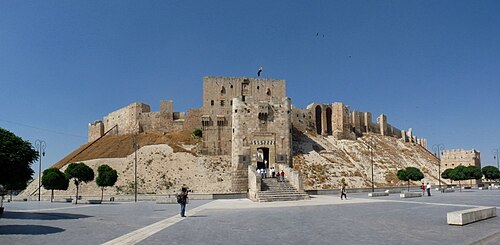
His expansion continued through northern Syria and Upper Mesopotamia. Despite facing assassination attempts by the Order of Assassins, Saladin eventually captured Aleppo in 1182, though he was unable to take the Zengid stronghold of Mosul.
![Ayyubid expansion 1174-1193, including the campaigns of Saladin, Qaraqush (nephew of Saladin) and Turan-Shah (elder brother of Saladin).[61]](/images/60/a0/60a0e19699d29db2174430aa50750ab000ec9ef7c57be4887dc80069da1e4d46.png)
Military Innovations and Diplomacy
Saladin's campaigns were supported by a diverse army and innovative weaponry. Records from the period, such as the Tabṣira by Murḍi Ibn cālī Ibn Murḍi al-Ṭarsūsī, describe experimental military technology, including crossbows mounted inside shields.
![Experimental crossbow mounted inside a shield, in the Tabṣira by Murḍi Ibn cālī Ibn Murḍi al-Ṭarsūsī written for Saladin, late Fāṭimid or early Ayyūbid Egypt, c. 1170 CE (Ms. Hunt.264, f.117, Bodleian Library, Oxford, UK).[45]](/images/6b/03/6b032d59d3de7143460802324686bb9eaa00e0a8a9609e2b2d2f63a29b8acfcd.jpg)
Wars Against the Crusaders
![Saladin on a posthumous dirham of the Ayyubid Al-Ashraf Musa, with obverse legend: "The Victorious King, Righteousness of the World and the Faith, Yusuf ibn Ayyub".[3][1][2] Dated 1215 CE;[3] similar coins were also minted in Saladin's lifetime.[98]](/images/b2/ab/b2abf2929112bb978e026cc668a3e16f3614df200b44f79888d1090b33c99665.jpg)
The primary objective of Saladin's unified empire was the removal of the Crusader presence from the Levant. His military efforts culminated in the Battle of Hattin, a decisive victory that shattered the Crusader army and paved the way for the Siege of Jerusalem in 1187.
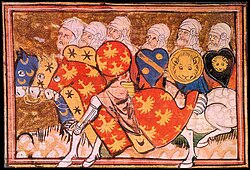
The fall of Jerusalem prompted the Third Crusade (1189–1192), led by figures such as King Richard I (the Lionheart) of England. This period was marked by intense conflict, including the Siege of Acre and the Battle of Arsuf. Despite the tenacity of the Third Crusade, Saladin managed to maintain control of Jerusalem.
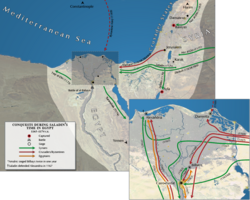
The Legacy of the Third Crusade
The conflict between Saladin and Richard I became legendary, symbolizing a clash of two great military minds. While Richard I captured Acre and executed thousands of prisoners, he was unable to recapture Jerusalem. The war eventually ended in a truce, leaving the city in Muslim hands.
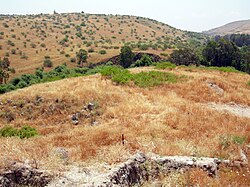
Summary of Saladin's Reign
![Zengid soldiers from Mosul, with swords and the aqbiya turkiyya coat, tiraz armbands, boots and sharbush hat. Kitab al-Aghani, 1218–1219.[108]](/images/bf/fe/bffec140e7190a52461582c798db49331dc30eb0c83693f6f619fdbf1eb1dc43.jpg)
| Period | Role/Title | Key Event/Achievement |
|---|---|---|
| 1169–1171 | Vizier of Fatimid Egypt | Rose to power under Caliph al-Adid |
| 1171 | Founder of Ayyubid Dynasty | Abolished Fatimid Caliphate; restored Sunni rule |
| 1174–1182 | Sultan of Egypt and Syria | Conquered Damascus, Hama, Homs, and Aleppo |
| 1187 | Military Commander | Victory at Hattin and recapture of Jerusalem |
| 1189–1192 | Sultan | Opposed the Third Crusade and King Richard I |
Death and Succession
![Detail of inlaid brass writing box, with soldier wearing a hauberk. Mosul, 1230–1250 CE, British Museum.[118][119]](/images/d7/7f/d77f2b1559c3df9c78cede722016eeaf7986d9a0e8e73c788fa54cd3f8162e9f.jpg)
Saladin died in Damascus on March 4, 1193, at the age of 55 or 56. He was buried in the Mausoleum of Saladin within the Umayyad Mosque. His empire was divided among his sons: Al-Aziz Uthman took control of Egypt, while Al-Afdal assumed power in Syria.
![Four women mourning the death of Saladin, on a coin of the Turkmen Artuqid lord of Mardin Husam al-Din Yuluq Arslan, a vassal of Saladin, 589 H (1193 CE).[153]](/images/45/3b/453b5fd3e7b54e57b636ec9256d15f09fbc1610bf30ed5270a5985bfbe09f4f4.jpg)
Frequently Asked Questions
How did Saladin come to power in Egypt?
Saladin arrived in Egypt as part of a military expedition led by his uncle Shirkuh to support the Fatimid vizier Shawar. After Shirkuh's death in 1169, the Fatimid caliph al-Adid appointed Saladin as vizier, allowing him to consolidate power and eventually abolish the Fatimid Caliphate.
What was the significance of the Battle of Hattin?
The Battle of Hattin was a pivotal victory for Saladin's forces, which effectively destroyed the military strength of the Kingdom of Jerusalem. This victory directly enabled Saladin to recapture the city of Jerusalem in 1187.
What was the 'Saladin tithe'?
The Saladin tithe was a special tax implemented in 1188 in Europe to help finance the Third Crusade, which was launched in response to Saladin's capture of Jerusalem.
Who succeeded Saladin after his death?
Saladin's empire was split between his heirs. His son Al-Aziz Uthman became the sultan of Egypt, and his son Al-Afdal became the emir of Damascus in Syria.
What was Saladin's relationship with the Abbasid Caliphate?
Saladin realigned Egypt with the Baghdad-based Sunni Abbasid Caliphate after abolishing the Shia Fatimid Caliphate. He was officially proclaimed Sultan of Egypt and Syria by the Abbasid caliph al-Mustadi.