An-Nasir Yusuf: The Last Ayyubid Sultan of Syria
The mid-13th century was a period of extreme volatility in the Levant, marked by the decline of old dynasties and the rise of formidable new powers. At the center of this storm was An-Nasir Yusuf (1228–1260), a Kurdish ruler of the Ayyubid dynasty. As the great-grandson of the legendary Saladin, Yusuf inherited a legacy of prestige but faced the impossible task of navigating the conflicting ambitions of the Egyptian Mamluks, the European Crusaders, and the unstoppable Mongol war machine.
Early Life and Rise to Power
Born in 1228, An-Nasir Yusuf ascended to the position of Emir of Aleppo in 1236 at the tender age of seven, following the death of his father, Al-Aziz Muhammad. Because of his youth, his early reign was managed by a four-man regency council. This council included the vizier Ibn al-Qifti, emirs Shams al-Din Lu'lu' al-Amini and 'Izz al-Din 'Umar ibn Mujalli, and Jamal al-Dawla Iqbal.
The true power behind the throne during these early years was his grandmother, Dayfa Khatun, the daughter of Al-Adil I, who served as the effective ruler until 1242. Following her death, Shams al-Din became Yusuf's most influential advisor and commander-in-chief until 1251. Throughout his tenure, Yusuf relied heavily on the Qaymariyya, a loyal troop of soldiers whose emirs provided critical strategic counsel.
The Struggle with the Egyptian Mamluks
The political landscape shifted violently in 1250 with the death of the Ayyubid sultan of Egypt, as-Salih Ayyub. When his son Turanshah was murdered by the Bahri Mamluks (an elite caste of soldier-slaves), the throne was seized by Shajar al-Durr, the widow of as-Salih Ayyub. An-Nasir Yusuf refused to recognize a female ruler, and in a show of Ayyubid solidarity, the Emirs of Syria granted him the city of Damascus.
This sparked a series of military conflicts. In October 1250, Yusuf attempted to conquer Egypt to overthrow the new Mamluk leader, the Atabek Aybak, but was defeated at Gaza. A second attempt in January 1251 ended in a significant defeat led by the Mamluk vanguard under Qutuz. In a humiliating gesture of victory, Aybak sent 3,000 of Yusuf's captured soldiers back to Damascus on the backs of donkeys.
Despite a brief accord in 1253 that gave Egypt control over Gaza, Jerusalem, Nablus, and the coastline of al-Sham, tensions remained high.
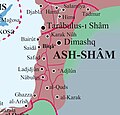
By 1254, internal Mamluk strife saw leaders like Baibars al-Bunduqdari and Qalawun al-Alfi flee to Syria. Yusuf granted them refuge and their former domains, prompting another invasion of Egypt in 1255, which again ended in defeat for the Ayyubid forces.
Diplomacy with the Crusaders
While fighting the Mamluks, An-Nasir Yusuf maintained complex relations with the European Crusaders. He engaged in correspondence with the barons of Acre and even suggested to King Louis IX of France that he might surrender Jerusalem in exchange for French military aid in conquering Egypt. However, Louis IX, still recovering from the losses of the Seventh Crusade, declined the offer. The two powers eventually signed a truce in 1254, though Louis continued to send his royal armorer to Damascus to source materials for crossbows.
The Mongol Catastrophe
The greatest threat to Yusuf's reign came from the East. As early as 1243, Yusuf had sent envoys to the Mongol ruler Arghun Aqa, and by 1245, he was paying tribute to the Mongols to ensure his survival. However, the situation turned dire in 1258 when Hulagu Khan sacked Baghdad.
Despite warnings from Baibars to mobilize for war, An-Nasir Yusuf initially attempted to appease Hulagu by sending his son, al-Malik al-Aziz, with gifts and a request for help against Egypt. Hulagu responded with a stern demand for total submission. Terrified, Yusuf turned to Egypt for help, which provided the catalyst for Saif ad-Din Qutuz to proclaim himself Sultan of Egypt to better lead the defense against the Mongols.
The Fall of Aleppo and Damascus
In December 1259, the Mongols reached Aleppo. While Yusuf's uncle, Turanshah, refused to surrender, the city was stormed after a seven-day siege, followed by five days of massacre. An-Nasir Yusuf fled toward Gaza, stopping briefly in Nablus. Shortly after, Damascus fell to the Mongol general Kitbuqa after the city's emirs surrendered without resistance.
The collapse was total. After a final defeat in the olive groves of Nablus, Yusuf's own emirs abandoned him to join Qutuz. In a final twist of fate, Yusuf, his son, and his brother were abducted in Gaza by a servant and delivered to Hulagu Khan. Following the Mongol defeat at the Battle of Ain Jalut on September 3, 1260, Hulagu ordered the execution of An-Nasir Yusuf and his brother.
Key Facts
- Lineage: Great-grandson of Saladin.
- Reign: Emir of Aleppo (1236–1260) and Sultan of the Ayyubid Empire (1250–1260).
- Key Adversaries: The Bahri Mamluks of Egypt and the Mongol Empire under Hulagu Khan.
- Major Losses: The sack of Aleppo (1259) and the fall of Damascus.
- Fate: Executed by the Mongols in 1260 after the Battle of Ain Jalut.
| Role | Period | Key Location | Outcome |
|---|---|---|---|
| Emir of Aleppo | 1236–1260 | Aleppo | City sacked by Mongols |
| Sultan of Ayyubid Empire | 1250–1260 | Damascus | Emirate abolished |
| Conflict with Mamluks | 1250–1255 | Gaza/Egypt | Repeated military defeats |
| Mongol Submission | 1245–1260 | Syria/Iraq | Execution by Hulagu Khan |
Frequently Asked Questions
Who was An-Nasir Yusuf?
An-Nasir Yusuf was the Ayyubid Kurdish Emir of Syria and the last Sultan of the Ayyubid Empire, ruling from Aleppo and Damascus until his death in 1260.
How did An-Nasir Yusuf relate to Saladin?
He was the great-grandson of Saladin, the founder of the Ayyubid dynasty.
Why did he conflict with the Mamluks?
He refused to recognize the legitimacy of Shajar al-Durr as the Sultana of Egypt and attempted to reclaim Egyptian territory for the Ayyubid dynasty.
What led to the fall of Aleppo in 1259?
The Mongol army, led by Hulagu Khan, besieged the city for seven days. After the city was stormed, the population was massacred for five days.
How did An-Nasir Yusuf die?
He was abducted in Gaza and sent to Hulagu Khan, who executed him and his brother after the Mongols were defeated by the Egyptians at the Battle of Ain Jalut.