County of Edessa: The Rise and Fall of the First Crusader State
The County of Edessa (Latin: Comitatus Edessanus) was a pivotal Crusader state established in the 12th century within Upper Mesopotamia. Serving as the first of the Crusader states to be created, it occupied a unique and precarious position in the Near East. Its capital, Edessa (modern-day Şanlıurfa, Turkey), was not only a strategic military hub but also a renowned center of intellectual life for the Syriac Orthodox Church, where Ancient Greek philosophy was translated into Syriac, eventually paving the way for Arabic translations.
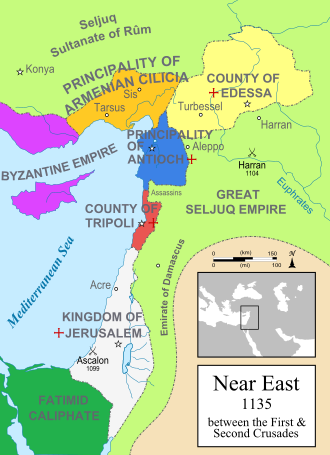
Unlike its counterparts in the Levant, the County of Edessa was landlocked and geographically isolated from the other Crusader states. This remoteness, combined with a strained relationship with the neighboring Principality of Antioch, left the county vulnerable. While the stronghold of Turbessel controlled the west bank of the Euphrates, a significant portion of the territory—including the capital—lay east of the river, far from the safety of the Mediterranean coast.
Key Facts
- Established: 1098 during the First Crusade.
- Capital: Edessa (1098–1144; 1146), later Turbessel (1144–1150).
- First Ruler: Baldwin of Boulogne.
- Demographics: Primarily Assyrian and Armenian Orthodox Christians.
- Fall: Captured by Zengi in 1144, triggering the Second Crusade.
- Geography: Landlocked state in Upper Mesopotamia (modern Turkey and Syria).
The Founding and Early Rule
The county was founded in 1098 when Baldwin of Boulogne diverged from the main Crusading army heading toward Jerusalem. Baldwin traveled through Cilicia to Edessa, where he convinced the local lord, Thoros, to adopt him as his son and heir. Baldwin also married Thoros' daughter, Arda of Armenia. Thoros, a Greek Orthodox Christian of Armenian origin, was unpopular with his Armenian Apostolic subjects and was removed from power in March 1098—either through abdication or assassination—allowing Baldwin to take the title of count.
When Baldwin became the King of Jerusalem in 1100 following the death of his brother, Godfrey of Bouillon, the county passed to his cousin, Baldwin of Bourcq. He was supported by Joscelin of Courtenay, who governed the vital fortress of Turbessel on the Euphrates, which served as a critical defensive outpost against the Seljuk Turks.
Integration with Local Populations
The Frankish lords maintained a positive relationship with their Armenian subjects, often solidified through marriage. The first three counts of Edessa all married Armenian women, including Baldwin's marriage to Arda and Baldwin of Bourcq's marriage to Morphia, daughter of Gabriel of Melitene.
Military Conflicts and Political Instability
The county was frequently embroiled in the volatile politics of northern Assyria and Asia Minor. In 1104, Edessa suffered a major defeat at the Battle of Harran, resulting in the capture of both Baldwin and Joscelin by the forces of Mosul. During their captivity, Tancred of Galilee served as regent, though Richard of Salerno handled the actual governance until the rulers were ransomed in 1108.
Leadership shifted again in 1119 when Joscelin I became count after Baldwin II ascended to the throne of Jerusalem. However, stability remained elusive; Joscelin was captured in 1122, and during a rescue attempt, Baldwin II was also taken prisoner, leaving the Kingdom of Jerusalem temporarily without a king.
The Fall of the County
The decline of the state accelerated under Joscelin II, who succeeded his father in 1131. While Joscelin II neglected the county's defenses and alienated the counts of Tripoli, the Muslim leader Zengi united the powerful cities of Aleppo and Mosul. In 1144, Zengi besieged Edessa and captured the city on December 24.
This loss was the first major setback for Outremer (the collective Crusader states) and served as the primary catalyst for the Second Crusade. Despite the scale of the mobilization, the Second Crusade failed to recover Edessa, opting instead for a failed campaign against Damascus. Joscelin II briefly regained the capital in 1146 following Zengi's death, but lost it again months later. He was eventually captured by Nur ad-Din in 1150 and remained a prisoner until his death in 1159.
The remnants of the county, including Turbessel, were sold by Joscelin's wife to the Byzantine Emperor Manuel I Komnenos, but these lands were quickly conquered by Nur ad-Din and the Sultan of Rum.
Demographics and Governance
Despite its large territorial size, the County of Edessa had a relatively small population. The capital city housed approximately 10,000 residents, while the rest of the territory consisted largely of scattered fortresses. The population was a diverse mix of Assyrian and Armenian Orthodox Christians, Greek Orthodox Christians, and Arab Muslims. Although the Latin (Roman Catholic) population remained small, the state maintained a Roman Catholic archbishop as the official religious authority.
| Category | Details |
|---|---|
| Official Languages | Latin (official), Syriac, Old French, Italian, Armenian, Arabic, Greek |
| Religions | Roman Catholicism (official), Armenian Apostolic, Greek Orthodox, Syriac Orthodox, Islam, Judaism |
| Government Type | Feudal Monarchy |
| Key Strongholds | Edessa, Turbessel |
| Successor States | Emirate of Zengids, Byzantine Empire |
Frequently Asked Questions
Why was the County of Edessa more vulnerable than other Crusader states?
Edessa was landlocked and remote from the other Crusader states. Furthermore, half of its territory lay east of the Euphrates, far from the Mediterranean coast, making it difficult to defend and reinforce.
Who was the first Count of Edessa?
Baldwin of Boulogne was the first count. He established the state in 1098 after convincing the local ruler, Thoros, to adopt him as heir.
What event triggered the Second Crusade?
The fall of the city of Edessa to Zengi on December 24, 1144, was the primary catalyst that provoked the launch of the Second Crusade.
What was the significance of Turbessel?
Turbessel was a critical fortress on the west bank of the Euphrates. It served as a strategic outpost against the Seljuk Turks and became the seat of the county after the capital, Edessa, was lost.
What was the ethnic and religious makeup of the population?
The population was predominantly composed of Assyrian and Armenian Orthodox Christians, along with Greek Orthodox Christians and Arab Muslims, while the ruling Latin class remained a small minority.