Saint Onuphrius: The Desert Hermit and Patron of the Lost
Saint Onuphrius is a figure of profound spiritual significance in both the Eastern Orthodox and Catholic traditions. Known primarily as a desert hermit, his legacy spans centuries and continents, evolving from a symbol of asceticism to a patron saint associated with specific crafts and local folklore.
Key Facts
- Feast Day: Traditionally celebrated on June 12.
- Patronage: Patron saint of weavers and co-patron of Palermo (since 1650).
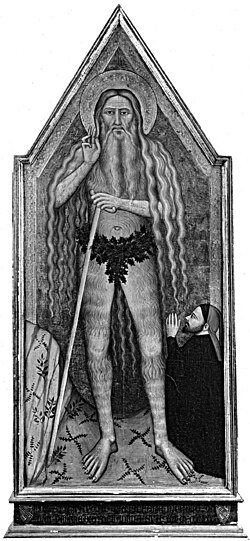
- Artistic Depiction: Often portrayed as a "wild man" covered in hair and wearing a girdle of leaves.
- Key Sites: Veneration sites include Jerusalem, Cappadocia, and various locations across Italy and Germany.
Veneration and Sacred Sites
The veneration of Saint Onuphrius is widespread, with his feast day observed on June 12 by both Catholic and Eastern Orthodox churches. While some Greek sources suggest he died on June 11, the June 12 date was established early in Orthodox calendars.
Throughout history, several significant structures have been dedicated to him. In the 15th century, the church of Sant'Onofrio was built on Rome's Janiculan Hill. In Poland, Orthodox seminarians begin their spiritual training at the monastery of St. Onuphrius in Jablechna. Local tradition holds that the saint chose this site himself, appearing to fishermen nearly four hundred years ago and leaving an icon of himself on the banks of the river Bug.
In Jerusalem, the St. Onuphrius Monastery is situated at the far end of Gai Ben Hinnom (the Gehenna valley). This site is historically significant as it is located within a Jewish cemetery from the Second Temple period and marks Hakeldama, the purported site where Judas Iscariot hanged himself.
Artistic Representation and Symbolism
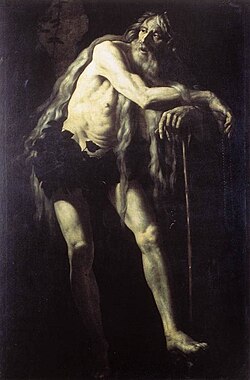
In religious art, Saint Onuphrius is frequently conflated with the medieval concept of the wild man. Because of his extreme asceticism in the desert, he is depicted as being completely covered in hair and wearing a loincloth or girdle made of leaves.
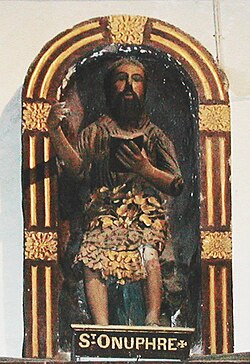
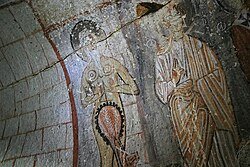
This unique appearance led to him becoming the patron saint of weavers. His image can be found in various historical settings, including the Snake Church (Yilanlı Kilise) in the Göreme valley open-air museum in Cappadocia, Turkey.
Other notable artistic tributes include a 1520 painting by Hans Schäufelein and works found in Pisa's camposanto. In Rome, the works of Battistello Caracciolo also reflect this tradition.
Name Variants and Linguistic Evolution
The name of the saint has evolved significantly across different languages and cultures. While commonly known as Onuphrius, Onouphrius, or Onofrius, it appears as Onofre in Spanish and Portuguese, Onofrei in Romanian, and Onofrio in Italian.
In Arabic, he is known as Abū Nufir or Nofer; the latter is a variant of Onuphrius that also translates to "herbivore." In English contexts, the name is sometimes Anglicized as Humphrey, though this is an unrelated name of Germanic origin.
Folklore and Local Traditions
In Sicily, Saint Onuphrius is deeply embedded in local folk belief. He is the go-to intercessor for those who have lost items. Many Sicilians recite prayers mentioning the miraculous properties of the saint's hair while searching for misplaced objects, such as rings or keys, believing it will hasten their recovery.
Furthermore, a sanctuary in Sutera, Sicily, houses a reliquary containing the saint's remains. Every first Sunday of August, the town celebrates a feast where the remains are carried through the streets accompanied by a priest, pilgrims, and a marching band.
| Category | Details |
|---|---|
| Feast Day | June 12 |
| Patronage | Weavers; Co-patron of Palermo |
| Visual Markers | Abundant hair, leaf girdle |
| Key Locations | Jerusalem, Cappadocia, Rome, Sicily, Poland |
| Arabic Name | Abū Nufir / Nofer ("herbivore") |
Frequently Asked Questions
Why is Saint Onuphrius the patron saint of weavers?
He is the patron of weavers because of his traditional depiction in art, where he is shown dressed only in his own abundant hair and a loincloth of leaves.
Where is the St. Onuphrius Monastery in Jerusalem located?
It is located at the far end of Gai Ben Hinnom (the Gehenna valley), within a Jewish cemetery from the Second Temple period, and marks the site of Hakeldama.
What is the Sicilian tradition regarding lost objects?
Sicilians pray to Saint Onuphrius when they lose something, often reciting prayers that reference the miraculous properties of his hair to help find the missing item.
How is Saint Onuphrius depicted in religious art?
He is typically depicted as a "wild man," characterized by being completely covered in hair and wearing a girdle made of leaves.
Is "Humphrey" the same name as Onuphrius?
While Onuphrius and Onofrio are sometimes Anglicized as Humphrey, they are actually unrelated names, as Humphrey typically has a Germanic etymology.