Saint Francis of Assisi: The Life, Legacy, and Spirit of the Franciscan Order
Saint Francis of Assisi remains one of the most beloved figures in Christian history, revered not only within the Catholic Church but across various denominations and spiritual traditions. Born as Giovanni di Pietro di Bernardone in 1181 in Assisi, within the Duchy of Spoleto of the Holy Roman Empire, he transformed from a youth of privilege into a champion of poverty, humility, and peace.
His life was defined by a radical commitment to the Imitation of Christ, leading him to renounce his worldly possessions and establish a way of life that emphasized kinship with all creation. Today, he is recognized as the founder of the Franciscan Order and a primary patron saint of animals and the environment.
![The oldest surviving depiction of Saint Francis is a fresco near the entrance of the Benedictine abbey of Subiaco, painted between March 1228 and March 1229. He is depicted without the stigmata, but the image is a religious image and not a portrait.[6]](/images/98/dc/98dcee57c51ddf2114073a448a255f6b7a7027aa21157ff5a4e1e2b416ea61b3.jpg)
Key Facts
- Born: 1181 in Assisi, Holy Roman Empire.
- Died: October 3, 1226, at approximately 44 years of age.
- Canonization: July 16, 1228, by Pope Gregory IX.
- Major Order: Founder of the Order of Friars Minor (OFM).
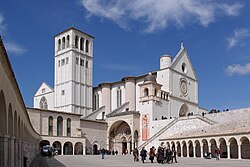
- Primary Shrine: Basilica of San Francesco d'Assisi.
- Feast Day: October 4.
- Key Attributes: Franciscan habit, birds, animals, stigmata, crucifix, book, and skull.
The Founding of the Franciscan Order
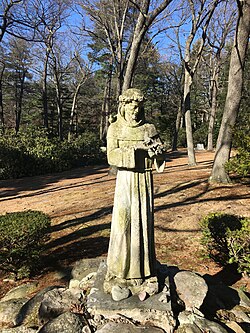
Francis' spiritual journey led to the creation of the Order of Friars Minor (OFM), a community dedicated to absolute poverty and service. Unlike the monastic traditions of the time, the Franciscans were mendicants, meaning they relied on charity and preaching rather than established estates.
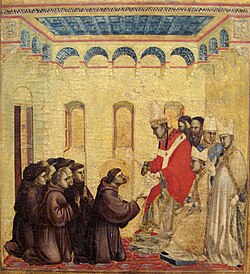
The reach of his vision extended beyond the friars. He helped establish the Poor Clares for women and the Third Order for laypeople who wished to live out Franciscan values while remaining in their secular lives. His commitment to peace was further evidenced by his missionary work during the Fifth Crusade, where he sought dialogue and understanding.
Stigmata and Final Days
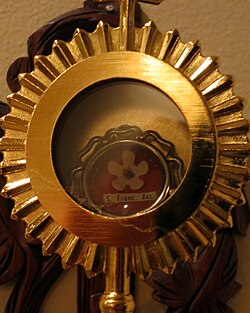
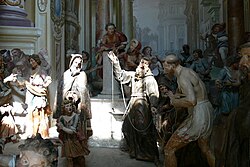
Toward the end of his life, Francis experienced the stigmata—the appearance of wounds corresponding to those of the crucified Christ. He viewed these marks as a profound part of his spiritual union with Jesus. He passed away on October 3, 1226, in Assisi, leaving behind a legacy of humility that would influence the Church for centuries.
![Francis considered his stigmata part of the Imitation of Christ.[38][39] by Cigoli, 1699](/images/72/9a/729a2f9d8218306d6a7439dca3385dc2999d1cac4d8b5873291964954d3254f7.jpg)
Sainthood and Veneration
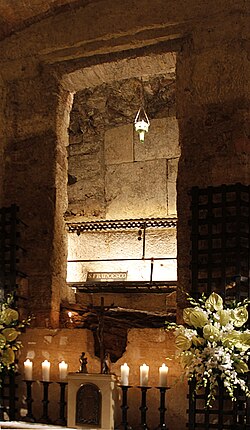
Francis was canonized quickly, on July 16, 1228, by Pope Gregory IX. His influence expanded beyond Catholicism; he is venerated in Anglicanism, Lutheranism, and the Old Catholic Church. In 1939, Pope Pius XII named him a joint patron saint of Italy alongside Catherine of Siena.
Nature, Environment, and Character

Saint Francis is perhaps most famous for his deep connection to the natural world. He viewed all creatures as brothers and sisters, a philosophy captured in his famous Canticle of the Sun (1224), also known as Laudes Creaturarum. This perspective has made him a symbol of ecological stewardship.
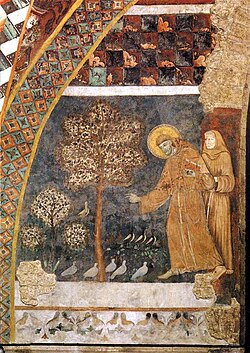
Stories of his interactions with nature, such as the legendary dialogue with the wolf of Gubbio, highlight his belief in peace and reconciliation between all living beings.
![St. Francis talking to the wolf of Gubbio (Carl Weidemeyer [de], 1911)](/images/f3/19/f31990f1647ff1d9d278f2adb9c69c67f397ad463213d362ed36022e0eed1bd5.jpg)
Literary and Artistic Legacy
![Icon of Saints, including Francis of Assisi, by Arsenie Boca, located in Draganescu Church[112]](/images/e3/3e/e33e17a6cecb8ddbb4ed11f48a0f7e8222f4ab85738ac3d970c632ed7e41352f.png)
Francis left behind several key writings that continue to guide the Franciscan tradition, including the Regula non bullata (Earlier Rule, 1221), the Regula bullata (Later Rule, 1223), and his final Testament (1226).
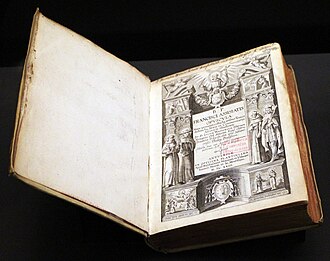
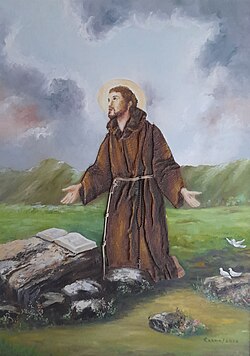
His life has inspired countless works of art, from the frescoes of Giotto to modern operas by Olivier Messiaen and films such as The Sultan and the Saint. His image is frequently depicted in art accompanied by birds or in a state of ecstasy during the stigmatization.
Summary of Saint Francis of Assisi
| Category | Details |
|---|---|
| Religious Orders | Order of Friars Minor (OFM), Poor Clares, Third Order |
| Key Writings | Canticle of the Sun, Regula bullata, Testament |
| Patronage | Animals, Ecology, Italy (Joint Patron) |
| Major Feast | October 4 |
| Primary Site | Basilica of San Francesco d'Assisi, Italy |
Frequently Asked Questions
What is the significance of the stigmata in the life of St. Francis?
The stigmata are the wounds of Christ that appeared on Francis' body. He considered these marks a spiritual gift and a central part of his Imitation of Christ, symbolizing his deep mystical union with the suffering of Jesus.
Which religious orders did Saint Francis found or influence?
He founded the Order of Friars Minor (OFM). He also co-founded the Poor Clares for women and established the Third Order for laypeople who wanted to follow his spiritual path without entering a monastery.
Why is Saint Francis considered the patron saint of animals?
Francis viewed all of nature as a reflection of God's creation, referring to animals and elements of nature as siblings. His legendary preaching to the birds and his peace-making with the wolf of Gubbio cemented this association.
When is the feast day of Saint Francis observed?
The primary feast day is observed on October 4. Some traditions also observe a secondary feast on September 17 to commemorate the receiving of the stigmata.
What are the most important writings attributed to him?
His most influential works include the Canticle of the Sun (a hymn of praise to creation), the Earlier and Later Rules for his order, and his Testament, written shortly before his death.