Hethum II and the Struggle for Cilician Armenia
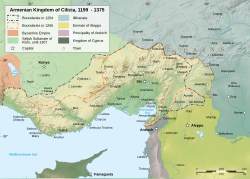
The history of the Armenian Kingdom of Cilicia is a saga of survival, diplomacy, and faith, epitomized by the turbulent life of Hethum II. Ruling during a period of immense geopolitical instability, Hethum II navigated the treacherous waters between the Mongol Empire, the Mamluk Sultanate of Egypt, and the Byzantine Empire. His life was marked by a unique duality: he was a king who abdicated his throne twice to embrace the spiritual life of a Franciscan friar, yet he remained the strategic architect of his nation's defense.
As a member of the Hethumid dynasty, Hethum II inherited a kingdom that was a vassal state of the Mongol Empire—a relationship established by his grandfather, Hethum I, in 1247. This alliance was a necessity for survival, providing a shield against regional enemies, though it required the constant provision of troops for Mongol campaigns.
Key Facts
- Reigns: Served as King of Cilician Armenia across three separate periods (1289–1293, 1295–1296, and 1299–1303).
- Faith: A devout member of the Franciscan Order (OFM), abdicating twice to enter monastic life.
- Alliances: Maintained a critical, though volatile, vassal relationship with the Mongol Ilkhanate.
- Major Conflict: Fought extensively against the Mamluk Sultanate of Egypt to protect Armenian territories.
- Death: Assassinated in 1307 by the Mongol general Bilarghu.
The First Reign and the Mamluk Threat (1289–1293)
Hethum II ascended the throne in 1289 following the death of his father, Leo II. He inherited a kingdom squeezed between the Turkish Karamanids and the Sultanate of Rum to the north and west, and the aggressive Mamluk Sultanate to the south. During this time, the Crusades were waning, leaving the Christian states of the Levant increasingly isolated.
Hethum's early reign was characterized by an openness to Western influence. He welcomed Spiritual Franciscans, including Angelo da Clareno, and dispatched St Thomas of Tolentino to Europe to advocate for a new crusade and the reunification of the Armenian Church with Rome.
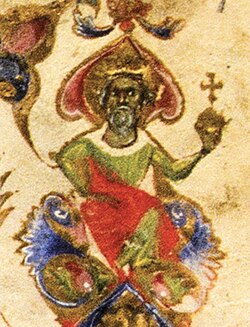
However, stability was short-lived. In 1292, the Mamluk Sultan Khalil invaded, sacking the city of Hromgla after a 33-day siege. To prevent total collapse, Hethum was forced to cede the cities of Marash, Behesni, and Tel Hamdoun. Overwhelmed by the political and military strain, Hethum abdicated in 1293 in favor of his brother, Thoros III, and entered a Franciscan monastery in Mamistra.
Betrayal and the Second Reign (1295–1296)
The peace of the monastery was brief. In 1295, Thoros III requested Hethum's return to the throne to revitalize the Mongol alliance. Hethum traveled to the Mongol capital to secure military aid, which he successfully obtained. Upon his return, he sought to strengthen ties with the Byzantine Empire through a marital alliance, arranging for his sister Rita to marry Emperor Michael IX Palaeologus.
While Hethum and Thoros were in Constantinople, their brother Sempad usurped the throne with the help of another brother, Constantine. Upon their return, Hethum and Thoros were captured and imprisoned in Partzerpert. During this captivity, Hethum suffered a brutal injury when he was partially blinded by cauterization. Thoros was murdered in 1298, but the political tides shifted again when Constantine ousted Sempad and freed Hethum.
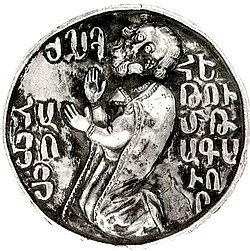
The Third Reign and the Battle of Homs (1299–1303)
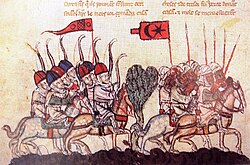
Hethum II resumed the crown in 1299, once again turning to the Mongols for support. Partnering with the Mongol leader Ghazan, Hethum launched a campaign in Syria. This culminated in a decisive victory at the Battle of Wadi al-Khazandar (also known as the Battle of Homs) in December 1299. The combined forces captured Damascus, allowing Hethum to reclaim lost Armenian territories.
This period of triumph led to historical debates regarding Hethum's movements. Some traditions suggest he visited Jerusalem in 1300, though modern historians like Angus Donal Stewart argue this was later propaganda. Others, such as Claude Mutafian, suggest he may have donated his amber scepter to the Armenian convent of Saint James in Jerusalem during this time.
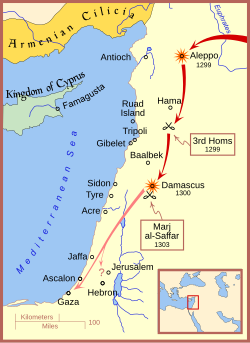
The tide turned in 1303 when the Mamluks counter-attacked. Despite a force of 80,000 Mongol troops, the Armenians and Mongols suffered defeats at Homs (March 30) and the Battle of Shaqhab (April 21). This marked the end of major Mongol invasions of Syria. Hethum abdicated for the final time, passing the crown to his nephew, Leo III, while remaining as Regent.
![Hethum II (left) parting from Ghazan and his Mongols in 1303 (History of the Tatars)[3]](/images/78/20/78207311ff450f4c44cfb0c0d837248c34b7fb34e3f246d93e1abd8d77e2d915.jpg)
The Final Betrayal and Legacy
The final years of Hethum's life were spent as the "Grand Baron of Armenia" and Regent. The kingdom remained under pressure from the Mamluks, who sought to punish the Armenians for their Mongol alliance. Internally, tensions rose with the Mongol general Bilarghu, a devout Muslim who intended to build a mosque in the Armenian capital of Sis—a move Hethum viewed as a precursor to a Mongol takeover.
On November 17, 1307, Bilarghu summoned Hethum to a meeting at Anazarbus. In a treacherous act, Bilarghu ordered the massacre of Hethum, his nephew King Leo III, and approximately 40 noblemen during a banquet. The Mongol Ilkhan Öljaitü, outraged by this treachery, later ordered the execution of Bilarghu and his soldiers.
| Period | Role | Key Event/Outcome |
|---|---|---|
| 1289–1293 | King (1st Reign) | Mamluk invasion; loss of Hromgla; first abdication. |
| 1295–1296 | King (2nd Reign) | Renewed Mongol alliance; imprisoned and blinded by Sempad. |
| 1299–1303 | King (3rd Reign) | Victory at Battle of Wadi al-Khazandar; recovery of lands. |
| 1303–1307 | Regent | Regency for Leo III; assassination by Bilarghu. |
Frequently Asked Questions
Why did Hethum II abdicate the throne multiple times?
Hethum II was deeply religious and sought to join the Franciscan Order. His abdications were attempts to pursue a monastic life, although he continued to influence Armenian politics as a power broker and regent.
What was the significance of the Mongol alliance for Cilician Armenia?
The alliance provided essential military protection against the Mamluks and Turkish sultanates. However, it made Armenia a vassal state, requiring them to provide troops for Mongol wars and leaving them vulnerable to the whims of Mongol generals.
Who was Bilarghu and why did he kill Hethum II?
Bilarghu was a Mongol general who sought to increase his control over the region and establish a mosque in Sis. He assassinated Hethum II and King Leo III after learning that Hethum had written to the Ilkhan Öljaitü expressing concern over Bilarghu's plans.
Did Hethum II actually visit Jerusalem?
Historians are divided. While medieval accounts by Nerses Balients claim he visited and received a certificate from the Khan bestowing Jerusalem upon him, modern scholars like Angus Donal Stewart view these claims as propaganda lacking contemporary evidence.
What happened to the Armenian Kingdom after Hethum's death?
Following the assassination of Hethum II and Leo III, Hethum's brother Oshin took the throne. The kingdom continued to struggle against Mamluk aggression and the shifting loyalties of the Mongol Ilkhanate until its eventual fall in 1375.