Ratites: The Evolution and Diversity of Flightless Birds
The ratites are a unique group of birds belonging to the infraclass Palaeognathae. Defined by their inability to fly, these birds lack a keel—the bony ridge on the sternum where flight muscles typically attach. While most ratites are characterized by their large size, long necks, and powerful legs, the group exhibits a surprising range of diversity, from the towering ostrich to the small, nocturnal kiwi.
Key Facts
- Defining Feature: Lack of a keel on the sternum, rendering them flightless.
- Temporal Range: They have existed from the Paleocene to the Holocene (56–0 Ma).
- Largest Living Species: The African ostrich, reaching up to 2.8 meters in height.
- Heaviest Known Bird: The extinct elephant bird (Aepyornis maximus), weighing over 400 kilograms.
- Unique Behavior: All ratite chicks are capable of swimming and diving.
Living Species of Ratites
The Giants: Ostriches and Emus
African ostriches are the largest extant ratites. A large specimen can stand nearly 2.8 meters (9 ft 2 in) tall and weigh up to 156 kilograms (344 lb), possessing the speed to outrun a horse. Following the ostrich in height is the Australian emu, which reaches up to 1.9 meters (6 ft 3 in) and weighs approximately 50 kilograms (110 lb). Both are powerful runners adapted for open plains and woodlands.
Forest and Plain Dwellers: Cassowaries and Rheas
The three species of cassowary, native to Australia and nearby islands, are shorter than emus but more solidly built, weighing up to 85 kilograms (187 lb). They prefer tropical forests and are known for their razor-sharp talons. In South America, the Pampas are home to two species of rhea. The larger American rhea grows to about 1.4 meters (4 ft 7 in) and typically weighs between 15 and 40 kilograms.
The Unique Kiwi
The smallest ratites are the five species of kiwi from New Zealand. Unlike their relatives, kiwis are chicken-sized, shy, and nocturnal. They live in deep burrows and rely on a highly developed sense of smell to hunt insects. Notably, kiwis lay eggs that are exceptionally large relative to their body size, sometimes equaling 15 to 20 percent of the female's body mass. The little spotted kiwi is the smallest, weighing between 0.9 and 1.9 kilograms.
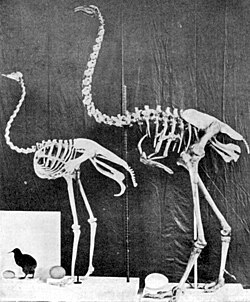
Extinct Ratites of the Holocene
The prehistoric record reveals ratites of staggering proportions. In New Zealand, at least nine species of moa existed, including the giant Dinornis robustus, which stood 3.7 meters (12 ft 2 in) tall and weighed 230 kilograms. These birds became extinct by A.D. 1400 following the arrival of Māori settlers around A.D. 1280.
Madagascar was home to the elephant bird (Aepyornis maximus), the heaviest bird ever known. These giants could weigh over 400 kilograms (880 lb) and stand 3 meters tall. Along with other Aepyornis and Mullerornis species, they declined after human arrival approximately 2,000 years ago, vanishing by the 17th or 18th century.
Classification and Evolution
Modern scientific classification uses mitochondrial DNA phylogeny to trace the lineage of these birds. As of 2014, research suggests ostriches occupy the basal branch, followed by rheas. A separate clade links moas with tinamous, while emus and cassowaries form another group. Interestingly, elephant birds and kiwis are identified as sister taxa.
Diet and Digestive Adaptation
The diet of ratites varies significantly, which is reflected in the length of their digestive tracts. Ostriches, primarily herbivores, have the longest tracts at 14 meters. Rheas follow with 8–9 meter tracts and are also mainly herbivorous. Emus have 7-meter tracts and an omnivorous diet. Cassowaries have shorter tracts (4 meters), and kiwis have the shortest, specializing in earthworms and insects.
| Species/Group | Max Height | Max Weight | Primary Diet | Status |
|---|---|---|---|---|
| Ostrich | 2.8 m | 156 kg | Herbivore | Extant |
| Emu | 1.9 m | 50 kg | Omnivore | Extant |
| Cassowary | 1.8 m | 85 kg | Omnivore/Herbivore | Extant |
| Rhea | 1.4 m | 40 kg | Herbivore | Extant |
| Kiwi | 0.45 m | 1.9 kg | Insectivore | Extant |
| Giant Moa | 3.7 m | 230 kg | Herbivore | Extinct |
| Elephant Bird | 3.0 m | 400+ kg | Herbivore | Extinct |
Frequently Asked Questions
Why are ratites unable to fly?
Ratites lack a keel on their sternum, which is the essential bony structure required for the attachment of powerful flight muscles.
Which ratite is the heaviest that ever lived?
The elephant bird (Aepyornis maximus) of Madagascar is the heaviest known bird, with weights exceeding 400 kilograms.
What makes the kiwi different from other ratites?
Kiwis are the only nocturnal extant ratites, are significantly smaller (chicken-sized), and lay eggs that are very large relative to their body mass.
How did moas become extinct?
Moas became extinct by A.D. 1400 due to hunting by Māori settlers who arrived in New Zealand around A.D. 1280.
Do all ratites have the same diet?
No, their diets range from primarily herbivorous (ostriches and rheas) to omnivorous (emus) and insectivorous (kiwis), which is reflected in the varying lengths of their digestive tracts.