Rain Gauges: History, Technology, and Measurement Methods
A rain gauge—also known as an udometre, ombrometer, pluviometer, or hyetometer—is a specialized instrument used by meteorologists and hydrologists to measure the amount of liquid precipitation falling within a specific area over a set period. By determining the depth of precipitation (typically measured in millimeters), these devices provide critical data on rainfall amounts per unit area.
Key Facts
- Purpose: Measures the depth of liquid precipitation in a predefined area over time.
- Standard Units: Modern measurements are typically in millimeters (mm), equivalent to liters per square meter.
- Early History: Rainfall recording began as early as 400 to 500 BCE in India and Ancient Greece.
- Placement: Gauges must be placed in open areas away from buildings and trees to avoid obstructions and artificial drips.
- Common Types: Includes standard cylinders, tipping buckets, weighing gauges, and advanced optical or acoustic sensors.
The Evolution of Rainfall Measurement
The practice of recording rainfall dates back millennia. In ancient India, readings were used to correlate rainfall with crop growth; for instance, in Magadha, the Arthashastra established precise standards for grain production, and state storehouses used rain gauges to classify land for taxation. Similar records appear in ancient Jewish texts from Palestine.
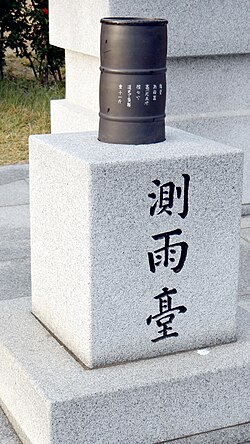
By 1247, the Song Chinese mathematician Qin Jiushao invented the Tianchi basin gauges to measure rain and snow. A major milestone occurred in 1441 during the Joseon dynasty of Korea, where the Cheugugi was created as the first standardized rain gauge.
In Europe, the 17th century saw significant advancements. In 1662, Christopher Wren and Robert Hooke collaborated to create the first tipping-bucket rain gauge in Britain. Between 1677 and 1694, Richard Towneley conducted the first systematic rainfall measurements over 15 years, publishing his findings in the Philosophical Transactions of the Royal Society. Later, in the late 18th century, Thomas Barker maintained meticulous records for 59 years, demonstrating that average rainfall varies greatly from year to year without a discernible pattern.
Standardization and National Coverage
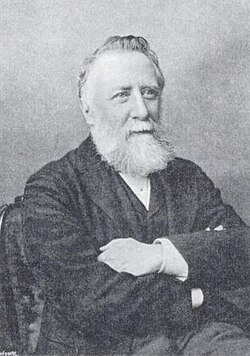
The push for national data collection began in earnest with George James Symons, who published the first volume of British Rainfall in 1860. Symons established a voluntary network of observers, growing the data pool from 168 stations in 1860 to 3,528 stations by 1899.
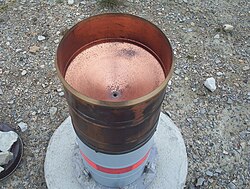
To ensure data accuracy across this vast network, Symons and Michael Foster Ward experimented with various gauge sizes and shapes. Their work led to the adoption of a standard gauge made of copper with a five-inch funnel, a design still utilized by the UK Meteorological Office today.
Types of Rain Gauges
Standard Rain Gauges
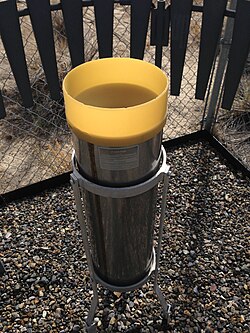
The standard United States National Weather Service rain gauge features an 8-inch (200 mm) funnel that empties into a metal graduated cylinder. This cylinder is housed within a larger 20-inch tall container to catch overflow during extreme weather. Measurements are read manually or via an Automatic Weather Station (AWS).
Tipping Bucket Rain Gauges
This device uses a funnel to channel water into a small, seesaw-like container. Once a pre-set amount of rain is collected, the bucket tips, dumping the water and sending an electrical signal to a recorder.
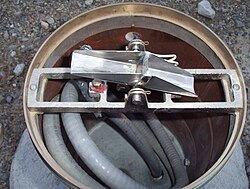
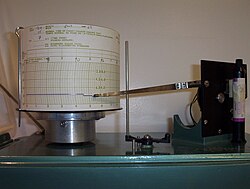
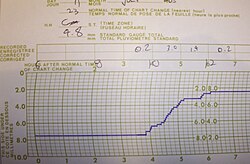
While useful for determining the character of rain (light, medium, or heavy), tipping buckets can underestimate intense rainfall or snowfall if the water does not tip the bucket immediately.
Weighing Precipitation Gauges
These gauges measure the mass of precipitation in a storage bin using a vibrating wire or a pen on a rotating drum. Unlike tipping buckets, they do not underestimate intense rain and can accurately measure hail and snow. They are often used in Automated Surface Observing System (ASOS) units as All Weather Precipitation Accumulation Gauges (AWPAG).
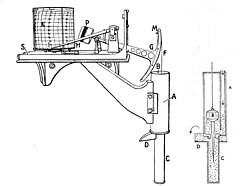
Pluviometer of Intensities
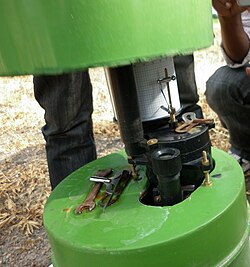
Also known as Jardi's pluviometer, this instrument measures average rainfall intensity. It uses a buoy and a feedback system with a conical needle to record the flow of water onto a rotating drum of cardboard, providing a visual representation of rainfall over time.
Advanced Optical and Acoustic Gauges
- Optical Rain Gauges: Use laser diodes and photo transistor detectors. When a drop falls through the laser beam, it scatters light, which is recorded as a flash.
- Acoustic Rain Gauges: Also called hydrophones, these sense the unique sound signatures of raindrops striking a water surface to estimate drop-size distribution and rainfall rate.
Comparison of Common Rain Gauge Types
| Gauge Type | Measurement Method | Key Advantage | Key Limitation |
|---|---|---|---|
| Standard Cylinder | Manual depth measurement | High accuracy | Requires manual reading |
| Tipping Bucket | Electrical pulse per tip | Easy intensity tracking | Underestimates heavy rain |
| Weighing Gauge | Mass of precipitation | Measures snow and hail | Higher cost and maintenance |
| Pluviometer | Buoy-driven pen/drum | Records rainfall regime | Mechanical complexity |
Operational Challenges and Limitations
Rain gauges face several environmental hurdles. In tropical cyclones, extreme winds can make data unreliable. Additionally, small amounts of water may stick to the funnel, leading to slight underestimations; amounts as low as 0.25 mm may be recorded simply as a trace.
Freezing temperatures pose another risk, as ice or snow can block the funnel. To prevent this, some gauges are equipped with automatic electric heaters to keep surfaces above freezing.
Frequently Asked Questions
What is a "trace" amount of rainfall?
A trace is recorded when the amount of precipitation is too small to be measured by the gauge, typically less than 0.01 inches or 0.25 mm.
Why must rain gauges be placed in open areas?
They must be away from buildings and trees to prevent obstacles from blocking rain or causing excess water (like drips from leaves or roofs) to enter the gauge, which would skew the data.
How do tipping bucket gauges handle snow?
Standard tipping buckets struggle with snow; however, many modern units, such as those in ASOS systems, use heating elements to melt frozen precipitation into water for measurement.
What is the difference between a rain gauge and a pluviometer?
While both measure precipitation, a pluviometer (specifically the pluviometer of intensities) is designed to record the rate or intensity of rainfall over time using a recording drum, rather than just the total accumulated depth.
Which rain gauge is the most accurate for heavy storms?
Weighing precipitation gauges are generally more accurate for intense rain than tipping bucket gauges because they measure mass directly and do not suffer from the "missing" rain that occurs between bucket tips.