Evapotranspiration: The Vital Link Between Earth's Surface and Atmosphere
In the complex machinery of our planet's climate, few processes are as essential to the movement of water as evapotranspiration (ET). This term describes the combined movement of water from the Earth's surface—including open water, ice, bare soil, and vegetation—into the atmosphere. By bridging the gap between the ground and the sky, evapotranspiration serves as a cornerstone of the local water cycle and a critical factor in global climate regulation.
Understanding ET is not merely a scientific pursuit; it is a practical necessity for modern society. Accurate measurements are vital for effective water resource management, optimizing agricultural irrigation, and managing entire watersheds.
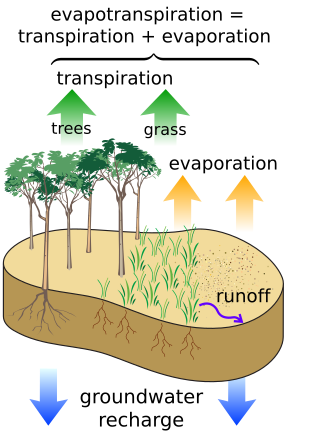
Key Facts
- Definition: The sum of evaporation (from soil and water bodies) and transpiration (from plants).
- Global Impact: Between 60% and 75% of land precipitation is returned to the atmosphere via evapotranspiration.
- Measurement Units: Typically expressed in millimeters of water per unit of time.
- Climate Connection: Rising global temperatures due to climate change are increasing evapotranspiration rates over land.
- Primary Drivers: Water availability, energy (heat), and atmospheric humidity.
The Mechanics of Evapotranspiration
To understand the whole, we must look at its two fundamental components:
- Evaporation: The direct movement of water from sources like soil and water bodies into the air. This process is influenced by solar radiation, heat, humidity, and wind speed.
- Transpiration: The process by which water is taken up by plants and released into the atmosphere.
While these are distinct processes, they function together to drive the water cycle. The rate at which this occurs is determined by several primary and secondary factors.
Primary Influencing Factors
Three main drivers control the levels of evapotranspiration in any given area:
- Water Availability: The amount of moisture present in the soil and larger bodies of water.
- Energy Availability: The amount of heat present in the air and soil, often measured by global surface temperature.
- Atmospheric Demand: The ability of the atmosphere to absorb water, known as humidity.
It is important to note that climate change is actively altering these dynamics. As global temperatures rise, the increased energy available to the system has led to higher evapotranspiration rates over land, representing a significant shift in the global water cycle.
Secondary Influencing Factors
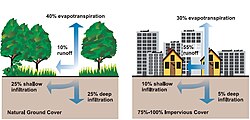
Beyond the primary drivers, local conditions such as vegetation type, the extent of vegetation coverage, soil characteristics, and irrigation practices play significant roles in determining how much water is moved into the atmosphere.
Measuring and Estimating Evapotranspiration
Because measuring atmospheric vapor flux directly can be difficult and time-consuming, scientists use several different methodologies to determine ET levels.
Direct Measurement: The Lysimeter
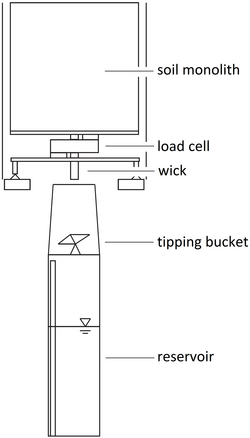
For precise measurements over small areas, researchers use a lysimeter. This device continuously monitors the weight of a plant and its surrounding soil. By accounting for any water added via precipitation or irrigation, the change in the total weight allows scientists to model the exact amount of water lost through evapotranspiration.
Indirect Estimation Methods
When direct measurement is not feasible, three main indirect methods are employed:
1. Catchment Water BalanceThis method uses a water balance equation to relate the change in water stored within a basin (ΔS) to its inputs and outputs. By knowing the precipitation (P), streamflow (Q), and groundwater recharge (D), the evapotranspiration (ET) can be calculated using the relationship between these variables.
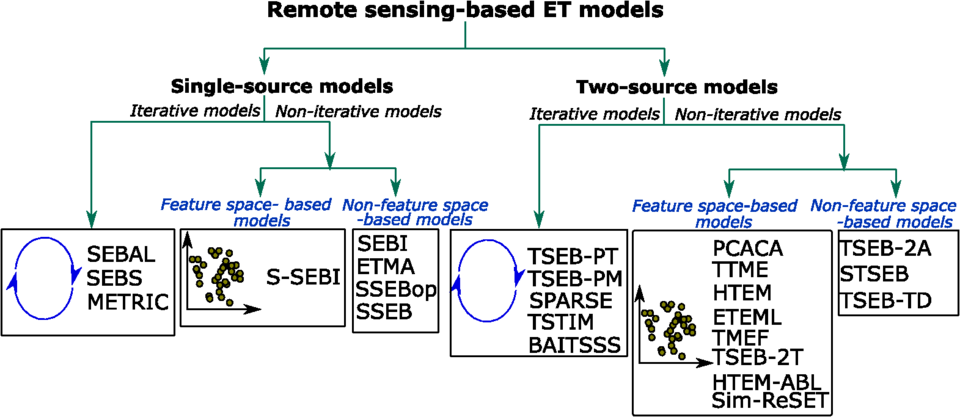
2. Energy BalanceThis approach calculates the energy required to change water from a liquid to a gas. By using instruments like scintillometers, radiation meters, or soil heat flux plates, scientists can solve for the energy available for actual evapotranspiration. Advanced algorithms like SEBAL and METRIC use satellite imagery to solve this energy balance on a pixel-by-pixel basis, providing maps of water management indicators over time.
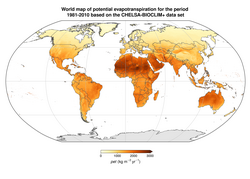
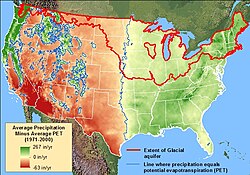
A crucial concept in meteorology is Potential Evapotranspiration (PET). This represents the amount of water that would be evaporated and transpired if there were an unlimited supply of water available. It reflects the energy and wind available to move water vapor away from the surface.
In practice, scientists often use Reference Evapotranspiration (ET₀), which is the PET calculated from a standardized reference surface, such as a field of short grass. Actual evapotranspiration can never exceed potential evapotranspiration; if water is scarce, the actual ET will be lower than the PET.
Summary of Evapotranspiration Concepts
| Concept/Method | Description | Primary Use |
|---|---|---|
| Evaporation | Direct water movement from surfaces to air | Foundational component of ET |
| Transpiration | Water release from vegetation | Foundational component of ET |
| Lysimeter | Weight-based direct measurement | High-precision small-scale studies |
| Potential ET (PET) | Theoretical maximum ET with ample water | Assessing energy/wind availability |
| Remote Sensing | Satellite-based energy balance (e.g., SEBAL) | Large-scale mapping and monitoring |
Frequently Asked Questions
What is the difference between evaporation and transpiration?
Evaporation is the process where water moves directly from surfaces like soil or open water into the air. Transpiration is the process where water is taken up by plants and released into the atmosphere through their tissues.
Why is potential evapotranspiration (PET) important?
PET tells us how much water the environment is "demanding" based on available energy and wind. It serves as a benchmark to understand if actual water loss is being limited by a lack of available moisture.
How does climate change affect evapotranspiration?
Climate change has led to an increase in global temperatures. This increase in heat provides more energy to the water cycle, which in turn increases evapotranspiration rates over land.
Can actual evapotranspiration be higher than potential evapotranspiration?
No. Actual evapotranspiration can be lower than potential evapotranspiration if there is insufficient water or if plants are unable to transpire effectively, but it can never exceed the potential limit set by available energy and atmospheric conditions.
What are some common models used in remote sensing for ET?
Several models are used to estimate ET via satellite, including ALEXI, BAITSSS, METRIC, SEBAL, SEBS, and SSEBop, among others.