Virga: The Science of Precipitation That Never Reaches the Ground
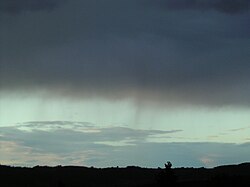
Have you ever looked up at a cloud and seen long, wispy streaks of rain or snow trailing downward, only to notice they vanish into thin air before touching the earth? This striking meteorological phenomenon is known as virga. Often referred to as a dry storm, virga represents a unique moment in the water cycle where precipitation begins its descent but fails to complete the journey to the surface.
What is Virga?
In technical terms, virga is an observable streak or shaft of precipitation that undergoes evaporation (changing from liquid to gas) or sublimation (changing directly from ice to gas) before reaching the ground. While virga consists of these evaporating streaks, a shaft of precipitation that successfully reaches the surface is classified by meteorologists as a precipitation shaft.
At high altitudes, precipitation often falls primarily as ice crystals. As these crystals descend, they may melt and eventually evaporate due to compressional heating—a process where air pressure increases as the particles move closer to the ground, warming the surrounding environment.
Global Occurrences and Climate
Virga is a common sight in various environments across the globe, particularly in regions with arid or temperate climates. It is frequently observed in:
- North America: Specifically within the Canadian Prairies and the Western United States.
- The Middle East
- North Africa
- Australia
Weather Impacts and Atmospheric Dynamics
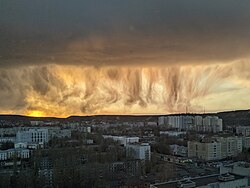
Virga is more than just a visual curiosity; it can significantly influence local weather patterns through thermal changes. Because water requires a high amount of energy to change from a liquid to a vapor state—a property known as the heat of vaporization—the process of evaporation removes substantial heat from the air.
Microbursts and Aviation Hazards
As precipitation evaporates, it can create cooling downdrafts. If these pockets of cold air descend rapidly, they can result in a wet or dry microburst. These sudden, intense bursts of air can be extremely hazardous to aviation, posing significant risks to aircraft during takeoff or landing.
Heat Bursts
Conversely, a rarer phenomenon can occur when precipitation evaporating at high altitudes causes compressional heating as it falls. This can lead to a gusty downburst that rapidly increases surface temperatures. This event, known as a heat burst, typically occurs in conditions of exceedingly dry air.
The Seeder-Feeder Mechanism
In certain conditions, ice virgae are produced via a seeder-feeder mechanism. This occurs when ice crystals from upper mixed-phase clouds (clouds containing both liquid water and ice) fall into lower-lying liquid clouds. These crystals then grow larger through riming (the collection of supercooled water droplets) or vapor deposition via the Wegener–Bergeron–Findeisen process.
Virga in the Solar System
The phenomenon of evaporating precipitation is not limited to Earth. Scientists have observed similar processes on other celestial bodies:
- Venus: Sulfuric acid rain evaporates before reaching the surface due to extreme heat.
- Gas Giants: Virgae have been observed on planets such as Jupiter.
- Mars: In 2008, NASA's Phoenix lander discovered a variety of snow virga falling from Martian clouds.
Key Facts
- Definition: Precipitation that evaporates or sublimates before hitting the ground.
- Alternative Name: Often called a "dry storm."
- Primary Cause: High heat of vaporization and compressional heating.
- Aviation Risk: Can cause dangerous microbursts or heat bursts.
- Etymology: Derived from the Latin virga, meaning a rod, branch, or shoot.
| Term | Reaches Ground? | Primary Process |
|---|---|---|
| Virga | No | Evaporation or Sublimation |
| Precipitation Shaft | Yes | Direct descent |
Frequently Asked Questions
What is the difference between virga and a precipitation shaft?
The primary difference is whether the precipitation reaches the surface. Virga evaporates or sublimates mid-air, while a precipitation shaft successfully reaches the ground.
Why does virga cause temperature changes?
When liquid water turns into vapor, it absorbs heat from the surrounding air (heat of vaporization). This can create cooling downdrafts. However, compressional heating during descent can also lead to warming, such as in a heat burst.
Can virga be dangerous?
Yes, virga can contribute to microbursts—sudden, powerful downdrafts of air—which are highly hazardous to pilots and aviation safety.
Is virga only found on Earth?
No. Virga-like phenomena have been observed on Venus (sulfuric acid), Jupiter, and Mars (snow).
What does the word "virga" mean?
The term comes from the Latin word virga, which translates to a rod, twig, branch, or spray.