Quneitra: The History and Destruction of the Golan Heights Capital
Perched in a high valley of the Golan Heights at an elevation of 1,010 meters (3,313 feet), Quneitra serves as a poignant symbol of the enduring conflict between Syria and Israel. Once a thriving garrison town and the capital of the Quneitra Governorate, the city now exists largely as a preserved ruin, standing as a silent witness to decades of geopolitical strife.
Since 1974, the city has been situated within a UN-patrolled buffer zone, established under United Nations Security Council Resolution 350 and the Agreement on Disengagement between Israel and Syria. This unique status has kept the city largely abandoned, though it remains a focal point of regional tension.
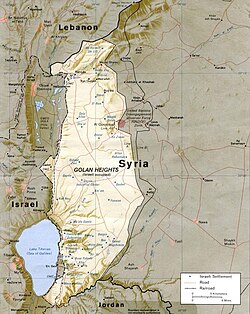
Key Facts
- Location: South-western Syria, Golan Heights.
- Status: Largely destroyed and abandoned capital of Quneitra Governorate.
- Key Events: Captured by Israel in 1967; briefly recaptured by Syria in 1973; destroyed by Israel in 1974.
- Current Control: Israel (since 2024).
- Demographics: Historically diverse, including Arabs, Circassians, and Turkmen.
- UN Status: Located within the UNDOF (United Nations Disengagement Observer Force) buffer zone.
Foundations and Early Growth
Quneitra was established during the Ottoman era, originally serving as a vital way station on the caravan route to Damascus. The modern city grew around an old Ottoman caravanserai (a roadside inn for travelers and their animals), which was constructed using stones from an ancient settlement.
By the late 19th century, Quneitra had become the administrative seat of the Golan. In 1888, records indicate the town consisted of approximately 260 basalt stone buildings and a population of 1,300, primarily composed of Circassians. Following Syrian independence from France in 1946, the population grew to roughly 21,000, becoming a diverse mix of Arabs, Turkmen, and Circassians.
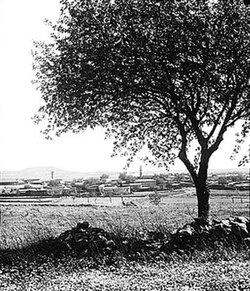
The Arab-Israeli Conflict and Destruction
The trajectory of Quneitra changed drastically during the Six-Day War. On June 10, 1967, the city came under Israeli control. For the next six years, it remained under Israeli occupation, becoming a symbolic point of contention for the Syrian government.
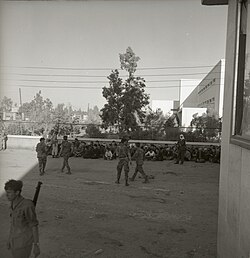

During the 1973 Yom Kippur War, the city became a fierce battleground. The Syrian Army briefly recaptured Quneitra before being repulsed by an Israeli counter-offensive involving massive tank concentrations and close air support. The city changed hands several times during this period of intense fighting.
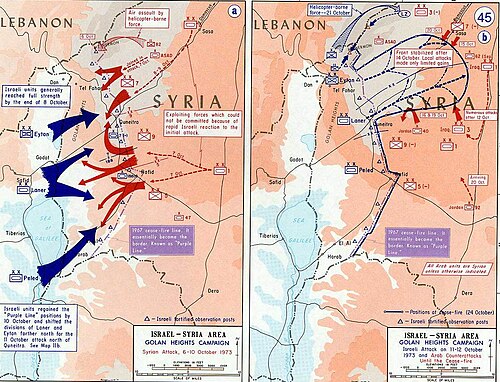
In June 1974, following a U.S.-brokered disengagement agreement, Israel returned the city to Syrian civilian control. However, prior to their withdrawal, Israeli forces systematically destroyed the city. A United Nations investigation led by Swiss engineer Edward Gruner documented the destruction of nearly 4,000 buildings and critical infrastructure, with damages estimated at 463 million Syrian pounds. The UN General Assembly subsequently condemned these acts as a grave breach of the Fourth Geneva Convention.
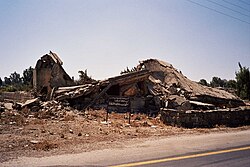
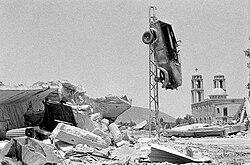
Quneitra as a Memorial and Modern Conflict
Following the destruction, the Syrian government chose not to rebuild the city, instead preserving the ruins as a museum to memorialize the devastation. This decision effectively turned the city into a ghost town, though a small population of 153 people was recorded in the Rasm al-Rawabi neighborhood during a 2004 census.
![Quneitra hospital. The sign reads: "Golan Hospital. Destructed by Zionists and changed it to firing target!" [sic]. Following the 2024 Israeli invasion of Syria, the hospital was completely demolished by the Israeli military on January 20, 2026.[63]](/images/ed/13/ed1330c117180bef2055e3855c01d381da42cabb431a802f1a304521ea9628c1.jpg)
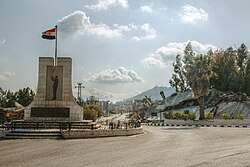
The city's instability continued during the Syrian Civil War. Between 2014 and July 2018, the city was de facto controlled by the Southern Front, a rebel alliance, before Syrian Government forces regained control. More recently, the area has seen renewed destruction; in January 2026, the Israeli military demolished the historic al-Golan hospital and the al-Andalus Cinema.
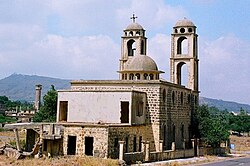
Regional Summary
| Attribute | Details |
|---|---|
| Elevation | 1,010 m (3,313 ft) |
| Historical Population | ~21,000 (post-1946) |
| 2004 Population | 153 (City) / 4,318 (Metro) |
| Primary Architecture | Basalt stone |
| Key Landmarks | St. George Greek Orthodox Church, al-Golan Hospital (destroyed) |
Frequently Asked Questions
Why is Quneitra currently a ruin?
The city was almost completely destroyed by Israeli forces in June 1974 before they withdrew from the area. The Syrian government subsequently chose to leave the ruins intact as a memorial to the destruction rather than rebuilding the city.
What is the current political status of Quneitra?
The city is located within a UN-patrolled buffer zone (UNDOF) in the Golan Heights. While historically returned to Syrian control in 1974, the region has seen various shifts in control during the Syrian Civil War and was re-occupied by Israel in 2024.
Who lived in Quneitra before its destruction?
The population was historically diverse, consisting primarily of Arabs, along with significant communities of Circassians from the Caucasus and Turkmen.
What was the UN's reaction to the city's destruction?
The United Nations General Assembly passed a resolution in 1974 describing the destruction of Quneitra as a grave breach of the Fourth Geneva Convention and formally condemned Israel for the acts.
What is the climate like in Quneitra?
Quneitra experiences a temperate climate with significant precipitation in the winter months (peaking in January and November) and warm, dry summers with very little rainfall in July and August.