Princeton Township: A History of the Former Mercer County Municipality
Princeton Township was a distinct municipality located in Mercer County, New Jersey, that played a significant role in the region's administrative and social landscape from the early 19th century until the beginning of 2013. Known for its affluent community and proximity to world-class education, the township eventually merged with the neighboring Borough of Princeton to create a single, unified municipality.
The township's journey began in 1683 when the area was first settled. It was officially incorporated as a township on April 9, 1838, formed from portions of Montgomery Township in Somerset County and West Windsor Township in Mercer County. Over the decades, the boundaries shifted, including the independence of the Borough of Princeton around 1894 and subsequent land cessions in 1928 and 1951.
Key Facts
- Existence: Incorporated April 9, 1838; disestablished January 1, 2013.
- Consolidation: Merged with the Borough of Princeton to form the current municipality of Princeton, New Jersey.
- Geography: Total area of 16.520 square miles, with 2.60% consisting of water.
- Population: 16,265 residents as of the 2010 census.
- Notable Landmark: Home to Drumthwacket, the official residence of the Governor of New Jersey.
- Wealth: Ranked as the 25th-wealthiest community in New Jersey as of the 2000 census.
Geography and Climate
The township spanned a total area of 16.520 square miles. The vast majority of this was land (16.090 square miles), while water bodies accounted for 0.430 square miles. The region sits at an elevation of approximately 200 feet.
The climate is characterized by distinct seasonal shifts. Based on 1991–2020 normals, the area experiences a wide temperature range, with record highs reaching 102.2°F and record lows dropping to −12.1°F. Annual precipitation averages 48.79 inches, distributed relatively evenly throughout the year, with July typically being the wettest month.
Demographics and Economy
Princeton Township saw steady population growth over the 20th century. From a population of 1,188 in 1870, it grew to 16,265 by 2010. The 2010 census revealed a diverse racial composition, with 75.52% White, 14.17% Asian, 4.98% Black or African American, and 6.91% identifying as Hispanic or Latino of any race.
Economically, the township was highly prosperous. According to the 2006-2010 American Community Survey, the median household income was $107,071, while the median family income reached $149,948. The per capita income was recorded at $71,050.
| Census Year | Population | Percentage Change |
|---|---|---|
| 1870 | 1,188 | — |
| 1930 | 2,738 | +92.3% (from 1920) |
| 1960 | 10,411 | +92.5% (from 1950) |
| 2000 | 16,027 | +21.4% (from 1990) |
| 2010 | 16,265 | +1.5% (from 2000) |
Government and Politics
The township was governed by a Township Committee. The final mayor before the consolidation was Chad Goerner, whose term ended on December 31, 2012. Politically, the township leaned heavily Democratic; as of March 2011, approximately 49.5% of registered voters were Democrats, while 13.2% were Republicans and 37.1% were unaffiliated.
This political leaning was evident in the 2009 gubernatorial election, where Democrat Jon Corzine received 66.1% of the vote compared to Republican Chris Christie's 26.9%.
Education and Local Landmarks
Education was a cornerstone of the community. Students in grades K-12 attended the Princeton Regional Schools, a district shared with the Borough of Princeton and serving students from Cranbury Township. The district included several elementary schools (Community Park, Johnson Park, Littlebrook, and Riverside), John Witherspoon Middle School, and Princeton High School.
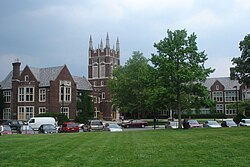
Beyond education, the township is home to Drumthwacket, a 20-room Greek Revival mansion that serves as the official residence of the Governor of New Jersey, featuring Italian gardens and a wood-paneled library.
Frequently Asked Questions
When did Princeton Township cease to exist?
Princeton Township was disestablished on January 1, 2013, when it merged with the Borough of Princeton to form the consolidated municipality of Princeton, New Jersey.
What is Drumthwacket?
Drumthwacket is a historic Greek Revival mansion located in the former Princeton Township that serves as the official residence of the Governor of New Jersey.
Which school district served the township?
Students attended the Princeton Regional Schools, which was a regional district shared between the township and the borough, and also served Cranbury Township.
How wealthy was Princeton Township?
The township was one of the wealthiest in the state; as of the 2000 census, it was ranked as the 25th-wealthiest community in New Jersey with a per capita income of $56,360.
What was the population of the township in 2010?
According to the 2010 United States census, the population of Princeton Township was 16,265 people.