Drumthwacket: The Historic Official Residence of the New Jersey Governor
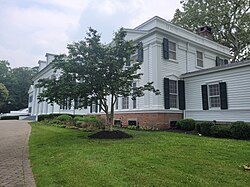
Located at 354 Stockton Street in Princeton, New Jersey, Drumthwacket serves as the official executive residence of the Governor of New Jersey. This stately mansion, situated near the state capital of Trenton, is more than just a home for political leaders; it is a historic house museum and a landmark of architectural and political significance.
The estate is currently administered by the New Jersey Department of Environmental Protection and is recognized for its contributions to agriculture, commerce, landscape architecture, and politics.
Key Facts
- Established: Built in 1835, expanded in 1893 and 1900.
- Architectural Styles: Greek Revival, Colonial, and Georgian.
- Historic Status: Listed on the National Register of Historic Places (1975) and the New Jersey Register of Historic Places (1975).
- Official Role: Designated as the governor's mansion in 1982.
- Location: Princeton, Mercer County, New Jersey.
A Legacy of Ownership and Architecture
Early Origins and the Olden Era
The land upon which the estate sits was originally owned by William Penn, the Quaker proprietor of the Province of Pennsylvania. In 1696, William Olden purchased the property and constructed a small white homestead known as the Olden House.
In 1835, Charles Smith Olden, who had amassed wealth through mercantile firms in Philadelphia and New Orleans, began construction of the main mansion. The name "Drumthwacket" is believed to be inspired by Sir Walter Scott's 1819 novel A Legend of Montrose, though modern linguistic sources suggest it derives from Scottish Gaelic words meaning "wooded hill." The original structure featured a center hall with two rooms on each side, a 2.5-story center section, and a prominent portico supported by six Ionic columns.
The Pyne and Spanel Expansions
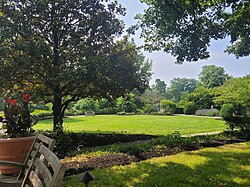
In 1893, the estate was purchased by Moses Taylor Pyne, a financier and benefactor of Princeton University. Pyne transformed the home into a magnificent estate by adding two wings in 1893 and 1900, designed by architect Raleigh C. Gildersleeve. These additions included a paneled library and extensive grounds featuring greenhouses, bridle paths, a dairy farm, and formal Italian gardens.
The property later passed to Abram Nathaniel Spanel in 1941. An industrialist and inventor who founded the International Latex Corporation (later International Playtex Corporation), Spanel used the mansion's Music Room as a space to conceive many of his patented inventions.
Transition to the Governor's Residence
The state of New Jersey purchased the estate from the Spanels in 1966 to replace Morven as the official governor's mansion. However, it was not until 1982 that it was formally designated as such, following fundraising efforts by the New Jersey Historical Society.
First Lady Deborah Kean established the Drumthwacket Foundation, a non-profit dedicated to the preservation and curation of the house. She oversaw the conversion of the mansion into an executive residence, replacing outdated furnishings with high-quality antiques suitable for ceremonial functions.
Later, First Lady Lucinda Florio (1990–1994) led further critical renovations. Her work focused on the private living quarters, updating antiquated heating, plumbing, and drinking water systems, and adding essential storage spaces and window treatments. She also restored the 11-acre Italianate gardens, which had fallen into disrepair.
Residential History of New Jersey Governors
The use of Drumthwacket as a primary residence has varied significantly among different administrations:
| Governor | Term | Residency Status |
|---|---|---|
| Thomas Kean | 1982–1990 | Lived in private home (Livingston) |
| James Florio | 1990–1994 | Full-time resident |
| Christine Todd Whitman | 1994–2001 | Part-time resident |
| Donald DiFrancesco | 2001–2002 | Part-time resident |
| John O. Bennett | 2002 | Resident (during 3.5-day acting term) |
| James McGreevey | 2002–2004 | Full-time resident |
| Richard Codey | 2004–2006 | Part-time resident |
| Jon Corzine | 2006–2010 | Part-time (Full-time during accident recovery) |
| Chris Christie | 2010–2018 | Official functions only (Lived in Mendham) |
| Phil Murphy | 2018–2026 | Official functions only (Lived in Middletown) |
| Mikie Sherrill | 2026–Present | Full-time resident |
Visiting Drumthwacket
Drumthwacket operates as a historic house museum and is open for guided tours on most Wednesdays (excluding August and the day before Thanksgiving). Tours are led by volunteer docents and cover six public rooms, including the solarium, center hall, dining room, parlor, music room, library, and the governor's study.
Visitors can also explore the surrounding gardens and the Olden House, which now houses the Drumthwacket Foundation and a gift shop.
Frequently Asked Questions
What is the meaning of the name Drumthwacket?
The name is likely derived from the character Dugald Dalgetty in Sir Walter Scott's 1819 novel A Legend of Montrose. Additionally, modern sources suggest it comes from Scottish Gaelic words meaning "wooded hill."
Who was the first governor to live at Drumthwacket?
While the mansion was designated as the official governor's residence in 1982, Governor Charles Smith Olden was the first governor to live in the house (during his term in 1860), as he was the original builder of the mansion.
Is Drumthwacket open to the public?
Yes, the mansion is open for guided tours on most Wednesdays, except for specific dates such as August and the day before Thanksgiving. Tours are conducted by volunteer docents.
What architectural styles are present in the mansion?
Drumthwacket features a blend of Greek Revival, Colonial, and Georgian architectural styles.
What is the role of the Drumthwacket Foundation?
The Drumthwacket Foundation is a non-profit organization responsible for the preservation, restoration, and curation of the mansion and its grounds.