Charles Smith Olden: The 19th Governor of New Jersey
Charles Smith Olden was a prominent American merchant, banker, and politician who steered New Jersey through the volatile onset of the American Civil War. Serving as the 19th governor of the state from 1860 to 1863, Olden's tenure was defined by a complex balancing act: maintaining a steadfast commitment to the Union while advocating for reconciliation with the South.
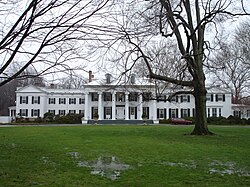
Beyond his political leadership, Olden left a lasting physical legacy in New Jersey. He constructed Drumthwacket, a grand mansion that would eventually transition from a private residence to a symbol of state authority.
Key Facts
- Term of Office: January 17, 1860 – January 20, 1863.
- Political Affiliations: Whig, Opposition Party, and National Union Party.
- Key Stance: Supported the Union and President Abraham Lincoln, but opposed the Emancipation Proclamation.
- Notable Legacy: Built Drumthwacket, now the official residence of the Governor of New Jersey.
- Judicial Service: Served on the New Jersey Court of Errors and Appeals from 1868 to 1873.
Early Life and Business Career
Born on February 19, 1799, near Princeton, New Jersey, Charles Smith Olden was raised in a Quaker family. He received his education at the Lawrenceville School, which provided the foundation for his later success in commerce.
Olden began his professional life working in his father's store before joining the mercantile firm of Matthew Newkirk. His ambition led him to New Orleans, where he managed a branch of Newkirk's firm from 1826 to 1832. Following the death of an uncle, Olden inherited a substantial estate, allowing him to return to Princeton. There, he established himself as a gentleman farmer and entered the financial sector, joining the board of directors of the Trenton Banking Company in 1842.
Rise in New Jersey Politics
Olden's political career began in earnest in 1844 when he was elected as a Whig to represent Mercer County in the New Jersey Senate. He served two terms, concluding in 1851. During his legislative tenure, he chaired the Committee on Education and showed a particular interest in the State Lunatic Asylum.
By 1856, Olden's political alignment shifted toward the American Party, through which he supported the presidential candidacy of Millard Fillmore.
The Governorship (1860–1863)
The Election of 1859
In 1859, Olden was nominated for governor by the Opposition Party—a coalition consisting of former Whigs, Republicans, and "Know Nothings" (members of the American Party). He won a narrow victory over the Democratic candidate, Edwin R.V. Wright.
Navigating the Civil War Crisis
Olden entered office during a period of extreme national tension. In his 1860 inaugural address, he argued that slavery was a matter of domestic policy and should be controlled exclusively by individual states. Despite this view, he supported Abraham Lincoln for president.
As the nation drifted toward conflict, Olden became a vocal advocate for compromise. He was the only state governor to attend the Washington Peace Conference in January 1861. While he did not speak, he voted for resolutions that included the extension of slavery in territories and the prohibition of Congressional abolition, fearing that secessionist sentiment could spark violence within New Jersey.
Once the Battle of Fort Sumter triggered the American Civil War, Olden's priorities shifted toward the preservation of the Union. He urged President Lincoln to view New Jersey as a critical border state and initially sought the creation of four regiments for coastal defense. However, he eventually deferred this responsibility to federal authorities.
Opposition to Emancipation
Despite his support for the war effort, Olden remained ideologically opposed to the Emancipation Proclamation (the executive order declaring slaves in Confederate states free). In September 1862, he joined the governors of Maryland, Delaware, Kentucky, and Missouri in declining to support the proclamation.
Later Career and Public Service
Constitutionally barred from seeking a second term, Olden left office in January 1863. He remained active in public life, serving as the first President of the Loyal National League of New Jersey, which later became the state branch of the National Union Party.
His later years were marked by significant appointments and academic contributions:
- Judiciary: Served on the New Jersey Court of Errors and Appeals (1868–1873).
- Commissions: Member of the Riparian Commission (1869–1875) and commissioner of the State Sinking Fund.
- Education: Served as treasurer of the College of New Jersey (now Princeton University) from 1849 to 1869 and as a trustee from 1863 to 1875.
- Electoral College: Acted as a presidential elector for Ulysses S. Grant in 1872.
Summary of Charles Smith Olden's Life
| Category | Details |
|---|---|
| Lifespan | February 19, 1799 – April 7, 1876 |
| Governor Term | 1860–1863 |
| Political Parties | Whig, Opposition, National Union |
| Education | Lawrenceville School |
| Key Residence | Drumthwacket (Princeton, NJ) |
| Successor | Joel Parker |
Personal Life and Death
Charles Smith Olden married Phoebe Ann Smith in 1832. Although the couple adopted one daughter, they had no biological children. Olden passed away at his home in Princeton on April 7, 1876, at the age of 77. He was laid to rest at the Stony Brook Meeting House and Cemetery.
Frequently Asked Questions
What was Charles Smith Olden's stance on slavery?
Olden believed that slavery was a domestic policy issue that should be regulated solely by the individual states. Consequently, while he supported the Union, he opposed the Emancipation Proclamation.
What is the significance of Drumthwacket today?
Originally built as Olden's personal residence, Drumthwacket was purchased by the state of New Jersey in 1966 and has served as the official residence of the governor since 1981.
How did Olden contribute to the American Civil War effort?
Olden supported President Abraham Lincoln and the national war effort to preserve the Union. He also led the Loyal National League of New Jersey to unite war supporters.
Which political parties was Olden affiliated with?
Throughout his career, Olden was associated with the Whig Party, the Opposition Party (a coalition of former Whigs, Republicans, and Know Nothings), and the National Union Party.
What roles did Olden hold after serving as governor?
After his governorship, he served on the New Jersey Court of Errors and Appeals, the Riparian Commission, and as a trustee and treasurer for the College of New Jersey (Princeton University).