American Civil WarAbraham LincolnConfederate States of AmericaUnion ArmyEmancipation Proclamation

American Civil War: The Conflict That Defined a Nation

American Civil War: The Conflict That Defined a Nation The American Civil War was a pivotal struggle fought from April 12, 1861, to May 26, 1865. This brutal conflict pitted the United St...

American Civil War: The Conflict That Defined a Nation

The American Civil War was a pivotal struggle fought from April 12, 1861, to May 26, 1865. This brutal conflict pitted the United States (the Union) against the Confederate States, a group of Southern states that had seceded from the Union. The war was a defining moment in American history, resulting in the dissolution of the Confederate States of America and the end of slavery across the nation.

At its core, the war was driven by deep-seated divisions over state rights and the institution of slavery. The election of Abraham Lincoln in 1860 served as the catalyst for the secession crisis, as Southern leaders feared his presidency would lead to the abolition of slavery.
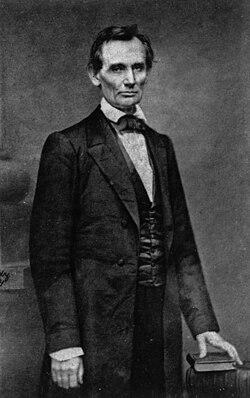
Portrait of the middle-aged Abraham Lincoln the year of 1860 by Mathew Brady
Portrait of Abraham Lincoln, an 1860 photograph portrait of Abraham Lincoln by Mathew Brady

Key Facts

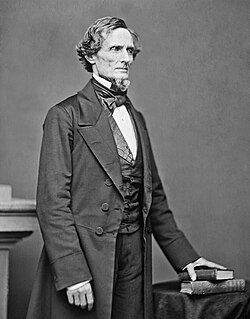
Middle-aged man in a goatee posed standing in a suit, vest and bowtie
Jefferson Davis, President of the Confederate States of America (1861–1865)
  • Duration: 4 years, 1 month, and 2 weeks.
  • Outcome: Union victory and the preservation of the United States.
  • Total Casualties: Over 1.6 million combined casualties, with estimated deaths ranging from 616,222 to over 1 million.
  • Key Leaders: Abraham Lincoln and Ulysses S. Grant (Union); Jefferson Davis and Robert E. Lee (Confederacy).
  • Major Turning Point: The Battle of Gettysburg, which altered the course of the war in the Union's favor.

The Outbreak of War and Secession
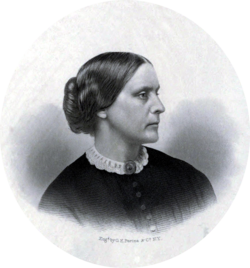
Susan B. Anthony was a women's rights activist and abolitionist.

The conflict began with the secession crisis, where slave-holding states broke away to form the Confederate States of America. The first shots were fired at the Battle of Fort Sumter, marking the official start of hostilities.
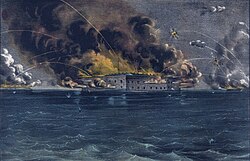
Artwork Despite him stone fort at center surrounded by water. The fort is on fire, and shells explode in the air above it.
The Battle of Fort Sumter, as depicted by Currier and Ives

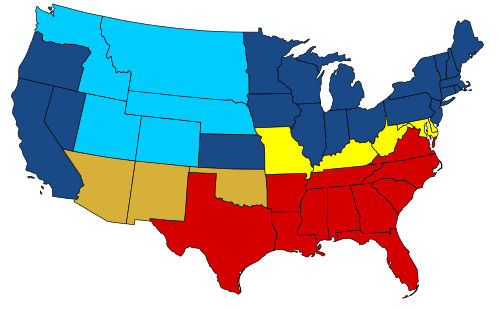
The geography of the war was complex. While many Southern states seceded, several border states—states that permitted slavery but did not secede—remained in the Union, though some experienced internal conflict with dual competing governments.
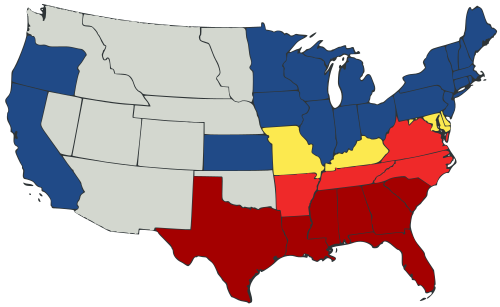
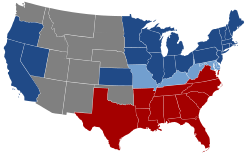
Map of US showing two kinds of Union states, two phases of secession and territories
Status of the states, 1861 Slave states that seceded before April 15, 1861 Slave states that seceded after April 15, 1861 Border Southern states that permitted slavery but did not secede (both KY and MO had dual competing Confederate and Unionist governments) Union states that banned slavery Territories

Division of the states during the American Civil War: Union, Confederacy, border states, and territories
Division of the states during the American Civil War: Union Confederacy Border states Territories

US secession map, showing the Union and the Confederacy Union states Union territories not permitting slavery (One of these states, West Virginia, was created in 1863, while KY, WV and MO had dual competing Confederate and Unionist governments) Confederate states Union territories that permitted slavery (claimed by Confederacy) at the start of the war, but where slavery was outlawed by the US in 1862

Comparing the Belligerents

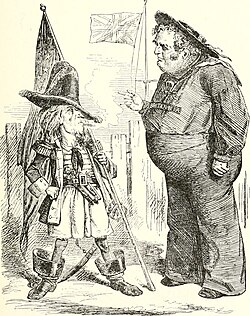
A December 1861 cartoon in Punch magazine in London ridicules American aggressiveness in the Trent Affair. John Bull, at right, warns Uncle Sam, "You do what's right, my son, or I'll blow you out of the water."

The Union and the Confederacy entered the war with vastly different resources. The North possessed a massive advantage in population, industrial capacity, and infrastructure, while the South relied heavily on its cotton exports and military leadership.

Comparison of Union and Confederate Resources (1860 vs 1864)
Metric Union (1860) Confederacy (1860) Union (1864) Confederacy (1864)
Population 22.1 Million 9.1 Million 28.8 Million 3.0 Million
Railroad Miles 21,800 8,800 29,100 Negligible
Manufactures 90% 10% 98% 2%
Arms Production 97% 3% 98% 2%

Military Strategy and Theaters of War

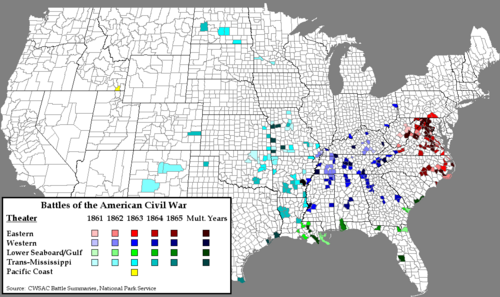
Map of the United States with counties colored
County map of Civil War battles by theater and year

The Union employed the Anaconda Plan, a strategic naval blockade designed to squeeze the Confederacy by cutting off trade and forcing rebel forces out of key regions like Missouri along the Mississippi River.
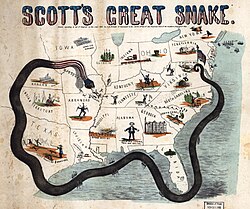
A cartoon map of the South surrounded by a snake.
General Scott's Anaconda Plan, featuring a tightening naval blockade, forcing rebels out of Missouri along the Mississippi River, Kentucky Unionists sit on the fence, idled cotton industry illustrated in Georgia.

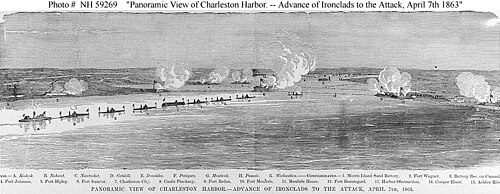
The Union Navy utilized ironclads—steam-propelled warships protected by iron plates—to maintain a continuous blockade of major Southern ports, which was sustained by the North's overwhelming industrial production.
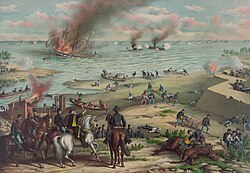
Painting of land battle scene in foreground and naval battle with sinking ships in background
Battle between the USS Monitor and Merrimack

Panoramic view of ships in harbor during battle
Gunline of nine Union ironclads. South Atlantic Blockading Squadron off Charleston. Continuous blockade of all major ports was sustained by the North's overwhelming war production.

The Eastern Theater

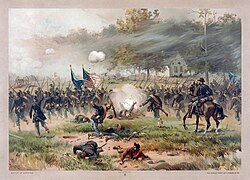
The Eastern Theater saw intense fighting between the Army of the Potomac and the Army of Northern Virginia. This region hosted some of the war's bloodiest encounters, including the Battle of Antietam, the deadliest one-day battle in the war's history.
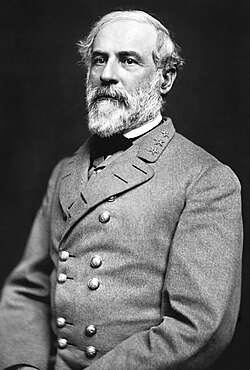
Old man with gray beard and military uniform
Robert E. Lee, the overall commander of the Confederate States Army

Painting of battlefield scene
A portrait depicting the Battle of Antietam, which resulted in over 22,000 casualties, the Civil War's deadliest one-day battle

The Battle of Gettysburg proved to be a critical turning point. The failure of Pickett's Charge on the final day of the battle shifted the momentum decisively toward the Union.
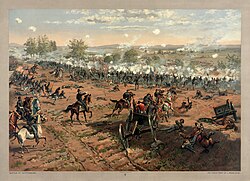
Cavalry charges on a battlefield
A portrait depicting Pickett's Charge on July 3, 1863, the final day of the Battle of Gettysburg, which proved the Civil War's deadliest battle but also one of its most significant, altering the course of the war in the Union's favor

The Western and Other Theaters

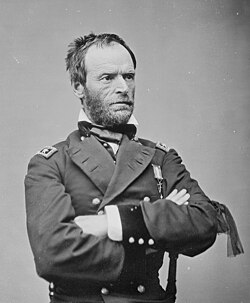
In the West, Union forces captured New Orleans and secured vital docks and arsenals in St. Louis. General William Tecumseh Sherman later conducted his famous "March to the Sea," devastating Confederate infrastructure.
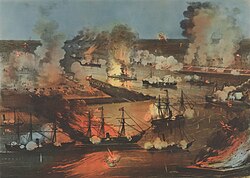
New Orleans captured

General William Tecumseh Sherman

The war also extended to the Trans-Mississippi theater and the lower seaboard, with the Union gradually reclaiming territory year by year.
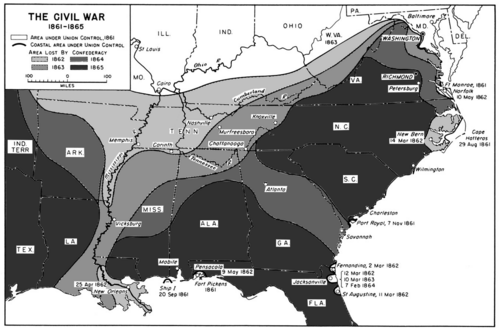
A map of the US South showing shrinking territory under rebel control
Map of Confederate territory losses year by year

The Path to Emancipation

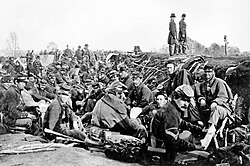
Union soldiers in the trenches, just prior to the Second Battle of Fredericksburg in May 1863

As the war progressed, its purpose evolved from simply preserving the Union to the total abolition of slavery. On January 1, 1863, Abraham Lincoln issued the Emancipation Proclamation, declaring that all enslaved people in Confederate-held territory were free.

Abolition of slavery in the various states of the US over time: Abolition of slavery during or shortly after the American Revolution (Vermont, 1777; Massachusetts [including Maine], 1783) The Northwest Ordinance, 1787 Gradual emancipation in New York (starting 1799, ended 1827), Pennsylvania (1780–1857), New Hampshire (1783–1857), Connecticut [including the Western Reserve] (1784–1848), Rhode Island (1784–1853) and New Jersey (starting 1804; ended by Thirteenth Amendment, 1865) The Missouri Compromise, 1821 Effective abolition of slavery by Mexican or joint US/British authority Abolition of slavery by Congressional action, 1861 Abolition of slavery by Congressional action, 1862 Emancipation Proclamation as originally issued, 1 Jan 1863 Subsequent operation of the Emancipation Proclamation in 1863 Abolition of slavery by state action during the Civil War Operation of the Emancipation Proclamation in 1864 Operation of the Emancipation Proclamation in 1865 Thirteenth Amendment to the US constitution, 18 Dec 1865 Territory incorporated into the US after the passage of the Thirteenth Amendment

Following the war, the Freedmen's Bureau was established to provide education and training for the newly freed population, helping them transition into a post-slavery society.
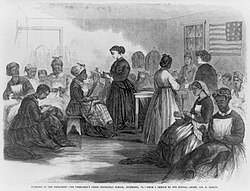
Through the supervision of the Freedmen's Bureau, Northern teachers traveled into the South to provide education and training for the newly freed population.

The Human Cost and Legacy

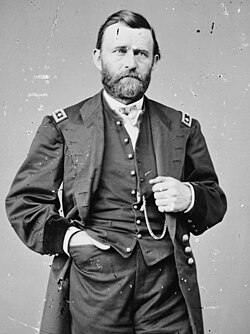
Ulysses S. Grant, a Union army general who was later elected the nation's 18th president

The American Civil War was a catastrophe of unprecedented scale. Hundreds of thousands died not only in combat but from disease and the harsh conditions of prisoner-of-war camps.
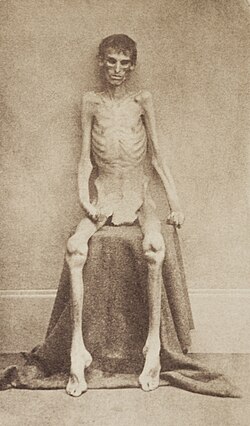
Union soldier held as a POW

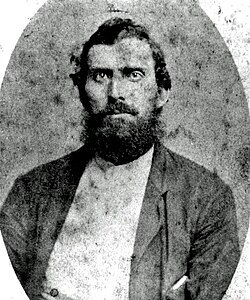
The war's impact extended beyond the battlefield, sparking internal unrest such as the New York anti-draft riots of 1863 and the emergence of resistance movements like the Free State of Jones.
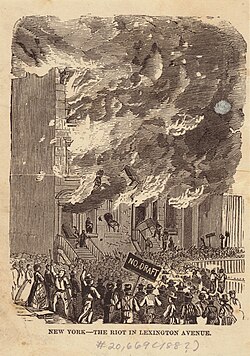
Building on fire as rioters look on, one holds a sign that says "no draft"
Rioters attacking a building during the New York anti-draft riots of 1863

Newton Knight, one of the founders of the Free State of Jones

The conflict's legacy persists in literature, film, and music, from the poetry of Walt Whitman to modern cinematic depictions of the struggle for freedom.
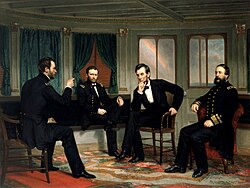
Painting of four men conferring in a ship's cabin, entitled "The Peacemakers".
The Peacemakers by George Peter Alexander Healy portrays, from left to right, Sherman, Grant, Lincoln, and Porter discussing plans for the last weeks of the Civil War aboard the steamer River Queen in March 1865. It currently hangs in the Oval Office dining room.

Frequently Asked Questions

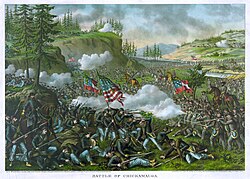
The Battle of Chickamauga, the war's highest two-day loss battle
Nathaniel Lyon secured docks and arsenal in St. Louis, leading Union Army forces to expel the Missouri Confederate forces and government.[187]
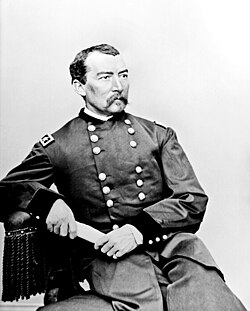
Philip Sheridan
Philip Sheridan
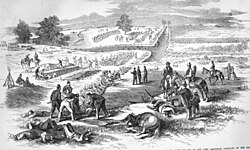
An illustration of the war dead following the Battle of Antietam battlefield in 1862
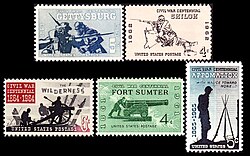
Beginning in 1961, the US Post Office released commemorative stamps for five famous battles, each issued on the 100th anniversary of the respective battle.

Who were the primary leaders of the Union and Confederacy?

The Union was led by President Abraham Lincoln and General Ulysses S. Grant. The Confederacy was led by President Jefferson Davis and General Robert E. Lee.

What was the significance of the Battle of Gettysburg?

The Battle of Gettysburg is considered one of the most significant battles of the war, as it halted the Confederate invasion of the North and altered the course of the conflict in the Union's favor.

What was the Anaconda Plan?

The Anaconda Plan was a Union strategy that involved a tightening naval blockade of the Southern coast and control of the Mississippi River to isolate the Confederacy and deplete its resources.

How many casualties resulted from the American Civil War?

Total casualties were immense, with the Union suffering over 821,000 and the Confederacy over 914,000. Total deaths are estimated between 616,222 and over 1 million, including soldiers and civilians.

What did the Emancipation Proclamation achieve?

Issued by Abraham Lincoln on January 1, 1863, it declared that all enslaved people in the rebellious states were free, fundamentally changing the war's goal to include the abolition of slavery.

References

  1. "End of the Rebellion; The Last Rebel Army Disbands". The New York Times. United States Department of War. May 29, 1865. Archived from the original on September 15, 2018. Retrieved July 29, 2022.
  2. Among the many other contemporary sources and later historians citing May 26, 1865, as the end date for the American Civil War hostilities are George Templeton Strong, who was a prominent New York lawyer; a founder, treasurer, and member of the Executive Committee of United States Sanitary Commission throughout the war; and a diarist. A diary excerpt is published in Gienapp, William E. (ed.). The Civil War and Reconstruction: A Documentary Collection. New York: W.W. Norton & Co., 2001, pp. 313–314 ISBN 978-0-393-97555-0. A footnote in Gienapp shows the excerpt was taken from an edited version of the diaries by Allan Nevins and Milton Halsey Thomas, eds., The Diary of George Templeton Strong, vol. 2 (New York: The Macmillan Company), pp. 600–601, which differs from the volume and page numbers of the original diaries; the page in Strong's original handwriting is shown at "Volume 4, pages 124–125: diary entries for May 23 (continued)–June 7, 1865". Archived from the original on November 16, 2022 – via New-York Historical Society Museum & Library.
  3. 211,411 Union soldiers were captured, and 30,218 died in prison. The ones who died have been excluded to prevent double-counting of casualties.
  4. 462,634 Confederate soldiers were captured and 25,976 died in prison. The ones who died have been excluded to prevent double-counting of casualties.
  5. The Union was the US government and included the states that remained loyal to it, both the non-slave states and the border states (Missouri, Kentucky, Maryland, and Delaware) where slavery was legal. Missouri and Kentucky were also claimed by the Confederacy and given full state delegations in the Confederate Congress for the duration of the war.