Polish Commemorative Coins: History, Materials, and Minting
Commemorative coins in Poland serve as tangible records of the nation's heritage, celebrating milestones that shape its identity. These special issues are produced by the Polish Mint and issued exclusively by the National Bank of Poland, the sole authority permitted to issue Polish coinage.
Each year, the National Bank of Poland releases a series of collector and commemorative coins. These pieces are designed to mark events of general importance to Poland or those with broader international significance, spanning a wide array of themes including political shifts, historical anniversaries, scientific breakthroughs, cultural achievements, sporting triumphs, and humanitarian efforts.
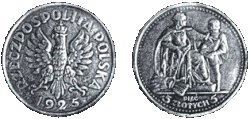
Key Facts
- Sole Issuer: Only the National Bank of Poland can issue official coins.
- Production: All commemorative coins are minted by the Polish Mint.
- Precious Metals: Common materials include silver (Ag 925), gold (Au 900), and pure gold (Au 999.9).
- Circulation Equivalents: Many commemorative designs have counterparts minted in Nordic Gold (a special brass alloy) for common use.
- Currency Shift: A major redenomination occurred on January 1, 1995, where 10,000 old złotych (PLZ) were exchanged for one new złoty (PLN).
Materials and Composition
The choice of material for a commemorative coin often reflects its intended value and rarity. High-value collector pieces are typically struck from precious metals:
- Silver: Usually an alloy of Ag 925.
- Gold: Available in Au 900 or high-purity Au 999.9.
In addition to these precious metals, the Polish Mint produces occasional coins intended for wider use. These are crafted from Nordic Gold, a specialized brass alloy known for its durability and gold-like appearance, providing a more accessible alternative to the precious metal versions.
Minting Trends and Volume (2000–2010)
The production of commemorative coins fluctuates annually based on the number of events being honored. Between 2000 and 2010, the National Bank of Poland maintained a consistent output of collector pieces, with a notable peak in 2009.
| Year | Total Issues | Gold | Silver | 200 zł | 100 zł | 50 zł | 37 zł | 30 zł | 25 zł | 20 zł | 10 zł |
|---|---|---|---|---|---|---|---|---|---|---|---|
| 2000 | 17 | 7 | 10 | 4 | 3 | – | 2 | 8 | - | - | - |
| 2001 | 16 | 6 | 10 | 3 | – | 4 | 6 | - | - | - | - |
| 2002 | 12 | 4 | 8 | 1 | 3 | – | 3 | 5 | - | - | - |
| 2003 | 16 | 6 | 10 | 2 | 4 | – | 4 | 6 | - | - | - |
| 2004 | 19 | 5 | 14 | 3 | 2 | – | 5 | 9 | - | - | - |
| 2005 | 22 | 8 | 14 | 5 | 3 | – | 3 | 11 | - | - | - |
| 2006 | 18 | 5 | 13 | 3 | 2 | – | 4 | 9 | - | - | - |
| 2007 | 16 | 5 | 11 | 4 | 1 | – | 3 | 8 | - | - | - |
| 2008 | 22 | 9 | 13 | 6 | 2 | 1 | – | 4 | 9 | - | - |
| 2009 | 24 | 7 | 17 | 4 | 1 | – | 1 | – | 1 | 4 | 13 |
| 2010 | 22 | 7 | 15 | 3 | 2 | – | 1 | 4 | 11 | - | - |
Currency Redenomination
The history of the Polish złoty is marked by a significant economic adjustment in the 1990s. Due to high inflation during the early part of the decade, the currency underwent redenomination—a process of changing the face value of currency to make it more manageable.
On January 1, 1995, the transition was finalized: 10,000 old złotych (PLZ) were converted into one new złoty (PLN). This shift created a new baseline for all subsequent commemorative coins issued from 1995 through the present day.
Frequently Asked Questions
Who is authorized to issue commemorative coins in Poland?
The National Bank of Poland is the only institution authorized to issue Polish coins, while the actual production is handled by the Polish Mint.
What materials are used for these coins?
Commemorative coins are typically minted from silver (Ag 925), gold (Au 900), or pure gold (Au 999.9). Occasional coins for common use are made from a brass alloy known as Nordic Gold.
What happened to the Polish currency in 1995?
To combat the effects of inflation from the early 1990s, Poland redenominated its currency on January 1, 1995, replacing 10,000 old złotych (PLZ) with one new złoty (PLN).
What themes do Polish commemorative coins cover?
They mark a variety of significant events, including political, historical, scientific, cultural, sporting, and humanitarian milestones of both national and international importance.
How many coins were issued in 2009?
In 2009, a total of 24 issues were released, including 7 gold and 17 silver coins.