Collector Banknotes of the National Bank of Poland
The National Bank of Poland (NBP) has a tradition of honoring the nation's most influential cultural and scientific figures through the issuance of commemorative currency. Between 2009 and 2011, the NBP released a series of three distinct collector banknotes, each with a face value of 20 złotych. These notes serve not only as legal tender but as intricate pieces of art that celebrate Polish heritage.
Key Facts
- Denomination: All three collector banknotes have a face value of 20 złotych.
- Issuance Period: The series was released between September 2009 and November 2011.
- Manufacturer: All notes were produced by the Polish Security Printing Works (PWPW).
- Honorees: The series commemorates poet Juliusz Słowacki, composer Frédéric Chopin, and scientist Marie Skłodowska-Curie.
The 200th Birth Anniversary of Juliusz Słowacki
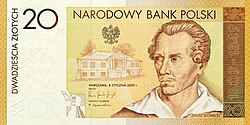
Issued on September 23, 2009, this banknote commemorates the 200th anniversary of the birth of Juliusz Słowacki, a preeminent poet and playwright of the Romanticism era in Poland. Designed by Maciej Kopecki, the note blends portraiture with architectural landmarks.
The obverse features a bust of Słowacki alongside a stylized image of the manor house in Krzemieniec, which currently houses the Juliusz Słowacki Museum, and the state emblem of the Republic of Poland. The reverse showcases a fragment of the King Sigismund III Vasa Column in Warsaw, images of flying cranes, a reproduction of an excerpt from the poem "Uspokojenie" (Reassurance), and a fragment of St. John the Baptist's Cathedral in Warsaw.
Security Features of the Słowacki Note
To prevent counterfeiting, the NBP implemented several advanced security measures:
- Watermark: A profile portrait of Juliusz Słowacki.
- Optically Variable Ink: Markings that shift from golden to green, found on the denomination and the crane image.
- Recto-Verso: An image of an inkwell and quill pen that completes only when viewed through the paper against light.
- Tactile Elements: Intaglio printing and a raised crane image, plus an "XX" feature for the visually impaired.
- Other Features: Ultraviolet ink (showing ten cranes), a latent "2009" image, and microprinting of Słowacki's works.
The 200th Anniversary of the Birth of Frédéric Chopin
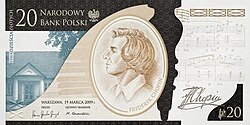
Released between February and March 2010, this note celebrates the 200th anniversary of the birth of the world-renowned composer and pianist Frédéric Chopin. Measuring 138 x 69 mm, the note was designed by Grzegorz Pfeifer and Katarzyna Jarnuszkiewicz.
The obverse features a profile portrait of Chopin created via steel engraving by artist Przemysław Krajewski. It also depicts the manor house in Żelazowa Wola (Chopin's birthplace) and a reproduction of the first edition of Mazurka in B-flat major, Op. 7 No. 1, along with the composer's autograph. The reverse displays a facsimile of Étude in f-minor, Op. 10, No. 9, set against a landscape of willows typical of Central Poland.
Security Features of the Chopin Note
The Chopin banknote utilizes a sophisticated array of security technology:
- Watermark: A profile portrait of Frédéric Chopin.
- Optically Variable Ink: Used for the composer's signature, a stylized music stand, and a stave, changing from golden to green.
- Recto-Verso: Musical notation fragments that align perfectly when held to the light.
- Ultraviolet Ink: Visible on the serial number and a fragment of the Mazurka in B-flat major (bars 2-3 and 7-8).
- Tactile Elements: Intaglio printing on the obverse and an "XX" feature for the visually impaired.
The 100th Anniversary of Marie Skłodowska-Curie's Nobel Prize
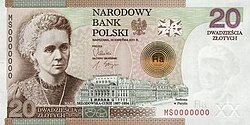
The final note in this series was put into circulation on November 25, 2011, to mark the 100th anniversary of Marie Skłodowska-Curie receiving the Nobel Prize in Chemistry. Designed by Agnieszka Próchniak with steel engraving by Przemysław Krajewski, this note was printed in a limited volume of 60,000 copies.
The obverse presents an image of Marie Skłodowska-Curie alongside the Sorbonne building in Paris. The reverse features the Nobel Prize medal, a quotation from her speech regarding radium, and an image of the Radium Institute in Warsaw. The note shares the same dimensions as the Chopin note (138 x 69 mm).
Summary of Collector Banknotes
| Honoree | Issue Date | Key Visuals | Designer/Engraver |
|---|---|---|---|
| Juliusz Słowacki | Sept 23, 2009 | Krzemieniec Manor, Sigismund III Column | Maciej Kopecki |
| Frédéric Chopin | Feb/Mar 2010 | Żelazowa Wola Manor, Musical Scores | G. Pfeifer, K. Jarnuszkiewicz, P. Krajewski |
| Marie Skłodowska-Curie | Nov 25, 2011 | The Sorbonne, Nobel Medal, Radium Institute | Agnieszka Próchniak, P. Krajewski |
Frequently Asked Questions
What is the face value of these collector banknotes?
Each of the three commemorative banknotes issued by the National Bank of Poland has a face value of 20 złotych.
Who manufactured these banknotes?
All three banknotes were manufactured and printed by the Polish Security Printing Works, known as PWPW.
What is the "XX" feature found on the notes?
The "XX" feature is a tactile element located in the bottom left-hand corner of the obverse, designed specifically to assist visually impaired individuals in identifying the note.
How many Marie Skłodowska-Curie banknotes were printed?
The National Bank of Poland printed a limited volume of 60,000 notes for the Marie Skłodowska-Curie commemorative issue.
What is recto-verso printing?
Recto-verso is a security feature where fragments of an image are printed on both the front and back of the note; when held up to the light, these fragments align perfectly to form a complete image.