500-Złoty Banknote: A History of Poland's High-Value Currency
The 500-złoty note has served as a cornerstone of high-value transactions in Poland across several different eras of the nation's monetary history. From early treasury notes to the modern currency managed by the National Bank of Poland, the evolution of this denomination reflects the political and economic shifts of the country.
Key Facts
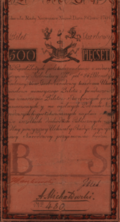
- The first 500-złoty note appeared as a treasury note in 1794.
- Tadeusz Kościuszko has been featured on multiple versions of the 500-złoty note.
- The 1944 Lublin series note was withdrawn early due to frequent forgery.
- The 1948 series featured imagery of miners and circulated until 1977.
- The current 500-złoty note was introduced in 2017 to optimize cash settlements and currency management.
The Early Eras of the Złoty
The history of the 500-złoty denomination begins in the late 18th century, with a note issued as part of the treasury notes in 1794.
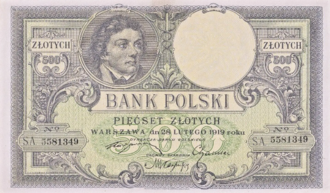
Following the reinstatement of the złoty in 1924, a new 500-złoty note was introduced. This specific note was dated 1919 and had been printed in advance in the United Kingdom. Featuring the image of Tadeusz Kościuszko, a national hero, it remained the highest-value note in circulation until the start of World War II.
The obverse of this 1919 note showcased the primary design elements of the era.
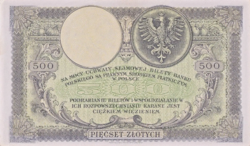
The reverse side completed the design of this high-value currency piece.
War-Era and Post-War Transitions
During the period of the General Government, the Bank of Issue in Poland released a 500-złoty note dated 1940. This was followed by the Lublin series (seria lubelska) in 1944. However, the 500-złoty note from this series was withdrawn in 1947—earlier than other notes in the same series—because it was frequently forged.
In the immediate post-war years, two additional 500-złoty notes were issued, dated 1946 and 1947. These entered circulation in 1946 and 1949, respectively, before both were withdrawn in 1950.
The Third Złoty and the Miner Series
In 1950, a new series dated 1948 was introduced. The 500-złoty note was the largest denomination in this series and shifted its imagery toward the working class, featuring a likeness of a miner on the front and three miners at work on the back. These notes remained in use from 1950 until 1977.
Starting in January 1975, these were gradually replaced by smaller notes. The design returned to featuring Tadeusz Kościuszko. These subsequent notes bore dates of 1974, 1976, 1979, and 1982. Notably, the 1982 notes continued to be issued into the 1990s without a date change. They circulated until the end of 1996 and could be exchanged for the fourth złoty until the end of 2010.
Modern Currency and the 2017 Reintroduction
A new series of banknotes was launched in 1995, which initially only included denominations of 10, 20, 50, 100, and 200 złotych. It was not until 2017 that the National Bank of Poland reintroduced the 500-złoty note.
The reintroduction was designed to achieve several economic goals: facilitating cash settlements between individuals, reducing currency management costs for both entrepreneurs and the central bank, and improving the overall management of the circulating banknote supply.
Summary of 500-Złoty Note Eras
| Era/Series | Key Date(s) | Notable Features/Events |
|---|---|---|
| First Złoty | 1794 | Issued as treasury notes. |
| Second Złoty | 1919 (circ. 1924) | Printed in UK; featured Tadeusz Kościuszko. |
| General Government | 1940 | Issued by the Bank of Issue in Poland. |
| Lublin Series | 1944 | Withdrawn in 1947 due to frequent forgery. |
| Third Złoty (Early) | 1948 | Featured miners; circulated 1950–1977. |
| Third Złoty (Late) | 1974–1982 | Returned to Kościuszko imagery; circulated until 1996. |
| Current Series | 2017 | Introduced to optimize cash settlements and costs. |
Frequently Asked Questions
Why was the 1944 Lublin series 500-złoty note withdrawn early?
The 1944 Lublin series 500-złoty note was withdrawn in 1947 because it was particularly susceptible to forgery.
Who is featured on the 500-złoty notes?
Tadeusz Kościuszko has been featured on several versions, including the 1919 note and the series issued between 1974 and 1996. The 1948 series featured miners.
When could the Third Złoty notes be exchanged for the new currency?
Notes from the Third Złoty series could be exchanged for the new currency until the end of 2010.
Why did the National Bank of Poland introduce the 500-złoty note in 2017?
It was introduced to make cash settlements between individuals easier, lower currency management costs for the central bank and businesses, and improve the management of the banknote supply.
Which 500-złoty note was the highest value in circulation before WWII?
The 500-złoty note dated 1919, which was printed in the United Kingdom and put into circulation in 1924, was the highest-value note until the outbreak of World War II.