Perfumed Gloves in Renaissance and Early Modern Europe
In the courts of the Renaissance and Early Modern periods, fragrance was more than a personal preference; it was a symbol of status, a tool of diplomacy, and occasionally, a source of suspicion. Among the most coveted luxury items were perfumed gloves, which served as sophisticated accessories and highly valued gifts among the European aristocracy.
From the influential houses of Italy to the royal courts of England and Spain, these scented garments were exchanged to cement alliances, express affection, and demonstrate wealth. The art of scenting leather required specialized skill, often involving professional perfumers who traveled across borders to serve the elite.
Key Facts
- Perfumed gloves were staple New Year's Day gifts for aristocrats in Tudor and Stuart England.
- Catherine de Medici and Isabella D'Este were prominent figures in the culture of scented glove gifting.
- Elizabeth I received as many as 23 pairs of perfumed gloves for a single New Year's celebration in 1603.
- Diplomats, such as the Spanish ambassador Count of Villamediana, used luxury gloves to influence court policy.
- Fear of poisoning led to strict security protocols regarding scented apparel for the English monarchy.
The Tradition of Scented Gifts
The practice of gifting perfumed gloves spanned several generations of European nobility. Catherine de Medici (1519-1589) presented these items to her daughter, Elisabeth of Valois, the wife of Philip II of Spain. Similarly, Isabella D'Este (1474-1539), known for creating her own scents, gifted gloves to Claude of France (1499-1524).
In England, these items became essential components of high-society etiquette. For example, in 1526, Elizabeth Neville, daughter of John Neville of Chevet, included a pair of perfumed gloves valued at £3-4s in her wedding apparel. Other notable recipients included Princess Mary and King Henry VIII, who received a pair from Archangelo Arcano, one of his military engineers and gunners.
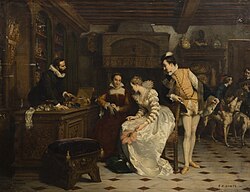
Perfumed Gloves and the Court of Elizabeth I
During the reign of Elizabeth I, the allure of fragrance was tempered by political paranoia. William Cecil, a trusted advisor, issued a memorandum warning the Queen against accepting perfumed clothing, sleeves, or gloves from strangers due to fears that the scents could mask poison.
Royal Production and Trade
Despite these fears, the Queen continued to use and receive scented gloves. Some were crafted by John Wynyard, a page of the royal wardrobe, who utilized a steel perfuming pan for his work. The trade also extended internationally; in 1562, jewelry merchant John Dymocke presented perfumed black velvet gloves to Eric XIV of Sweden.
London became a hub for this craft with the arrival of Italian specialists. Guillam Bisco, an Italian glove perfumer, settled in the Queenhithe Ward, while Frances Lewcattelly (Lucatelli), a Venetian perfumer, operated in Blackfriars after receiving permission to work in London in 1569.
The "Earle of Oxford's Perfume"
A notable anecdote involves Edward de Vere, 17th Earl of Oxford, who returned from Italy in 1576 with a collection of "sweet bagges," a perfumed leather jerkin, and gloves. Elizabeth was so pleased with the scent of the gloves that it became known as the "Earle of Oxford's perfume." While this story was later popularized by figures like Isaac Disraeli, evidence suggests the scent was not widely adopted by the general Elizabethan population.
Jacobean Diplomacy and Political Influence
By the Jacobean era, perfumed gloves evolved into strategic diplomatic tools. In September 1603, the Count of Villamediana, the Spanish ambassador to England, arrived with a vast supply of Spanish gloves and a professional perfumer to assist in his efforts to leverage support for Spanish policy at court.
During a dinner hosted by Villamediana, Lady Carey was presented with Spanish leather gloves, followed by a gold necklace. Similarly, the King of Spain, Philip III, provided perfumed gloves and other scented goods as gifts for Margaret Howard, Countess of Nottingham, following the Somerset House Conference and the treaty ratification at Valladolid.
| Person | Role/Relation | Context of Use |
|---|---|---|
| Catherine de Medici | Queen/Matriarch | Gave gloves to daughter Elisabeth of Valois |
| Elizabeth I | Queen of England | Received 23 pairs for New Year 1603 |
| Count of Villamediana | Spanish Ambassador | Used Spanish gloves for diplomatic leverage |
| Isabella D'Este | Renaissance Noble | Created own scents for gifts to Claude of France |
| John Wynyard | Royal Wardrobe Page | Used a steel pan to perfume the Queen's gloves |
Frequently Asked Questions
Why were perfumed gloves feared by Elizabeth I's advisors?
William Cecil advised the Queen to be cautious because there were concerns that perfumes in clothing or gloves could be used to deliver poison to the wearer.
Who were the primary providers of glove perfumes in London?
Many specialists came from Italy, including Guillam Bisco in Queenhithe Ward and the Venetian perfumer Frances Lewcattelly in Blackfriars.
How were perfumed gloves used in diplomacy?
Diplomats, such as the Spanish ambassador Count of Villamediana, used luxury items like Spanish leather gloves as gifts to gain favor and influence political support at the royal court.
What was the "Earle of Oxford's perfume"?
It was the specific scent of gloves brought back from Italy by Edward de Vere in 1576, which greatly pleased Queen Elizabeth I, though it did not become a common fragrance among the public.
What materials were used for these luxury gloves?
The source mentions the use of black velvet and high-quality Spanish leather, with some pairs featuring elaborate embroidery such as seed pearls.