Face Masks and Visards in Early Modern England and Scotland
Long before the modern era, face coverings served as essential accessories for the nobility of England and Scotland. From the mid-16th century through the late 17th century, masks—often referred to as antifaces or visards—were utilized for a variety of reasons, ranging from the practical need for sun protection to the social requirements of courtly etiquette and anonymity.
The Rise of Masking in the Tudor Era
The use of face coverings was noted as early as 1554, when a Spanish observer at the wedding of Mary I of England and Philip of Spain remarked that women in London frequently wore veils, antifaces, or masks when walking outdoors. By the 1570s, this practice had become more widespread among the upper classes. Emanuel van Meteren observed that "ladies of distinction" had adopted the fashion of covering their faces with feathers, vizards, and silken masks.
Queen Elizabeth I was a notable proponent of this trend. Her masks were crafted from satin supplied by Baptist Hicks and featured linings of perfumed leather. Historical records place the Queen wearing one of these masks while walking in the gardens of Oatlands Palace in September 1602.
Sun Protection and Royal Protocol in Scotland
In Scotland during the 1590s, Anne of Denmark utilized masks primarily as a functional tool to protect her complexion from the sun while horse riding. These specific masks were constructed with black satin faces, lined with taffeta, and decorated and fastened with Florentine ribbon.
The social significance of the mask was highlighted during the Union of Crowns in June 1603. John Chamberlain noted that Anne had potentially damaged her complexion by traveling to England without a mask. Conversely, Arbella Stuart praised the Queen for appearing "barefaced" when greeting the public at Newbury, a gesture that pleased both native and foreign observers. However, Anne returned to the practice in 1604, wearing a black mask while observing the arrival of the Spanish ambassador, the 5th Duke of Frías, from a barge on the Thames.
The Stuart Court and the Art of the Visard
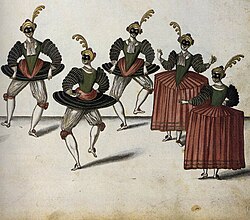
During the Stuart period, these coverings became known as visard masks. They were used both for sun protection and as part of the elaborate costumes for masques—stylized courtly performances. Queen Henrietta Maria employed a specialist visard maker named John King, who produced masks from colored leather and "Venetian" visards, a term likely referring to an Italian method of modeling soft leather.
Despite their popularity, masks sometimes clashed with court protocol. In 1627, Charles I issued a household regulation to prevent ladies from entering Henrietta Maria's presence chamber while "masked and muffled." However, exceptions were made for personal reasons; for instance, Henrietta Maria permitted her favorite, Lucy Hay (the Countess of Carlisle), to wear a mask at court following a bout of smallpox.
The 17th Century Resurgence
Visards saw a renewed surge in popularity during the 1660s. The famous diarist Samuel Pepys recorded a specific instance in 1663 at the Theatre Royal, Drury Lane. He noted that Mary Cromwell donned her vizard as the theater filled, observing that hiding the entire face had become a "great fashion among the ladies." This trend was pervasive enough that Pepys purchased a vizard for his own wife later that same day.
Key Facts
- Materials: Masks were crafted from satin, silken fabrics, taffeta, and colored or perfumed leather.
- Primary Uses: Protection against sunburn, concealment of illness (such as smallpox), and courtly fashion.
- Notable Makers: Baptist Hicks supplied satin to Elizabeth I, and John King served as a visard maker for Henrietta Maria.
- Terminology: "Antifaces" and "visards" were common terms for these face coverings.
| Person | Period | Primary Use/Context | Materials Mentioned |
|---|---|---|---|
| Elizabeth I | Late 16th/Early 17th C. | Garden walks/Fashion | Satin, perfumed leather |
| Anne of Denmark | 1590s - 1604 | Sun protection (horse riding) | Black satin, taffeta, Florentine ribbon |
| Lucy Hay | Stuart Era | Post-smallpox concealment | Not specified |
| Mary Cromwell | 1660s | Public anonymity at theater | Not specified |
Frequently Asked Questions
Why did noblewomen wear masks in the 16th and 17th centuries?
Masks were used primarily to protect the skin from sun damage, to maintain anonymity in public spaces like theaters, and occasionally to hide facial scarring from diseases like smallpox.
What is a visard?
A visard is a type of face mask common in the Stuart court and later the 1660s, often made of leather or fabric, designed to cover the face.
What were "Venetian" visards?
Venetian visards were a style of mask provided by makers like John King, and the term likely refers to a specific Italian technique used to model soft leather.
Did the monarchy always encourage the use of masks?
Not always. While many royals wore them, Charles I implemented a regulation in 1627 to stop ladies from entering the presence chamber of Henrietta Maria while "masked and muffled."
Who supplied the materials for Queen Elizabeth I's masks?
The satin used in Queen Elizabeth I's masks was supplied by Baptist Hicks.