Pedro Duque: A Journey from Earth to Orbit and Governance
Pedro Duque is a distinguished figure whose career spans the heights of space exploration, the complexities of private aerospace business, and the responsibilities of national governance. Born in Madrid in 1963 to parents from Badajoz—an air traffic controller and a school teacher—Duque developed an early aptitude for the sciences that would eventually lead him beyond the Earth's atmosphere.
Early Life and Academic Foundation
Duque's professional journey began with a rigorous academic foundation. In 1986, he earned a degree in aeronautical engineering (the study and design of aircraft and spacecraft) from the Universidad Politécnica de Madrid (UPM). Following his graduation, he spent six years working for GMV and the European Space Agency (ESA), establishing himself as a skilled engineer before being selected as an astronaut candidate in 1992.
Astronaut Career and Space Missions
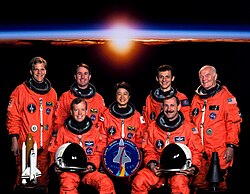
To prepare for the rigors of space, Duque underwent extensive training in both the United States and Russia. His first major milestone came as a mission specialist on the Space Shuttle mission STS-95, where he was responsible for supervising ESA experimental modules.
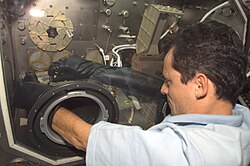
In October 2003, Duque returned to space via a Soyuz TMA ship for a short-term visit to the International Space Station (ISS) during a crew changeover. This specific scientific program was designated by ESA and Spain as Misión Cervantes.
Bridging Academia and Private Enterprise
Returning to Earth, Duque transitioned into roles that merged his practical experience with academic leadership. In 2003, he joined the UPM School of Aeronautical Engineers as the head of operations for the Spanish USOC, where he also lectured on space science and operations.
His expertise soon transitioned into the private sector. In 2006, he became the CEO of Deimos Imaging. Under his leadership, the company achieved a significant milestone in 2009 by launching Deimos 1, the first Spanish earth observation satellite. This satellite was designed for critical applications in forestry, wildfire detection, and agriculture. Duque later ascended to the role of executive president of the company in 2011.
Return to the European Space Agency
In October 2011, Duque returned to the ESA to resume his duties as an astronaut. He took on a leadership role as the head of the Flight Operations Office until 2015, overseeing ESA's operations on the ISS. His commitment to training continued in 2016 through his participation in ESA CAVES, and he subsequently managed the review of future crewed flights within the astronaut corps.
Political Career and Ministerial Leadership
Following a vote of no confidence in the government of Mariano Rajoy in June 2018, Pedro Sánchez appointed Duque as the Minister of Science, Innovation and Universities.
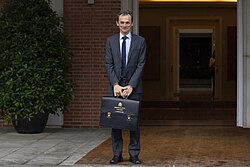
During his tenure, Duque focused on strengthening Spain's presence in the global space community. In April 2019, he announced a funding increase of €701 million for the ESA between 2020 and 2026 to ensure Spain's contribution remained proportional to its economy. He was elected as a Member of Parliament (MP) for Alicante in the 2019 general elections. In January 2020, his role was refined to Minister of Science and Innovation, while university affairs were transferred to Manuel Castells.
Recent Appointments and Strategic Roles
After leaving politics, Duque continued to influence the aerospace sector. In May 2022, he joined the strategic committee of Destinus as an advisor, contributing to the development of a hypersonic liquid hydrogen aircraft. Most recently, in December 2023, he was appointed as the chair of Hispasat.
Key Facts
- Education: Degree in aeronautical engineering from Universidad Politécnica de Madrid (1986).
- Space Missions: Mission specialist on STS-95 and participant in Misión Cervantes (ISS).
- Corporate Leadership: Former CEO and Executive President of Deimos Imaging.
- Government Service: Minister of Science, Innovation and Universities (2018–2020).
- Financial Impact: Increased Spain's ESA contribution by €701 million (2020–2026).
- Current Roles: Advisor to Destinus and Chair of Hispasat.
| Period/Year | Role/Achievement | Organization |
|---|---|---|
| 1986 | Aeronautical Engineering Degree | UPM |
| 1992 | Selected as Astronaut Candidate | ESA |
| 1998 | Mission Specialist (STS-95) | NASA/ESA |
Frequently Asked Questions
What was Misión Cervantes?
Misión Cervantes was the name given by ESA and Spain to the scientific program during Pedro Duque's visit to the International Space Station in October 2003.
What was the significance of the Deimos 1 satellite?
Deimos 1 was the first Spanish earth observation satellite, launched in 2009 for use in agriculture, forestry, and the detection and control of wildfires.
How did Pedro Duque impact Spain's relationship with the ESA?
As Minister of Science, Innovation and Universities, he announced an increase of €701 million in Spain's contribution to the ESA between 2020 and 2026.
What is Pedro Duque's current role in the aerospace industry?
He currently serves as the chair of Hispasat and is an advisor to the strategic committee of Destinus, a company developing hypersonic liquid hydrogen aircraft.