Oxford University Press: A History of Scholarly Publishing
From its humble beginnings in the late 15th century to its status as a global leader in academic publishing, Oxford University Press (OUP) has shaped the dissemination of knowledge for centuries. What started as a series of royal grants and fragmented printing efforts evolved into a sophisticated international operation, bridging the gap between elite scholarship and public education.
Early Origins and Royal Privileges (1480–1668)
Printing at the University of Oxford began around 1480, focusing primarily on scholarly works, prayer books, and Bibles. The legal foundation of the press was solidified in the 1630s by Archbishop William Laud, the university's chancellor. Laud successfully petitioned King Charles I for rights that allowed Oxford to compete with the King's Printer and the Stationers' Company.
A pivotal moment occurred in 1636 with the "Great Charter," which granted the university the right to print "all manner of books." Additionally, Laud secured the exclusive privilege of printing the King James Version (Authorized Version) of the Scripture, a venture that provided significant financial returns for the next 250 years.
The Establishment of the Central Print Shop (1668–1830)
In 1668, Vice-chancellor John Fell—who also served as the Dean of Christ Church and Bishop of Oxford—established the university's first central print shop. Fell was an ambitious visionary who drafted a comprehensive printing program. His goals included publishing the Bible in Greek, Coptic Gospels, works of the Church Fathers, texts in Arabic and Syriac, and a detailed history of insects.
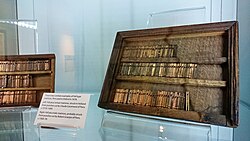
While the press saw early success—including the launch of the Oxford Almanack in 1674, which ran uninterrupted until 2019—the early 18th century experienced a period of stagnation. The business was eventually rescued by William Blackstone, a Delegate who implemented sweeping administrative and accounting reforms by 1760 to ensure efficiency.
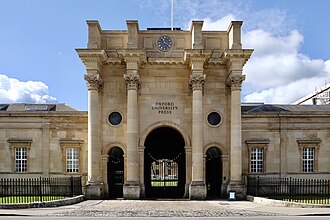
By the late 18th century, the press began to expand its physical footprint. In 1825, the Delegates purchased land on Walton Street, and by 1830, the press moved into new buildings designed by Daniel Robertson and Edward Blore.
Commercial Expansion and the Rise of Modern Publishing (1830–1900)
The mid-19th century was a period of transition. Under the leadership of Thomas Combe (Printer from 1830 to 1872), the press remained a joint-stock business. While Combe was a successful businessman who acquired the Wolvercote paper mill, he was less focused on innovation or fine printing. Notably, his shop produced the flawed first edition of Lewis Carroll's Alice's Adventures in Wonderland in 1865.
The press was modernized under Secretary Bartholomew Price, appointed in 1868. Price introduced "vigilant superintendence" to the business and collaborated with Alexander Macmillan to create the Clarendon Press series of affordable school books. Price also expanded the press's intellectual reach, approving the Sacred Books of the East series in 1875 under Friedrich Max Müller.
By 1880, OUP had transitioned into a full-scale publisher. Henry Frowde was appointed Publisher to the university, overseeing the publication of the Revised Version of the New Testament (1881) and the opening of the first overseas office in New York City in 1896. By 1884, the university bought back all shares, gaining full ownership of the print shop, bindery, and paper mill.
The Oxford English Dictionary (OED)
One of the most ambitious projects in publishing history began in 1879 when OUP took on the "New English Dictionary," offered by James Murray and the Philological Society. Originally estimated to take ten years and cost £9,000, the project proved far more complex. The first edition was not completed until 1928—13 years after Murray's death—with a final cost of approximately £375,000.
Global Reach and the Contemporary Era (1900–Present)
In the 20th century, OUP expanded its global footprint. By 1928, the press had imprints and depots in cities including London, Leipzig, Toronto, Melbourne, Cape Town, Bombay, Calcutta, Madras, and Shanghai. India, in particular, became a vital hub for distribution to Africa and Southeast Asia.
The press also diversified into music publishing in 1923 by acquiring the Anglo-French Music Company. This move allowed OUP to promote national music outside the German mainstream, though the department did not become profitable until 1939.
Despite the challenges of the Great Depression, which were mitigated by reorganization in the New York office by Geoffrey Cumberlege, OUP continued to grow. In the United States, OUP USA eventually published eighteen Pulitzer Prize-winning books. However, the era of physical printing came to an end on August 27, 2021, when OUP closed its printing division, Oxuniprint.
The Clarendon Press Imprint
The name "Clarendon Press" originated in 1713 when printing moved to the Clarendon Building on Broad Street. For a time in the 20th century, the label was used to distinguish books printed in Oxford from those published by the London office (which used "Oxford University Press"). Today, the Clarendon Press name is reserved as a prestigious imprint for academic publications of particular importance.
Key Facts
- Founded: Printing began around 1480; central print shop established in 1668.
- The Great Charter (1636): Granted the right to print "all manner of books."
- OED: The first edition of the Oxford English Dictionary took from 1884 to 1928 to complete.
- Global Expansion: First overseas office opened in New York City in 1896.
- Diversification: Established a Music Department in 1923.
- End of Printing: The printing division, Oxuniprint, closed in August 2021.
| Period | Key Focus | Major Milestone |
|---|---|---|
| 1480–1668 | Early Printing | Royal grants and the Great Charter (1636) |
| 1668–1830 | Institutionalization | Establishment of central print shop by John Fell |
| 1830–1900 | Modernization | Launch of the OED and global expansion |
| 1900–Present | Globalization | International depots and transition to digital/publishing |
Frequently Asked Questions
What is the difference between Oxford University Press and Clarendon Press?
Historically, Clarendon Press referred to books printed in Oxford, while Oxford University Press referred to those from the London office. Currently, Clarendon Press is used as a specific imprint for academic works of high importance.
Who was responsible for the first central print shop at Oxford?
Vice-chancellor John Fell established the university's first central print shop in 1668, creating a formal program for scholarly and scientific works.
How long did it take to complete the first edition of the OED?
The project began appearing in print in 1884, but the first edition was not completed until 1928, taking 44 years to finish.
When did OUP stop its own printing operations?
OUP closed its printing division, known as Oxuniprint, on August 27, 2021, ending centuries of in-house printing.
What was the significance of the Great Charter of 1636?
The Great Charter gave the University of Oxford the legal right to print "all manner of books," allowing it to compete with the King's Printer and the Stationers' Company.