Imperial Gazetteer of India: A Historical Reference of the British Empire
The Imperial Gazetteer of India stands as one of the most comprehensive historical reference works documenting the British Indian Empire. Originally conceived as a gazetteer—a geographical dictionary or directory used to provide statistics and summary information about specific places—it served as a vital administrative and scholarly tool for the British administration in India.
The project was the vision of Sir William Wilson Hunter, who began planning the work in 1869. Over several decades, the publication evolved from a modest set of volumes into a massive encyclopedic undertaking, capturing the geography, history, and administration of the region.
Key Facts
- First Published: 1881.
- Original Architect: Sir William Wilson Hunter.
- New Editions: Published in 1908, 1909, and 1931 by Oxford University Press.
- Scope: Covers descriptive, historical, economic, and administrative aspects of India.
- Format: Includes encyclopedic volumes, alphabetical gazetteers, an index, and an atlas.
Evolution of the Editions
The Early Editions
The first edition of the Imperial Gazetteer of India was released in 1881, consisting of nine volumes. As the need for more detailed information grew, a second edition was issued between 1885 and 1887, expanding the work to fourteen volumes.
In 1893, a revised and significantly enlarged version of the article on India was published as a standalone volume titled The Indian Empire: Its Peoples, History, and Products. This volume provided updated statistics and a deeper dive into the region's demographics and economy. All of these early efforts were edited by Sir William Wilson Hunter.
The New Editions (1908–1931)
Following the death of Sir William Wilson Hunter in 1900, the work was compiled by a team including Sir Herbert Hope Risley, William Stevenson Meyer, Sir Richard Burn, and James Sutherland Cotton. These "New Editions," published by the Clarendon Press (Oxford University Press), expanded the work to 26 volumes.
The structure of these later editions was highly organized: the first four volumes focused on the Indian Empire (Descriptive, Historical, Economic, and Administrative), followed by 20 volumes of alphabetical listings, and concluding with a dedicated index and an atlas.
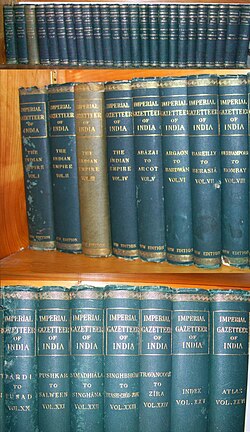
Provincial Series
To complement the main work, a parallel series of publications known as the Imperial Gazetteer of India: Provincial Series was also prepared, providing more localized detail on specific provinces.
Summary of Publication History
The following table outlines the growth and structure of the Imperial Gazetteer across its primary iterations.
| Edition | Publication Date | Number of Volumes | Publisher |
|---|---|---|---|
| First Edition | 1881 | 9 | Trübner & Co. |
| Second Edition | 1885–1887 | 14 | Trübner |
| New Editions | 1908, 1909, 1931 | 26 | Oxford University Press |
Frequently Asked Questions
Who was responsible for the original plan of the Imperial Gazetteer of India?
Sir William Wilson Hunter created the original plans for the work in 1869 and edited the first two editions.
What is the difference between the early editions and the "New Editions"?
The early editions (1881 and 1885–87) were smaller in scale and published by Trübner. The New Editions (1908, 1909, and 1931) were expanded to 26 volumes, published by Oxford University Press, and included specialized volumes for the atlas and general encyclopedic data.
What specific topics did the four encyclopedic volumes cover?
The first four volumes of the New Editions focused on the Descriptive, Historical, Economic, and Administrative aspects of the Indian Empire.
Who compiled the 26-volume edition after Sir William Wilson Hunter's death?
The 26-volume work was compiled by Sir Herbert Hope Risley, William Stevenson Meyer, Sir Richard Burn, and James Sutherland Cotton.
What was the purpose of the Provincial Series?
The Provincial Series was a parallel set of publications designed to provide more specific, localized information than what was available in the general Imperial Gazetteer.