Orkney IslandsScotlandKirkwallNorse historyScapa Flow

Orkney Islands: A Journey Through History, Nature, and Innovation

Orkney Islands: A Journey Through History, Nature, and Innovation Situated in the Northern Isles of Scotland, the Orkney Islands are a breathtaking archipelago where ancient history meets...

Orkney Islands: A Journey Through History, Nature, and Innovation

Situated in the Northern Isles of Scotland, the Orkney Islands are a breathtaking archipelago where ancient history meets cutting-edge sustainability. Known for their dramatic coastlines, Neolithic monuments, and a unique blend of Scottish and Norse heritage, these islands offer a glimpse into the evolution of human civilization in the North Atlantic.

From the bustling hub of Kirkwall to the remote shores of North Ronaldsay, Orkney is defined by its relationship with the sea and its ability to adapt across millennia.
ภาพประกอบบทความ
ภาพประกอบจากบทความต้นฉบับ
: ภาพประกอบจากบทความต้นฉบับ

Key Facts

ภาพประกอบบทความ
ภาพประกอบจากบทความต้นฉบับ
  • Total Area: 990 km² (380 sq mi).
  • Population: 22,020 as of 2024.
  • Highest Point: Ward Hill, reaching 481 meters (1,578 ft).
  • Largest Settlement: Kirkwall.
  • Administrative Status: Council area of Scotland, United Kingdom.
  • Unique Wildlife: Home to the seaweed-eating North Ronaldsay sheep.

A Tapestry of History
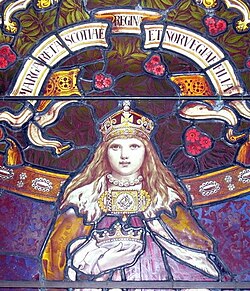
Margaret depicted in the Lerwick Town Hall
Lerwick Town Hall stained glass window depicting "Margaret, queen of Scotland and daughter of Norway"

Prehistory and the Iron Age

Orkney is world-renowned for its prehistoric sites. The islands served as a center for early human settlement, featuring complex structures from the Neolithic and Iron Age. Notable sites include the Ring of Brodgar and various brochs—thick-walled stone towers characteristic of Iron Age Scotland.
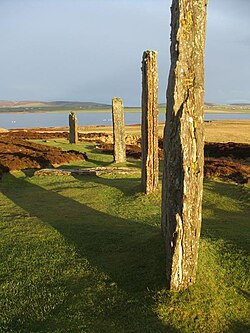
Four large standing stones sit in a field of grass and heather. They are illuminated by reddish sunlight and they cast long shadows to the left. A lake and low hills lie beyond.
Ring of Brodgar, on the island of Mainland, Orkney
: Ring of Brodgar, on the island of Mainland, Orkney

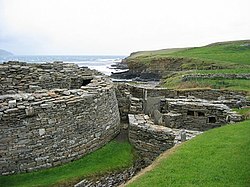
A semi-circular stone wall at left hints at the existence of a large and ancient building and to the right are the ruins of various other stone structures. In the background a low cliff divides a body of water from grassy fields.
Midhowe Broch on the west coast of Rousay
: Midhowe Broch on the west coast of Rousay

The Norse Era and Scottish Integration

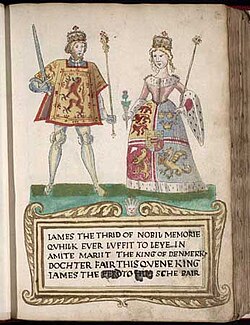
The islands were heavily influenced by Norwegian rule, beginning with figures like Harald Fairhair, who took control in 875. This Norse period left a lasting mark on the local dialect, place names, and architecture. The transition to Scottish rule was gradual, eventually solidified through political betrothals, such as that of James III and Margaret of Norway.
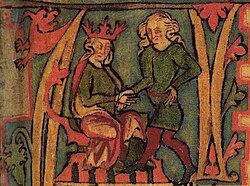
A page from an illuminated manuscript shows two male figures. On the left, a seated man wears a red crown and on the right, a standing man has long fair hair. Their right hands are clasped together.
According to the Orkneyinga Saga, Harald Fairhair (on the right, with fair hair) took control of Orkney in 875. He is shown here inheriting his kingdom from his father Halfdan the Black, in an illustration from the Flateyjarbók.
: According to the Orkneyinga Saga, Harald Fairhair (on the right, with fair hair) took control of Orkney in 875. He is shown here inheriting his kingdom from his father Halfdan the Black, in an illustration from the Flateyjarbók.

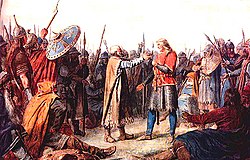
A group of warriors in medieval garb surround two men whose postures suggest they are about to embrace. The man on the right is taller, has long fair hair and wears a bright red tunic. The man on the left his balding with short grey hair and a white beard. He wears a long brown cloak.
Artist's conception of King Olaf Tryggvason of Norway, who forcibly Christianised Orkney.[67] Painting by Peter Nicolai Arbo.
: Artist's conception of King Olaf Tryggvason of Norway, who forcibly Christianised Orkney.[67] Painting by Peter Nicolai Arbo.

The spiritual heart of this era remains the St Magnus Cathedral in Kirkwall, a testament to the islands' medieval significance.
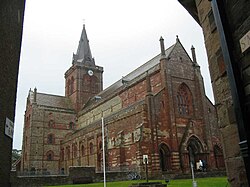
A large church made from red and yellow stone with a square tower and a spire on the tower.
St Magnus Cathedral in Kirkwall
: St Magnus Cathedral in Kirkwall

A picture on a page in an old book. A man at left wears tights and a tunic with a lion rampant design and holds a sword and sceptre. A woman at right wears a dress with an heraldic design bordered with ermine and carries a thistle in one hand and a sceptre in the other. They stand on a green surface over a legend in Scots that begins "James the Thrid of Nobil Memorie..." (sic) and notes that he "marrit the King of Denmark's dochter."
James III and Margaret, whose betrothal led to Orkney passing from Norway to Scotland.
: James III and Margaret, whose betrothal led to Orkney passing from Norway to Scotland.

The 20th Century and Military Significance

In the modern era, Orkney played a critical strategic role during the World Wars, particularly through Scapa Flow, a natural harbor used by the British Home Fleet. The legacy of this period is still visible today in the Italian Chapel, built by prisoners of war.
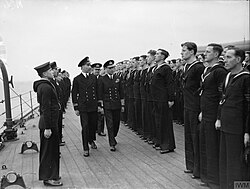
King George VI visiting the Home Fleet based at Scapa Flow, March 1943
: King George VI visiting the Home Fleet based at Scapa Flow, March 1943

The Italian Chapel on Lamb Holm was built and decorated by Italian prisoners of war working on the Churchill Barriers.[105]
: The Italian Chapel on Lamb Holm was built and decorated by Italian prisoners of war working on the Churchill Barriers.[105]

Geography and Natural World

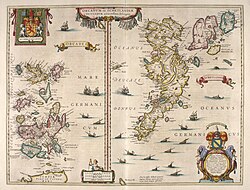
An old map of two island groups with the Orcades at left and Schetlandia at right. A coat of arms at top left shows a red lion rampant on a yellow shield flanked by two white unicorns. A second heraldic device is shown at the bottom right below the Oceanus Germanicus. This has two mermaids surrounding a tabula containing very small writing, topped by a yellow and blue shield.
Blaeu's 1654 map of Orkney and Shetland. Mapmakers at this time continued to use the original Latin name Orcades.

Island Layout and Geology

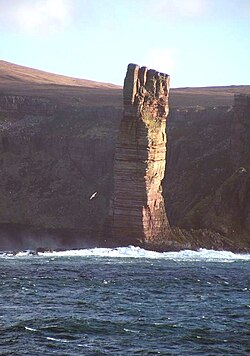
The archipelago is divided into the Mainland and various smaller islands. The geology is diverse, featuring dramatic cliffs and sea stacks, most notably the Old Man of Hoy.
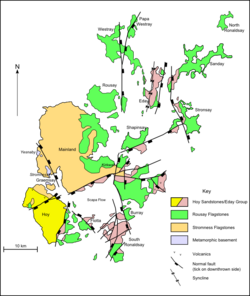
A map of the geology of Orkney. Hoy to the southwest is predominantly formed from Hoy/Eday Sandstones. The Mainland at centre is largely Stromness flagstones with Rousay flagstones to the east. The North and South Isles are a mixture of Eday and Rousay sandstones.
Geology of Orkney
: Geology of Orkney

A tall perpendicular stack of brown rock stands in the sunlight in front of a shore with high cliffs that lie in the shadows.
The Old Man of Hoy
: The Old Man of Hoy

Climate and Environment

Orkney experiences a maritime climate with cool summers and mild winters. Precipitation is distributed throughout the year, with the highest rainfall typically occurring in November and December. The environment supports unique species, including the semi-feral North Ronaldsay sheep, which have evolved a specialized diet of seaweed.

North Ronaldsay sheep are a semi-feral breed that has evolved to eat seaweed.[170] Their unique genetic inheritance makes them of interest to conservationists.[171]
: North Ronaldsay sheep are a semi-feral breed that has evolved to eat seaweed.[170] Their unique genetic inheritance makes them of interest to conservationists.[171]

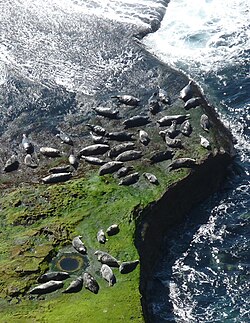
Seals hauled out at Lyrie Geo on Hoy
: Seals hauled out at Lyrie Geo on Hoy

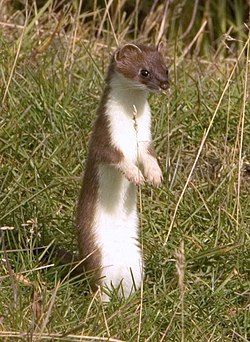
Stoat
Stoat
: Stoat

Modern Economy and Innovation

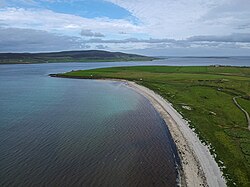
Aerial image of Sands of Evie, a beach near Stenso, Mainland

Sustainable Energy Leadership

Today, Orkney is a global leader in renewable energy. The islands are pioneering projects in wind, wave, and hydrogen manufacturing. The European Marine Energy Centre (EMEC) serves as a primary site for testing wave and tidal energy technologies.
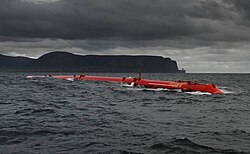
A long red tube lies in the water under dark, cloud-covered skies with black hills in the distance.
Pelamis on-site at EMEC's wave testing site off Billia Croo
: Pelamis on-site at EMEC's wave testing site off Billia Croo

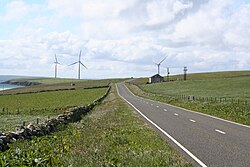
Wind turbines, Sanday
: Wind turbines, Sanday

Tourism and Transport

Tourism is a vital economic driver, fueled by the islands' heritage sites and natural beauty. Transport between the islands is maintained by a fleet of ferries, while connections to the mainland are provided by air and sea routes from Aberdeen, Lerwick, and Gills Bay.
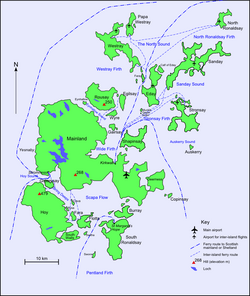
 A map of the Orkney archipelago showing main water transport routes. A small island with a high elevation is at the southwest. At centre is the largest island, which also has low hills. Ferry routes spread out from there to the smaller islands in the north.
Map of Orkney showing main transport routes
: Map of Orkney showing main transport routes

MV Earl Thorfinn arrives at Westray. Orkney Ferries operate a fleet of inter-island ferries.[231]
: MV Earl Thorfinn arrives at Westray. Orkney Ferries operate a fleet of inter-island ferries.[231]

Demographics and Administration

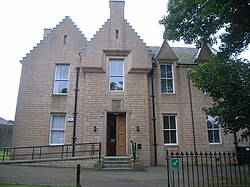
Kirkwall Sheriff Court, completed 1877: Orkney's main courthouse, also served as headquarters of Orkney County Council 1890–1975

The population is concentrated primarily on the Mainland, with Kirkwall serving as the administrative and commercial center. The islands are governed by the Orkney Islands Council.

Population Distribution by Island (2011)
Island Population
Orkney Mainland 17,162
South Ronaldsay 909
Westray 588
Sanday 494
Hoy 419
Burray 409
Stronsay 349
Shapinsay 307
Rousay 216
Eday 160

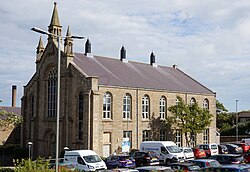
Council Offices on School Place, Kirkwall
: Council Offices on School Place, Kirkwall

Frequently Asked Questions

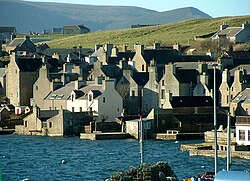
Stone houses crowd around a shore, the gable ends facing the water, with green hills beyond.
Stromness on the Mainland is the second-largest settlement in Orkney.
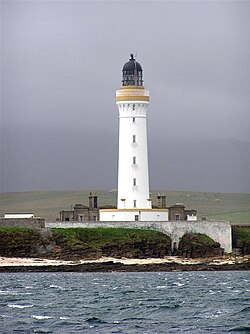
 A tall white lighthouse with a brown stripe around the parapet and dark coloured lantern sits on a rocky shore. A white wall obscures the lower floor of grey stone buildings gathered around its base.
Hoy High Lighthouse on Graemsay
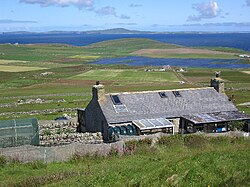
Farms and fields on Rousay
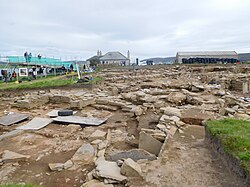
Excavations by UHI Archaeology Institute at the Ness of Brodgar have contributed to Orkney's heritage tourism.
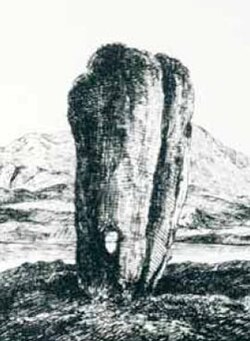
 A black and white line drawing of a tall standing stone that is wider at the top than the base. It has a long vertical crack on the right-hand side and there is a small hole that goes right through it near the ground. A lake and hill are in the background.
The Odin Stone
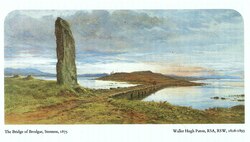
The Bridge of Brodgar, Stenness, 1875 by Walter Hugh Patton (1828–1895)

What is the largest town in Orkney?

Kirkwall is the largest settlement in Orkney, serving as the main administrative and commercial hub.

How did Orkney become part of Scotland?

Orkney was originally under Norwegian rule. It passed to Scotland following a betrothal between James III of Scotland and Margaret of Norway.

What makes the North Ronaldsay sheep unique?

These sheep are a semi-feral breed that has evolved to survive primarily on a diet of seaweed, making them a point of interest for conservationists.

What is Scapa Flow?

Scapa Flow is a large natural harbor in Orkney that was of immense strategic importance to the British Home Fleet during the 20th century, particularly during the World Wars.

Is Orkney involved in renewable energy?

Yes, Orkney is a pioneer in sustainable energy, focusing on wind and wave power, and is actively developing hydrogen manufacturing capabilities.