Home Fleet: The Royal Navy's Guardian of British Waters
The Home Fleet was a cornerstone of the United Kingdom's maritime defense, serving as a primary naval formation of the Royal Navy. Operating within British territorial waters from 1902 until 1967, this fleet underwent numerous reorganizations to adapt to the evolving threats of the 20th century, from the dreadnought race of the pre-war era to the strategic tensions of the Cold War.
Throughout its existence, the Home Fleet acted as the first line of defense for the British Isles, ensuring the security of trade routes and preventing enemy breakouts into the Atlantic. In 1967, the formation reached its conclusion when it was merged with the Mediterranean Fleet to create the Western Fleet.
Key Facts
- Active Periods: 1902–1904, 1907–1914, and 1932–1967.
- Primary Role: Defense of United Kingdom territorial waters and European sea lanes.
- WWII Base: Scapa Flow was the primary operational base for intercepting enemy ships.
- Major Achievement: The sinking of the German battleship Scharnhorst during the protection of convoy JW55B.
- Final Transition: Amalgamated into the Western Fleet in December 1967.
Evolution Before the First World War
The origins of the Home Fleet were marked by frequent structural changes. In 1902, the Admiralty established the Home Squadron as a permanent force. By 1905, this was renamed the Channel Fleet. However, in 1907, a new Home Fleet was formed using reserve and new vessels, eventually absorbing the Channel Fleet in 1909 to become the principal force in British waters.
By 1912, the organization evolved into the Home Fleets, consisting of the First, Second, and Third Fleets. This unified command lasted until the outbreak of the First World War on August 4, 1914, when the First Fleet was renamed the Grand Fleet under the command of Admiral John Jellicoe.
The Inter-war Period and Rebirth
Following the disbandment of the Grand Fleet in 1919, the name "Home Fleet" was briefly used for the reserve fleet before disappearing again. It was resurrected in March 1932, replacing the Atlantic Fleet following the Invergordon Mutiny.
By 1933, under Admiral Sir John Kelly, the fleet was a formidable force. Its composition included the flagship Nelson, the 2nd Battle Squadron, the Battlecruiser Squadron (featuring Hood and Renown), the 2nd Cruiser Squadron, three destroyer flotillas, a submarine flotilla, and two aircraft carriers.
The Home Fleet in the Second World War
During the Second World War, the Home Fleet served as the Royal Navy's main battle force in European waters. Based at Scapa Flow, its primary strategic objective was to prevent the German Kriegsmarine from breaking out of the North Sea.
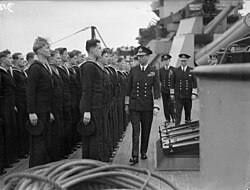
The fleet was heavily involved in protecting the Arctic Convoys (PQ, QP, JW, and RA) traveling between the UK, Iceland, and Russia. A crowning achievement occurred under Admiral Sir Bruce Fraser, sailing in HMS Duke of York, with the sinking of the battleship Scharnhorst. As the Battle of the Atlantic intensified, the Western Approaches Command was created to handle specific escort duties. After the destruction of the Tirpitz in 1944, the Home Fleet's priority decreased, and many of its heavy units were redeployed to the Far East.
Cold War Era and NATO Integration
In the post-war era, the Home Fleet shifted its focus toward protecting North Atlantic sea lanes from the Soviet Union. This period saw increased cooperation with Western allies, including combined exercises with French and Dutch navies in 1949.
With the establishment of NATO in 1953, the Commander-in-Chief, Home Fleet, took on the additional role of Commander-in-Chief, Eastern Atlantic (CINCEASTLANT), headquartered at Northwood in northwest London. The fleet continued to evolve, incorporating guided missile destroyers and aircraft carriers like Victorious and Albion.
By the 1960s, the command structure moved permanently ashore to Northwood. In February 1963, remaining frigate and destroyer squadrons were merged into Escort Squadrons. The Home Fleet's history concluded in December 1966 when its remaining squadrons were disbanded, leading to the 1967 merger into the Western Fleet.
Summary of Home Fleet History
| Period | Designation/Status | Key Focus/Event |
|---|---|---|
| 1902–1914 | Home Squadron / Home Fleets | Pre-WWI reorganization and unification. |
| 1914–1919 | Grand Fleet (First Fleet) | Primary force during World War I. |
| 1932–1939 | Home Fleet (formerly Atlantic Fleet) | Inter-war buildup and deterrence. |
| 1939–1945 | Home Fleet | WWII blockade of North Sea and Arctic Convoys. |
| 1945–1967 | Home Fleet / CINCEASTLANT | Cold War defense and NATO integration. |
Frequently Asked Questions
What was the primary purpose of the Home Fleet during WWII?
Its chief responsibility was to prevent the German Kriegsmarine from breaking out of the North Sea and to protect vital Arctic convoys traveling to and from Russia.
Where was the Home Fleet based during the Second World War?
The fleet was based at Scapa Flow, a location chosen for its strategic advantage in intercepting ships attempting to run the British blockade.
How did the Home Fleet relate to NATO?
Starting in 1953, the Commander-in-Chief of the Home Fleet also served as the Commander-in-Chief, Eastern Atlantic (CINCEASTLANT) within the NATO military command structure.
What happened to the Home Fleet in 1967?
The Home Fleet was amalgamated with the Mediterranean Fleet to form a new entity known as the Western Fleet.
Which notable battleship was the flagship in 1933?
The flagship of the Home Fleet in 1933 was the Nelson.