Oberste Heeresleitung: The Command Structure of the Imperial German Army
The Oberste Heeresleitung (OHL), or Supreme Army Command, served as the highest echelon of command for the Imperial German Army during the early 20th century. While initially designed as a military coordination body, the OHL evolved significantly during World War I. By the latter stages of the conflict, the Third OHL had transitioned from a strategic headquarters into a de facto political authority, wielding dictatorial power over the German Empire.
Formation and Operational Structure
Following the unification of the German Empire in 1871, the various regional armies—including the Prussian, Royal Saxon, Württemberg, and Bavarian forces—remained autonomous during peacetime. Each maintained its own general staff and war ministry. However, the Imperial Constitution designated the German Emperor as the Oberster Kriegsherr (Supreme Warlord), granting him command of the combined armies upon the outbreak of war.
In practice, the Emperor's role was largely ceremonial. Actual authority rested with the Chief of the German General Staff, who issued orders in the Emperor's name. The OHL was the command staff led by this Chief, supported by a complex network of specialized divisions:
- Central Division (Zentral-Abteilung): Managed internal General Staff affairs.
- Operations Division (Operationsabteilung): The core of the OHL, responsible for strategic planning and orders.
- Operations Division B: Established on August 15, 1916, to oversee the Turkish and Macedonia fronts.
- Operations Division II: Formed on September 23, 1916, by merging the heavy artillery section with the Field Munitions Service to manage the war economy.
- Information Division (Nachrichtenabteilung): Focused on military intelligence analysis; renamed the Foreign Armies Division in May 1917.
- Abteilung III b: Dedicated to espionage and counter-espionage.
- Political Division (Politische Abteilung): Handled legal matters and liaison with political authorities.
Beyond the General Staff, the OHL included the Emperor's Military Cabinet, the Intendant General for supplies, and various specialist advisers in fields such as medicine, telegraphy, and railways. Coordination with the Imperial German Navy (led by the Admiralty Staff and later the Seekriegsleitung or SKL) was notably poor; for instance, the navy was unaware of the Schlieffen Plan, the initial strategy to attack France via Belgium.
Key Facts
- Role: Highest command echelon of the Imperial German Army.
- Political Shift: The Third OHL became the de facto political authority of the Empire.
- Key Figures: Led by Helmuth von Moltke, Erich von Falkenhayn, and the duo of Paul von Hindenburg and Erich Ludendorff.
- Total War: Implemented the Hindenburg Programme to mobilize the entire economy for victory.
- Dissolution: Disbanded in July 1919 under the terms of the Treaty of Versailles.
The Evolution of Command: Three Phases of the OHL
The First OHL: Moltke and the Outbreak of War
At the start of World War I in 1914, the Großer Generalstab (Great General Staff) formed the core of the OHL under Colonel General Helmuth von Moltke. Moltke operated with a decentralized approach, delegating significant authority to subordinates like Colonel Gerhard Tappen and Lieutenant Colonel Richard Hentsch.
This delegation proved critical during the First Battle of the Marne. When communications broke down, Hentsch assessed a 25-mile gap between the 1st and 2nd Armies and ordered a retreat to the Aisne to avoid encirclement. The stress of the situation led Moltke to suffer a nervous breakdown on September 9, 1914.
The Second OHL: Falkenhayn and Attrition
Lieutenant General Erich von Falkenhayn took command in October 1914. Unlike Moltke, Falkenhayn centralized decision-making and maintained strict secrecy. His tenure was defined by the "Race to the Sea" and the First Battle of Ypres.
Falkenhayn faced a strategic divide: Field Marshal Paul von Hindenburg advocated for shifting resources to the Eastern Front to eliminate Russia, while Falkenhayn insisted that France and Great Britain were the primary threats. This led to the Battle of Verdun, where Falkenhayn attempted a strategy of attrition to wear down the French Army. The failure of this strategy, combined with the Battle of the Somme and Romania's entry into the war, led to his replacement in August 1916.
The Third OHL: The Hindenburg-Ludendorff Duumvirate
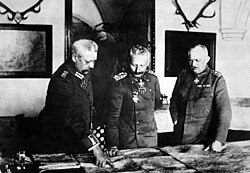
The Third OHL was led by Field Marshal Paul von Hindenburg, though he served primarily as a public figurehead. Actual control was exercised by his deputy, General Erich Ludendorff. Together, they functioned as military dictators, eventually displacing the Emperor and Chancellor Theobald von Bethmann Hollweg in political influence.
Under the Hindenburg Programme, the OHL pursued a "total war" strategy. This included the resumption of unrestricted submarine warfare—which provoked the United States to enter the war—and facilitating Vladimir Lenin's passage to Russia to destabilize the Eastern Front. After the Treaty of Brest-Litovsk, the OHL launched the 1918 spring offensive. However, following the Allied Hundred Days Offensive, Ludendorff called for an armistice and the parliamentarization of the government.
Armistice and Dissolution
During the German Revolution of 1918, Hindenburg and Lieutenant-General Wilhelm Groener (who replaced Ludendorff) advised the Emperor to abdicate. Groener entered the Ebert–Groener pact, ensuring the Army's support for the new republican government. The OHL moved through various locations, including Spa and Kassel, before finally settling in Kolberg to prevent Polish territorial encroachment.
The OHL and the Great General Staff were officially disbanded in July 1919 by the Treaty of Versailles.
| Commander | Term of Office | Primary Strategic Focus |
|---|---|---|
| Helmuth von Moltke | 1906 – Sept 1914 | Initial mobilization and Schlieffen Plan execution. |
| Erich von Falkenhayn | Sept 1914 – Aug 1916 | Centralized command and attrition (Battle of Verdun). |
| Paul von Hindenburg | Aug 1916 – July 1919 | Total war (Hindenburg Programme) and political dominance. |
Frequently Asked Questions
What was the primary role of the Oberste Heeresleitung?
The OHL was the supreme command of the Imperial German Army, responsible for the strategic planning, intelligence, and operational orders of the German war effort during World War I.
How did the Third OHL differ from the first two?
While the first two OHLs were primarily military headquarters, the Third OHL, led by Hindenburg and Ludendorff, assumed dictatorial political powers, effectively governing the German Empire during the latter part of the war.
What was the Hindenburg Programme?
The Hindenburg Programme was a total war strategy designed to mobilize all available German economic and industrial resources to achieve a decisive military victory.
Why was the relationship between the OHL and the Navy poor?
Coordination was lacking due to separate command structures; the OHL managed the army while the Admiralty Staff and Seekriegsleitung (SKL) managed the navy, leading to critical communication failures, such as the navy's ignorance of the Schlieffen Plan.
How was the OHL finally dissolved?
The OHL and the Great General Staff were disbanded in July 1919 as a direct requirement of the Treaty of Versailles following Germany's defeat in the war.