Erich Ludendorff: The Architect of German Strategy and Political Radicalism
Erich Ludendorff was a Prussian-born general and politician whose influence shaped the course of the First World War and the subsequent instability of the Weimar Republic. Rising from a non-noble background, Ludendorff became one of the most powerful men in the German Empire, eventually overseeing nearly every strategic decision of the war effort. His transition from a celebrated military tactician to a radical political figure highlights the turbulent intersection of militarism and nationalism in early 20th-century Germany.
Born on April 9, 1865, in Kruszewnia, Prussia, Ludendorff was the third of six children. Unlike many of his contemporaries in the high command, he did not come from the nobility, though his father was descended from Pomeranian merchants who had attained Junker status (land-owning nobility). This background did not hinder his ascent; after completing his cadet education, he was commissioned as a junior officer in 1885.
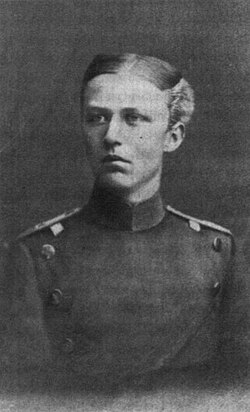
Early Military Career and the General Staff
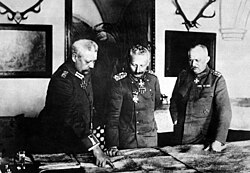
Ludendorff's early service was marked by consistent excellence. He served in the 57th Infantry Regiment, the 2nd Marine Battalion, and the 8th Grenadier Guards. His aptitude for strategy led him to the prestigious German War Academy in 1893, and by 1894, he was appointed to the General Staff. By 1904, he had joined the Army's Great General Staff, where he contributed to the development of the Schlieffen Plan, the strategic blueprint for a two-front war against France and Russia.
World War I: From Liège to Supreme Command
The Breakthrough at Liège
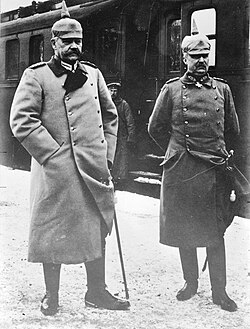
At the start of World War I in 1914, Ludendorff served as Deputy Chief of Staff to the German Second Army. He played a pivotal role in the Battle of Liège, Belgium, leading a successful assault to occupy the city and its citadel after the brigade commander was killed. His success in neutralizing the forts guarding the city allowed the German First Army to advance, earning him the Pour le Mérite, Germany's highest military decoration for gallantry.
Command in the East
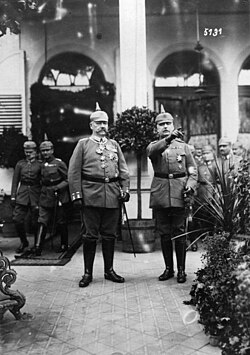
Ludendorff's fame grew through his partnership with Paul von Hindenburg. Together, they achieved significant victories on the Eastern Front, most notably at the Battle of Tannenberg. Their ability to stem Russian advances and secure victories in the East made them national heroes.
First Quartermaster General
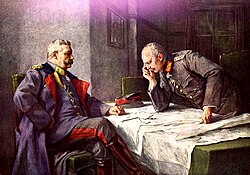
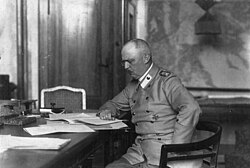
By August 29, 1916, the tide of war in the West was turning against Germany. Following the failures at Verdun and the Somme, Hindenburg was appointed Chief of the General Staff, and Ludendorff was named First Quartermaster General. In this role, Ludendorff held joint responsibility for the war effort, effectively overseeing virtually all strategic decisions for the German Empire until 1918.
Tactical Innovations and the Home Front
Ludendorff introduced the concept of elastic defense on the Western Front. Rather than packing defenders into a rigid front line, this doctrine utilized a lightly held front and a deeper battle zone where attackers were targeted by artillery and counterattacks. This shift significantly reduced German casualties relative to the British during the latter half of 1916.
Political Radicalization in the Weimar Republic
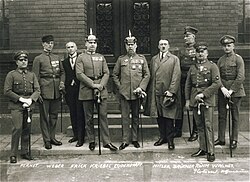
Following Germany's defeat in 1918, Ludendorff entered a period of political volatility. He became associated with right-wing movements that sought to overturn the new democratic order of the Weimar Republic. He participated in the failed Kapp Putsch of 1920, an attempted coup by Freikorps troops, and later supported Adolf Hitler's 1923 Beer Hall Putsch.
Ludendorff served as a member of the Reichstag from May 27, 1924, to July 1, 1928, representing the Reichswahlvorschlag. However, his later years were defined by increasing eccentricity and conspiracy theories. After marrying Mathilde von Kemnitz in 1925, the couple published works claiming that global problems were the result of conspiracies involving the Jesuits, Catholics, Freemasons, and Jews.
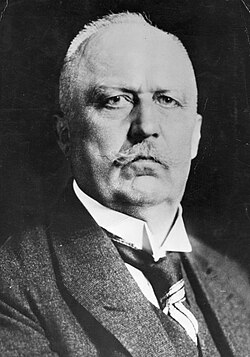
Key Facts
- Highest Rank: General der Infanterie.
- Key Role: First Quartermaster General of the Great General Staff (1916–1918).
- Major Victories: Played central roles in the victories at Liège and Tannenberg.
- Military Innovation: Developed the doctrine of elastic defense to reduce infantry losses.
- Political Activity: Involved in both the Kapp Putsch (1920) and the Beer Hall Putsch (1923).
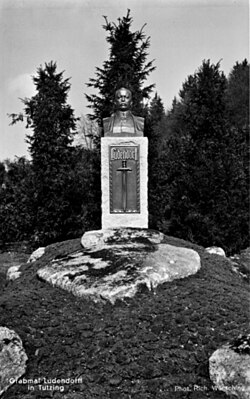
- Death: Died on December 20, 1937, in Munich, Germany.
| Period | Role/Position | Key Event/Contribution |
|---|---|---|
| 1885–1914 | Staff Officer | Development of the Schlieffen Plan |
| 1914 | Deputy Chief of Staff | Victory at the Battle of Liège |
| 1916–1918 | First Quartermaster General | Supreme strategic control of the German war effort |
| 1920–1923 | Political Activist | Participation in Kapp and Beer Hall Putsche |
| 1924–1928 | Reichstag Member | Political representation for right-wing factions |
Frequently Asked Questions
What was Ludendorff's role in World War I?
Ludendorff began as a staff officer and achieved fame for his tactical success at Liège and Tannenberg. By 1916, as First Quartermaster General, he effectively ran the German war effort, making the majority of strategic decisions until the end of the war in 1918.
What is "elastic defense"?
Elastic defense was a tactical shift where the front line was held lightly to minimize casualties from enemy artillery. Penetrating forces were then drawn into a "battle zone" where they were countered by concentrated artillery fire and organized counterattacks.
How did Ludendorff influence the rise of the Nazi Party?
Ludendorff provided military prestige to early right-wing radical movements. His participation in the 1923 Beer Hall Putsch alongside Adolf Hitler helped lend legitimacy to the nascent Nazi movement among nationalist and military circles.
What were Ludendorff's beliefs in his later years?
In his retirement, Ludendorff became obsessed with conspiracy theories. Along with his second wife, Mathilde, he wrote books claiming that Freemasons, Jesuits, and Jews were conspiring to control the world, and he founded the Bund für Gotteserkenntnis (Society for the Knowledge of God).
Who was Paul von Hindenburg in relation to Ludendorff?
Hindenburg was Ludendorff's superior and long-term partner in command. While Hindenburg often served as the public face and figurehead of the German military, Ludendorff was the primary strategist and administrator behind their joint successes.