North KoreaDPRKKim Jong UnPyongyangKorean Peninsula history

North Korea: A Comprehensive Profile of the Democratic People's Republic of Korea

Understanding the Democratic People's Republic of Korea The Democratic People's Republic of Korea (DPRK), commonly known as North Korea, is a unitary communist state located on the northe...

Understanding the Democratic People's Republic of Korea

The Democratic People's Republic of Korea (DPRK), commonly known as North Korea, is a unitary communist state located on the northern half of the Korean Peninsula. Characterized by its unique political structure and centralized governance, the nation has a complex history shaped by post-war division, ideological shifts, and a distinct cultural identity.
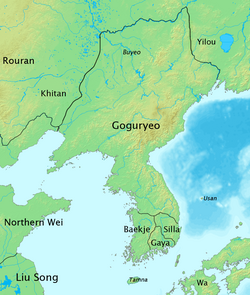
The name Korea is derived from Goguryeo, also known as Koryŏ, one of the Three Kingdoms of Korea.
: The name Korea is derived from Goguryeo, also known as Koryŏ, one of the Three Kingdoms of Korea.

Key Facts

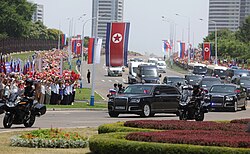
Motorcade transporting Russian President Vladimir Putin in Pyongyang, 19 June 2024
  • Capital: Pyongyang
  • Official Language: Korean (Munhwaŏ)
  • Official Script: Chosŏn'gŭl
  • Government Type: Unitary communist state
  • Current Leader: Kim Jong Un (WPK General Secretary and SAC President)
  • Total Area: 120,538 km²
  • Population: Approximately 25.95 million (2024 estimate)
  • Currency: Korean People's won (KPW)

Historical Context and Establishment
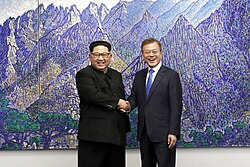
Kim Jong Un and South Korean President Moon Jae-in shake hands during the inter-Korean Summit, April 2018

The modern history of the DPRK is deeply rooted in the aftermath of World War II. Following the surrender of Japan on September 2, 1945, the Korean Peninsula underwent a period of transition. A Soviet administration was established north of the 38th parallel on October 3, 1945, leading to the formation of a provisional government in February 1946.
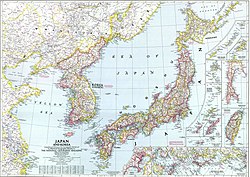
A 1945 National Geographic map of Korea, showing Japanese place names and provincial boundaries.
: A 1945 National Geographic map of Korea, showing Japanese place names and provincial boundaries.

The Democratic People's Republic of Korea was officially established on July 10, 1948. The nation's political landscape was further defined by the Korean War, a conflict where territory frequently changed hands before the front lines eventually stabilized.
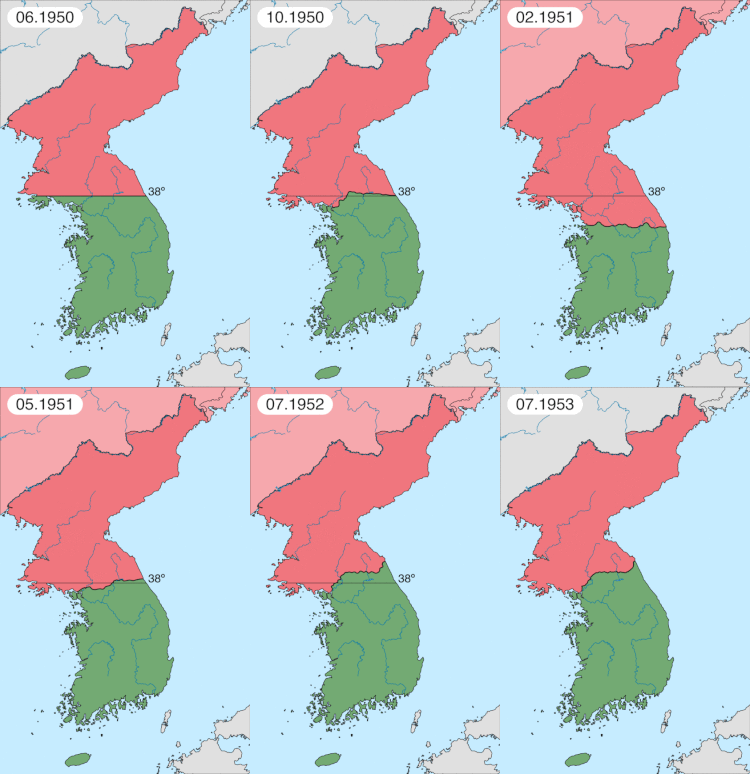
Territory often changed hands early in the war, until the front stabilized. North Korean, Chinese, and Soviet forces South Korean, U.S., Commonwealth, and United Nations forces
: Territory often changed hands early in the war, until the front stabilized. North Korean, Chinese, and Soviet forces South Korean, U.S., Commonwealth, and United Nations forces

The Leadership of the Kim Dynasty

The political structure of North Korea has been defined by the leadership of the Kim family. This lineage includes Kim Il Sung, Kim Jong Il, and the current leader, Kim Jong Un. The state operates under the guidance of the Workers' Party of Korea (WPK), with the Supreme People's Assembly serving as the legislature.
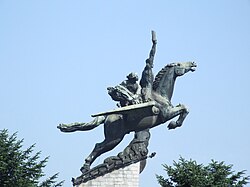
Statue of Chollima Movement in Pyongyang
: Statue of Chollima Movement in Pyongyang
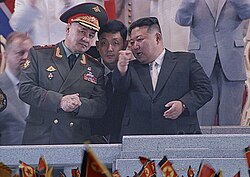
Kim Jong Un with Russian Defence Minister Sergei Shoigu during the ceremonies marking the 70th anniversary of the end of the Korean War in Pyongyang, 27 July 2023
: Kim Jong Un with Russian Defence Minister Sergei Shoigu during the ceremonies marking the 70th anniversary of the end of the Korean War in Pyongyang, 27 July 2023
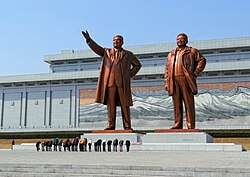
North Korean citizens paying respect to the statues of Kim Il Sung (left) and Kim Jong Il at the Mansudae Grand Monument
: North Korean citizens paying respect to the statues of Kim Il Sung (left) and Kim Jong Il at the Mansudae Grand Monument
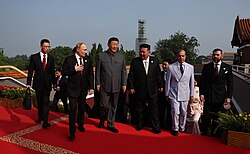
Kim Jong Un together with Russian president Vladimir Putin and Chinese leader Xi Jinping during the 2025 China Victory Day Parade
: Kim Jong Un together with Russian president Vladimir Putin and Chinese leader Xi Jinping during the 2025 China Victory Day Parade

Geography and Climate

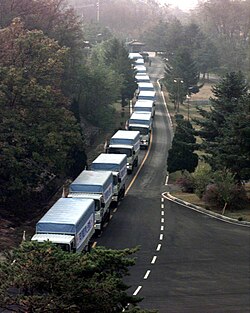
South Korean aid convoy entering North Korea through the Demilitarized Zone, 1998

North Korea covers a total area of 120,538 km², with very little water coverage (0.11%). The landscape is diverse, ranging from mountainous regions to coastal areas along the Yellow Sea and the Sea of Japan (also known as the East Sea).
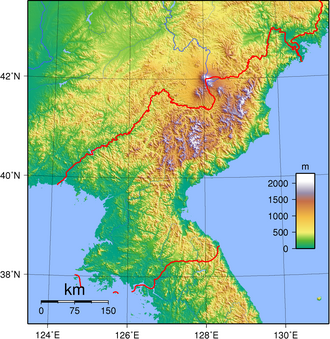
Topographic map of North Korea
: Topographic map of North Korea
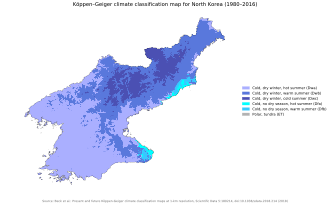
North Korea map of Köppen climate classification
: North Korea map of Köppen climate classification

Major Administrative Divisions

The country is divided into several provinces and special-level cities. Pyongyang serves as the capital and a directly governed city. Other significant administrative areas include:

  • Special Cities: Kaesong and Rason
  • Major Provinces: South Pyongan, North Pyongan, South Hwanghae, North Hwanghae, Chagang, Kangwon, South Hamgyong, North Hamgyong, Ryanggang, and South Pyongan.
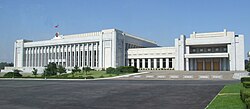
Mansudae Assembly Hall, seat of the Supreme People's Assembly
: Mansudae Assembly Hall, seat of the Supreme People's Assembly

Economy and Demographics

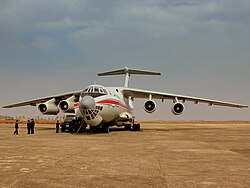
Ilyushin Il-76 strategic military airlifter used by Air Koryo

The economic landscape of the DPRK is characterized by specific GDP estimates. As of 2023, the estimated GDP (PPP) was $15.416 billion, with a per capita figure of $600. The 2024 nominal GDP estimate stands at $32.036 billion, with a per capita value of $1,261. The nation maintains a low Gini coefficient (16.6 as of 2020), indicating low income inequality.
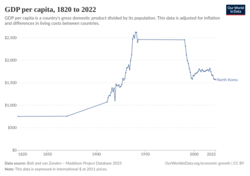
GDP per capita estimates from 1820 to 2022
: GDP per capita estimates from 1820 to 2022
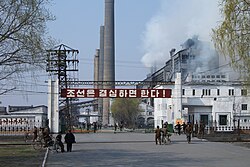
An industrial plant in Hamhung
: An industrial plant in Hamhung
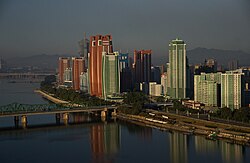
Mirae Scientists Street in Pyongyang
: Mirae Scientists Street in Pyongyang

Population and Urban Centers

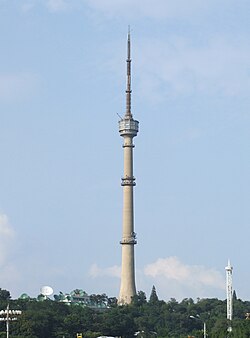
With a population estimated at 25.95 million in 2024, the country has a density of approximately 220/km². The largest urban center is Pyongyang, followed by Hamhung, Chongjin, and Nampo. Urban life in the capital is distinct, featuring landmarks like the Pyongyang TV Tower and various specialized residential streets.
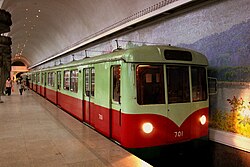
Pyongyang Metro with bomb shelter functions
: Pyongyang Metro with bomb shelter functions
The Pyongyang TV Tower, designed after the Ostankino Tower in Moscow
: The Pyongyang TV Tower, designed after the Ostankino Tower in Moscow : The name Korea is derived from Goguryeo, also known as Koryŏ, one of the Three Kingdoms of Korea.
Summary of North Korean Demographics and Economy
Category Data/Value
Estimated Population (2024) 25,950,000
Total Area 120,538 km²
Nominal GDP (2024 Est.) $32.036 billion
GDP Per Capita (Nominal) $1,261
Gini Index (2020) 16.6

Culture, Religion, and Society

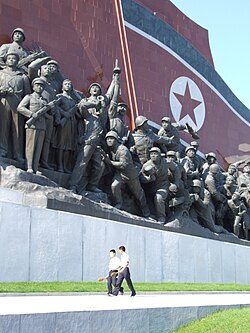
The Memorial of Soldiers at the Mansudae Grand Monument

Religion in North Korea is diverse but represents a small portion of the population. According to 2020 data, 72.9% of the population identifies as having no religion, while 13% follow Chondoism and 12% practice Shamanism. Buddhism accounts for 1.5%.
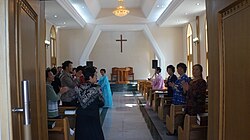
Chilgol Church in Pyongyang, where Kang Pan Sok—the mother of the late supreme leader Kim Il Sung—served as a Presbyterian deaconess
: Chilgol Church in Pyongyang, where Kang Pan Sok—the mother of the late supreme leader Kim Il Sung—served as a Presbyterian deaconess
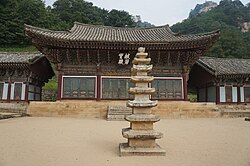
Pyohunsa Buddhist Temple, a National Treasure of North Korea
: Pyohunsa Buddhist Temple, a National Treasure of North Korea

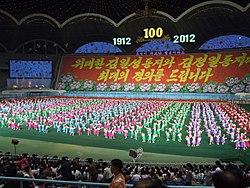
Cultural expression is visible through various mediums, including music, art, and large-scale performances like the Arirang Mass Games. The nation also maintains specific culinary traditions, such as yukhoe pibimpap.
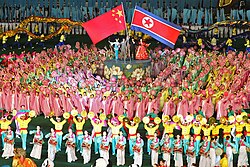
The close China-North Korea relationship is celebrated at the Arirang Mass Games in Pyongyang.
: The close China-North Korea relationship is celebrated at the Arirang Mass Games in Pyongyang.
A scene from the 2012 Arirang Festival
: A scene from the 2012 Arirang Festival
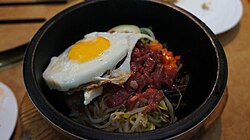
North Korean yukhoe pibimpap
: North Korean yukhoe pibimpap

Frequently Asked Questions

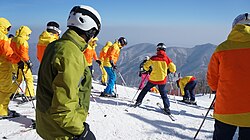
Foreign tourists in Masikryong Ski Resort
2017 composite satellite image of the Korean Peninsula at night, showing the difference in lighting between North and South Korea[257]
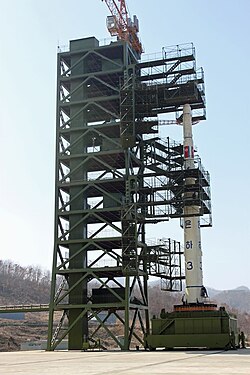
Unha-3 space launch vehicle at Sohae Satellite Launching Station
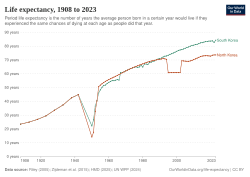
Development of life expectancy in North Korea and South Korea
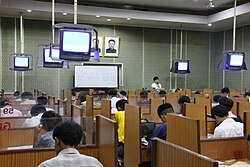
English lecture at the Grand People's Study House in Pyongyang
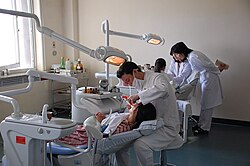
A dental clinic at Pyongyang Maternity Hospital
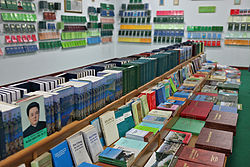
A North Korean bookstore with works of Kim Il Sung and Kim Jong Il
ภาพประกอบบทความ
ภาพประกอบจากบทความต้นฉบับ
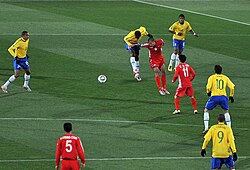
North Korea (in red) against Brazil at the 2010 FIFA World Cup

What is the official name of North Korea?

The official name is the Democratic People's Republic of Korea (DPRK).

What are the main languages spoken in the country?

The official language is Korean, specifically the Munhwaŏ dialect, and the official script used is Chosŏn'gŭl.

Who is the current leader of North Korea?

The current leader is Kim Jong Un, who holds the titles of General Secretary of the Workers' Party of Korea and President of the State Affairs of North Korea.

What is the capital city of North Korea?

The capital and largest city is Pyongyang.

How is the economy of North Korea measured?

The economy is measured using both GDP (PPP), which accounts for purchasing power parity, and Nominal GDP.

References

  1. North Korea is officially an atheist state. According to the U.S. Office of International Religious Freedom, North Korea is 58% agnostic and 15% atheist.[1]
  2. Including Christianity, Islam, and Chinese folk religion.
  3. The Supreme Leader of North Korea, who holds the titles of: General Secretary of the Workers' Party of Korea
  4. North Koreans use Chosŏn (Korean: 조선; Hanja: 朝鮮) when referring to North Korea or Korea as a whole. The literal translation of North Korea, Pukchosŏn (북조선; 北朝鮮), is rarely used, although it may be found in sources that predate the Korean War. South Koreans use Bukhan (Pukhan; 북한; 北韓) when referring to North Korea, derived from the South Korean name for Korea, Hanguk (Han'guk; 한국; 韓國).
  5. 조선민주주의인민공화국 (Hanja: 朝鮮民主主義人民共和國; MR: Chosŏnminjujuŭiinmin'gonghwaguk), also abbreviated as DPR Korea or Korea, DPR