Nightjars: The Secretive Nocturnal Birds of the Caprimulgidae Family
Nightjars are medium-sized birds known for their elusive nature and specialized lifestyles. Belonging to the family Caprimulgidae and the order Caprimulgiformes, these birds are primarily nocturnal (active at night) or crepuscular (active at dawn and dusk). They are easily identified by their long wings, short legs, and very short bills.
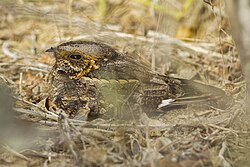
While the term "nightjar" originally referred to the European nightjar, it now encompasses a diverse group of species, including the nighthawks found in the New World. These birds have evolved a suite of physical adaptations that allow them to blend seamlessly into their environments, making them masters of camouflage.
Key Facts
- Global Presence: Found on every continent except Antarctica, including islands like New Caledonia and the Seychelles.
- Physical Traits: Characterized by long, pointed wings, small feet unsuitable for walking, and rictal bristles (stiff hairs around the mouth).
- Unique Behavior: The common poorwill is the only bird known to undergo a form of hibernation.
- Habitat: Most common in open country with some vegetation, ranging from sea level up to 4,200 meters.
- Conservation Risk: Roadkill is a significant cause of mortality due to their habit of roosting on roads.
Systematics and Classification
The Order Caprimulgiformes
The classification of these birds has undergone significant changes. Previously, the order Caprimulgiformes included several other groups, such as potoos, frogmouths, oilbirds, and owlet-nightjars. However, in 2021, the International Ornithological Congress redefined the order to apply exclusively to nightjars, moving the other groups into their own distinct orders. Phylogenetic research suggests that the extinct family Archaeotrogonidae, from the Eocene and Oligocene of Europe, are the closest known relatives of modern nightjars.
The Family Caprimulgidae
The family Caprimulgidae currently contains 22 genera. Historically, they were divided into two subfamilies: the typical nightjars (Caprimulginae) and the Chordeilinae (which include species with shorter bills and fewer rictal bristles). Modern molecular studies have shown that these divisions are not monophyletic, meaning they do not all share a single common ancestor. Recent taxonomic proposals in 2023 have suggested the introduction of monotypic genera—such as Antiurus, Quechuavis, and Tepuiornis—to better resolve these evolutionary relationships.
| Category | Details |
|---|---|
| Scientific Order | Caprimulgiformes |
| Scientific Family | Caprimulgidae |
| Number of Genera | 22 |
| Global Range | All continents except Antarctica |
| Key Subgroups | Nighthawks (New World), Eared Nightjars (Asia and Australia) |
Distribution, Habitat, and Behavior
Nightjars are highly adaptable and occupy a wide range of environments, from rainforests to deserts, though they generally avoid extremely arid desert regions. They are found at various elevations, with some species specializing in montane (mountain) habitats.
Many species are migratory. For example, the European nightjar and common nighthawk travel south for the winter. Research using geolocators has revealed that European nightjars from southern England winter as far south as the Democratic Republic of the Congo.
Adaptations and Survival
The plumage of the nightjar is designed for concealment, allowing them to hide during the day. However, they often possess pale spots or patches used for communication within their own species. One of the most remarkable physiological traits is found in the common poorwill (Phalaenoptilus nuttallii), which can enter a state of torpor—a significant reduction in body temperature and metabolic rate—for weeks or months, effectively hibernating.
Conservation and Status
Conservation efforts for nightjars are often hindered by the birds' secretive nature. In some cases, such as with Vaurie's nightjar in China, there is insufficient data to determine if a species is endangered or extinct because they are so difficult to locate.
Two primary threats affect the family: habitat loss and human infrastructure. Because nightjars frequently roost on roads, roadkill is a major cause of death. Additionally, since they nest directly on the bare ground, their eggs and chicks are vulnerable. While some ornithology texts suggest nightjars carry their young in their mouths to move them away from danger, scientific surveys have found very little evidence to support this claim.
Nightjars in Culture
The influence of nightjars extends into music and regional history. In the United States, Nebraska was once nicknamed the "Bugeater State," a reference to the common nighthawk. This moniker is still used today by a semi-professional soccer team in the state.
In the arts, nightjars appear in the lyrics of Elton John and Bernie Taupin's song "Come Down in Time." Additionally, musician Cosmo Sheldrake included nightjar calls in his album Wake up Calls, using the bird to symbolize the end of the night.
Frequently Asked Questions
What is the difference between a nightjar and a nighthawk?
Nighthawks are specific species of nightjars found in the New World (the Americas). While they share the same family characteristics, they are distinguished by certain physical traits like shorter bills.
Can nightjars really hibernate?
Yes, the common poorwill is unique among birds for its ability to undergo a form of hibernation, remaining torpid with a reduced body temperature for extended periods. Other nightjars can enter shorter states of torpor.
Why are nightjars often found on roads?
Nightjars have a habit of resting and roosting on roads, which unfortunately makes them highly susceptible to being killed by vehicles.
Where do nightjars build their nests?
Nightjars typically nest on the ground, laying one or two patterned eggs directly onto the bare earth rather than in a constructed nest.
Which continents are nightjars found on?
Nightjars are distributed across all continents except Antarctica, and they are also found on various island groups, including the Seychelles and New Caledonia.