New Zealand Spinach: A Comprehensive Guide to Tetragonia tetragonioides
Whether you are a home gardener looking for a hardy ground cover or a food enthusiast searching for nutrient-dense greens, New Zealand spinach (Tetragonia tetragonioides) is a fascinating plant to explore. Despite its common name, it is not a true spinach but a member of the Aizoaceae family, also known as the fig-marigold family. Known for its resilience and striking appearance, this leafy vegetable thrives where other greens might wither.
Key Facts
- Common Names: New Zealand spinach, Warrigal greens, Kōkihi, Botany Bay spinach, and Cook's cabbage.
- Native Range: Eastern Asia, Australia, and New Zealand.
- Primary Use: Edible leafy vegetable and ornamental ground cover.
- Defining Feature: A halophyte, meaning it is a salt-tolerant plant that grows well in saline ground.
- Nutritional Highlight: Exceptionally high in Vitamin K.
Botanical Description and Habitat
Tetragonia tetragonioides is characterized by its trailing growth habit, allowing it to form a dense carpet across the ground or climb through surrounding vegetation. While young plants may grow erect, they typically spread horizontally. The leaves are bright green, triangular in shape, and measure between 3 and 15 cm in length.
One of the plant's most distinct features is the presence of tiny papillae—small, bump-like protrusions—on both the top and bottom of the leaves, which give them the appearance of being covered in waterdrops. The plant produces yellow flowers and small, hard capsules containing four to ten horned seeds. Internally, the leaves, calyx, and ovary contain sphaeraphides, which are small, spherical crystal inclusions.
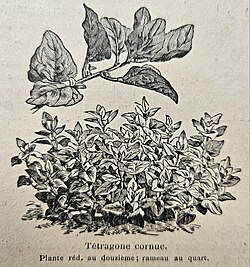
In its native environment, this species is typically found on sandy shorelines and bluffs, often in disturbed areas. Because of its adaptability, it has been introduced to Africa, Europe, North America, and South America, where it is sometimes classified as an invasive species.
Taxonomy and Regional Names
The plant was first described in 1781 by the Prussian naturalist Peter Pallas as Demidovia tetragonoides. It was later moved to the genus Tetragonia in 1891 by German botanist Otto Kuntze.
Depending on where it is grown, the plant carries various names. In New Zealand, it is known by the Māori name Kōkihi. In Australia, it is frequently called Warrigal Greens or Warrigal Cabbage; the term "warrigal" is a local descriptor for plants that were originally wild rather than farmed.
Cultivation and Preparation
New Zealand spinach is prized as an heirloom vegetable because it thrives in hot weather and is largely ignored by common pests, including slugs and snails. It can be grown as either an annual or a perennial, depending on the climate, and can overwinter in regions as cold as USDA zone 5.
Planting Guide
- Seed Preparation: Soak the thick, irregular seeds for 12 hours in cold water or 3 hours in warm water before planting.
- Timing: Plant seeds just after the last spring frost.
- Spacing: Plant seeds 5–10 mm deep and space them 15–30 cm apart.
- Growth: Seedlings typically emerge within 10 to 20 days, providing a steady supply of greens throughout the summer. Mature plants will self-seed.
Cooking and Safety
While the flavor and texture are similar to traditional spinach, Tetragonia tetragonioides contains oxalates—naturally occurring compounds that can affect nutrient absorption. To remove these, the leaves should be blanched in hot water for one minute and then rinsed in cold water before further cooking. While the tips can be eaten raw, the rest of the leaf is typically cooked.
Historical Use as Food
The plant's history as a food source is closely tied to early exploration. Captain Cook first documented the species, and his crew used the leaves—cooked and pickled—to help fight scurvy aboard the Endeavour. Later in the 18th century, botanist Joseph Banks introduced the seeds to Kew Gardens. For two hundred years, it remained the only cultivated vegetable originating from Australia and New Zealand.
The Māori people also utilized kōkihi. To reduce the bitterness found in older leaves, they traditionally boiled the plant with the roots of the pōhue (a species of Convolvulaceae now classified as Calystegia).
Nutritional Profile
When consumed after boiling, New Zealand spinach is highly hydrating, consisting of 95% water. It is a low-calorie food that provides a significant boost of essential vitamins and minerals, most notably Vitamin K.
| Nutrient | Amount | % Daily Value (DV) |
|---|---|---|
| Energy | 12 kcal (51 kJ) | - |
| Protein | 1.3 g | - |
| Carbohydrates | 2.13 g | - |
| Dietary Fiber | 1.4 g | - |
| Fat | 0.17 g | - |
| Vitamin K | - | 243% |
| Manganese | - | 23% |
| Vitamin C | - | 18% |
| Vitamin B 6 | - | 14% |
Frequently Asked Questions
Is New Zealand spinach the same as regular spinach?
No. While it shares a similar taste and texture, it belongs to the Aizoaceae family, whereas true spinach belongs to the Amaranthaceae family.
How do I remove oxalates from New Zealand spinach?
The most effective method is to blanch the leaves in hot water for one minute and then rinse them immediately in cold water before cooking.
Can I grow this plant in a cold climate?
Yes, the seeds can overwinter in areas as cold as USDA zone 5, although the plant is particularly well-suited for hot weather.
What makes this plant a "halophyte"?
A halophyte is a plant that is adapted to grow in saline (salty) conditions. This allows New Zealand spinach to thrive on sandy shorelines and in saline soils where other plants might struggle.
Is New Zealand spinach pest-resistant?
Yes, it is notably resistant to many insects, and evidence suggests that even slugs and snails generally do not feed on it.