Aizoaceae: The Fascinating World of Ice Plants and Living Stones
The Aizoaceae, commonly known as the fig-marigold family, represent one of the most diverse and visually striking groups of dicotyledonous flowering plants. Comprising approximately 1,800 species across 135 genera, this family is best known for its remarkable adaptations to arid environments. From the glistening "ice plants" to the camouflage-expert "living stones," the Aizoaceae showcase nature's ingenuity in water conservation and survival.
In South Africa, these plants are affectionately called vygies (meaning "small fig"), a name derived from their fruiting capsules that resemble true figs. Many enthusiasts and botanists also refer to the more unusual Southern African genera as mesembs, short for mesembryanthemums.
Key Facts
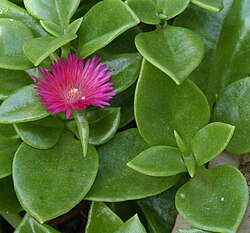
- Diversity: Contains 135 genera and roughly 1,800 species.
- Primary Habitat: 96% of species are endemic to the arid and semiarid regions of Southern Africa.
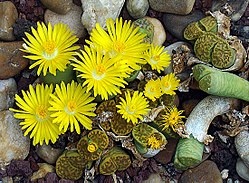
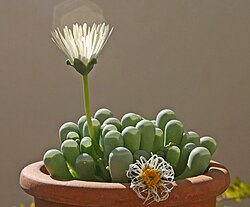
- Unique Forms: Includes "living stones" (Lithops, Conophytum) that mimic pebbles to avoid predation.
- Rapid Evolution: The subfamily Ruschioideae experienced one of the fastest diversification rates among angiosperms.
- Water Strategy: Most species are succulents and utilize specialized carbon fixation pathways like CAM.
Botanical Characteristics
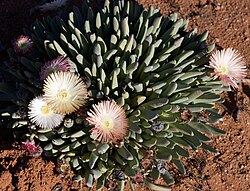
Aizoaceae plants are primarily herbaceous, though some exhibit slightly woody stems. They typically feature sympodial growth (where the main stem ends in a flower or branch, and growth continues from a side bud) and can be either erect or prostrate.
The leaves are generally simple, succulent, and arranged oppositely or alternately. One of the most distinctive features of the family is the presence of glistening epidermal bladder cells—specialized water-storage cells on the leaf surface that give many species their "ice plant" appearance.
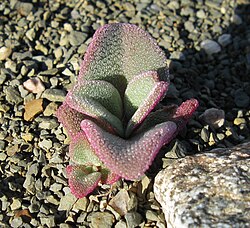
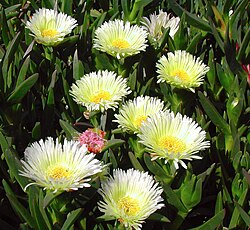
The flowers are typically actinomorphic (radially symmetrical) and perfect, meaning they contain both male and female reproductive organs. While true petals are absent, many species possess numerous linear petals derived from staminodes (sterile stamens). A fascinating biological trait is their hygrochastic seed capsules, which use a "jet action" to disperse seeds when they come into contact with water.
Distribution and Ecology
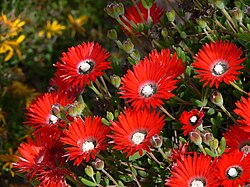
The vast majority of Aizoaceae diversity is concentrated in the Greater Cape Floristic Region and the Succulent Karoo of Southern Africa, the most plant-diverse temperate region on Earth. While most are endemic to this area, a few species are native to Australia and the Central Pacific.
Some species have traveled far beyond their native range. For example, Carpobrotus edulis has been introduced to the Mediterranean coast of Europe, New Zealand, Brazil, and the western coast of the United States.
Evolution and Metabolism
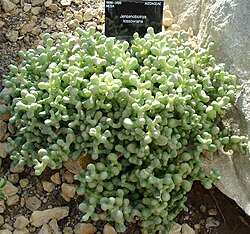
The evolutionary history of the Aizoaceae, particularly the subfamily Ruschioideae, is characterized by an incredibly rapid radiation occurring between 1.13 and 6.49 million years ago. This diversification happened at a rate of about 4.4 species per million years, coinciding with the rise of other major succulent groups like Cactaceae (cacti) and Agave.
To survive in harsh, dry climates, many Aizoaceae employ Crassulacean Acid Metabolism (CAM), a carbon fixation pathway that allows plants to keep their stomata closed during the day to prevent water loss. Interestingly, some species in the subfamily Sesuvioideae use C4 carbon fixation, a more efficient photosynthetic pathway that may have evolved multiple times within the group.
Taxonomy and Classification
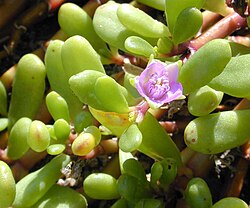
Due to their rapid evolution and extreme diversity, defining the exact boundaries between genera and species in Aizoaceae remains a challenge for taxonomists. The family is currently divided into several subfamilies:
- Acrosanthoideae: Includes the genus Acrosanthes.
- Aizooideae: Includes Aizoon and Tetragonia.
- Mesembryanthemoideae: Centered around the genus Mesembryanthemum.
- Ruschioideae: The largest subfamily, containing the famous "living stones" and ice plants.
- Sesuvioideae: Notable for containing C4 species like Sesuvium.
Representative Genera and Species
| Genus | Common Name / Note | Key Feature |
|---|---|---|
| Lithops | Living Stones | Mimics pebbles/rocks |
| Carpobrotus | Hottentot Fig | Edible fruit and leaves; invasive in CA |
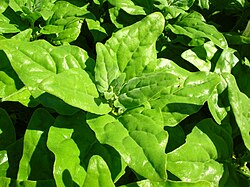
| Tetragonia | New Zealand Spinach | Used as a salad alternative |
| Mesembryanthemum | Ice Plant | Prominent epidermal bladder cells |
| Fenestraria | Window Plant | Translucent leaf tips |
Practical Uses and Cultivation
Many Aizoaceae are prized as novelty houseplants. Lithops and Conophytum are particularly popular due to their stone-like appearance. Beyond aesthetics, several species are edible:
- Tetragonia tetragonoides: Grown in dry climates as a high-end spinach substitute.
- Carpobrotus edulis: Provides edible leaves and fruit.
- Mesembryanthemum crystallinum: Features edible leaves.
In Southern California, some ice plants are utilized as firewalls to slow the spread of wildfires, although they can still burn if not properly maintained. However, C. edulis has become an invasive species in California after being introduced in the early 1900s for soil stabilization along railroads.
Frequently Asked Questions
What are "living stones"?
Living stones are succulent plants from genera such as Lithops, Conophytum, and Pleiospilos. They have evolved to resemble pebbles or gemstones to camouflage themselves from herbivores in their native Southern African habitats.
Why are they called "ice plants"?
The name comes from the glistening epidermal bladder cells found on the leaves of many species, which look like tiny droplets of ice or crystals.
Are all Aizoaceae plants edible?
No, not all are edible, but some specific species are. Tetragonia tetragonoides (New Zealand spinach), Carpobrotus edulis, and Mesembryanthemum crystallinum are known for having edible parts.
Where do most Aizoaceae species originate?
Approximately 96% of the species in this family are endemic to the arid and semiarid regions of Southern Africa, particularly within the Succulent Karoo and the Greater Cape Floristic Region.
How do these plants survive in the desert?
They use several adaptations, including succulent leaves for water storage, epidermal bladder cells, and specialized carbon fixation pathways like CAM (Crassulacean Acid Metabolism) to minimize water loss during the day.