Nested Grid Model: The Evolution of NCEP Weather Prediction
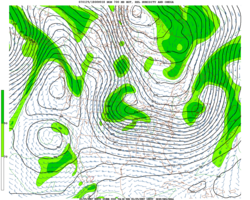
In the realm of meteorology, the ability to predict atmospheric changes depends heavily on the precision of numerical weather prediction models. One such pivotal tool was the Nested Grid Model (NGM), a system operated by the National Centers for Environmental Prediction (NCEP), a division of the United States National Weather Service. Designed to bridge the gap between global and regional forecasting, the NGM played a critical role in atmospheric science for over two decades.
The Architecture of the NGM
As its name implies, the NGM utilized a dual-layered grid system to process weather data. This approach allowed the model to balance broad atmospheric trends with more localized details. The model operated using two distinct levels:
- Hemispheric-scale grid: Used for broad, large-scale atmospheric patterns.
- Synoptic-scale grid: A more detailed grid with a resolution of approximately 90 kilometers, used for regional forecasting.
A defining scientific characteristic of the NGM was its reliance on the hydrostatic equation, which assumes a balance between the vertical pressure gradient force and gravity. While effective for many applications, this assumption meant the model was less suited for capturing non-hydrostatic mesoscale features—small-scale atmospheric phenomena like thunderstorms.
Timeline and Transition
The NGM was introduced in 1987, serving as the successor to the limited-area fine mesh (LFM) model. Beyond direct forecasting, it was instrumental in generating model output statistics (MOS), which are statistical corrections applied to raw model data to improve accuracy.
By the early 1990s, the landscape of weather modeling began to shift. Development of the NGM ceased in 1993. As computing power grew and the need for higher resolution increased, the model became obsolete, particularly for features that did not follow hydrostatic principles. This led to its scheduled replacement by the Global Forecast System (GFS) in 2001.
Despite the rise of the GFS and improvements to the Eta model (which later became the North American Mesoscale Model), certain NGM products persisted. While short-range LAMP products were phased out by 2006, the NGM MOS products remained in general use until their final discontinuation on March 3, 2009.
Key Facts
- Operator: National Centers for Environmental Prediction (NCEP).
- Launch Date: 1987 (replaced the LFM model).
- Grid Resolution: Approximately 90 kilometers for the synoptic-scale grid.
- Core Assumption: Based on the hydrostatic equation.
- End of Life: Development stopped in 1993; MOS products ended March 3, 2009.
- Successors: Global Forecast System (GFS) and the North American Mesoscale Model (NAM).
| Feature/Milestone | Detail |
|---|---|
| Primary Grid Scales | Hemispheric and Synoptic |
| Synoptic Resolution | ~90 km |
| Introduction Year | 1987 |
| Development Ceased | 1993 |
| Final MOS Discontinuation | March 3, 2009 |
Frequently Asked Questions
What does "Nested Grid" mean in the context of the NGM?
It refers to the use of two different grid scales—a broad hemispheric-scale grid and a finer synoptic-scale grid—where the smaller grid is "nested" within the larger one to provide higher resolution for specific areas.
What is the hydrostatic equation?
The hydrostatic equation is a simplification used in meteorology that assumes a balance between the upward pressure gradient force and the downward force of gravity, ignoring vertical acceleration.
Why was the NGM eventually considered obsolete?
The NGM was unable to accurately model non-hydrostatic mesoscale features, making it less effective than newer models like the GFS and the North American Mesoscale Model.
What are Model Output Statistics (MOS)?
MOS is a technique used to post-process raw numerical model data using statistical methods to create more accurate and reliable weather forecasts.
When did the NGM completely stop being used?
While the model was largely superseded by 2001, its MOS products continued to be used until March 3, 2009.