Weather Forecasting: The Science and Evolution of Atmospheric Prediction
Weather forecasting is the application of science and technology to predict atmospheric conditions for a specific location and time. While humans have attempted to anticipate the weather informally for millennia, the formalization of this practice began in the 19th century, evolving from simple observations of the sky to complex mathematical simulations.
Modern forecasts are generated by collecting quantitative data from the atmosphere, land, and ocean. Meteorologists use this data to project how the atmosphere will change. While early methods relied on manual calculations of barometric pressure (the pressure exerted by the atmosphere) and cloud cover, today's predictions are driven by computer-based models. Despite this automation, human expertise remains essential for pattern recognition, understanding teleconnections (climate anomalies linked between distant regions), and correcting model biases.
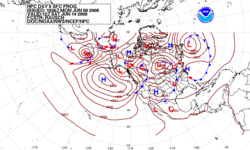
Key Facts

- Data-Driven: Forecasts rely on quantitative data from the land, ocean, and atmosphere.
- Technological Shift: The electric telegraph (1835) transitioned forecasting from local observation to regional prediction.
- Chaos Theory: The chaotic nature of the atmosphere means accuracy decreases as the forecast range increases.
- Human Element: Experts are still required to select the most reliable models based on performance and bias.
- Error Mitigation: Ensembles and model consensus are used to narrow errors and increase confidence.
The Evolution of Weather Prediction

Ancient and Early Methods
For thousands of years, weather prediction was an informal practice based on observation. However, the ability to forecast was severely limited by the speed of communication. Before the mid-19th century, weather reports traveled no faster than 160 kilometers per day, typically averaging between 60 and 120 kilometers per day via land or sea.
The Telegraph Revolution
The invention of the electric telegraph in 1835 marked the beginning of the modern era. By the late 1840s, weather reports could be transmitted almost instantaneously across wide areas. This allowed meteorologists to make predictions based on conditions occurring further upwind, providing a critical window of warning for storms.

The Rise of Numerical Prediction
As computing power grew, the field shifted toward Numerical Weather Prediction (NWP). This involves using mathematical equations to describe the physics of the atmosphere, land, and ocean. While powerful, these models face challenges due to the massive computational requirements and the inherent difficulty in measuring initial conditions with perfect accuracy.

Forecasting Techniques and Challenges

Common Methodologies
- Persistence: The assumption that tomorrow's weather will be the same as today's.
- Nowcasting: Very short-term forecasting focusing on the immediate future.
- Analog: Comparing current conditions to similar historical weather patterns.
- Artificial Intelligence: The emerging use of machine learning to improve probabilistic forecasting.

Why Forecasts Fail
The primary obstacle to perfect prediction is the chaotic nature of the atmosphere. Small errors in the initial measurement of conditions can lead to large discrepancies in the outcome over time. Consequently, the "range" of the forecast—the time between the present and the predicted event—directly impacts accuracy.

Specialized Applications of Forecasting

Weather prediction is not only for the general public; it is critical for various high-stakes industries:
- Aviation: Managing air traffic, avoiding icing, and monitoring volcanic ash clouds.
- Marine: Ensuring shipping safety and managing tropical cyclone warnings.
- Agriculture and Forestry: Predicting frosts, droughts, and managing crop cycles.
- Utilities: Anticipating surges in electricity demand during heatwaves or cold snaps.
- Military: Planning strategic operations based on atmospheric conditions.


Summary of Forecasting Evolution
| Era | Primary Tool | Communication Speed | Basis of Prediction |
|---|---|---|---|
| Ancient/Informal | Visual Observation | Very Slow (Physical Travel) | Pattern Recognition |
| Early Modern | Telegraph & Barometer | Instantaneous (Electric) | Upwind Conditions |
| Modern/Digital | Computer Models & Satellites | Real-time Global Data | Numerical Physics & AI |

Frequently Asked Questions
Why do weather forecasts become less accurate over time?
This is due to the chaotic nature of the atmosphere. Small errors in measuring initial conditions grow over time, meaning the further into the future a forecast attempts to predict, the higher the likelihood of inaccuracy.
What is the role of a human meteorologist in the age of computers?
Humans are necessary to interpret model data, recognize complex patterns, and account for model biases. They select the most appropriate model based on their knowledge of current atmospheric teleconnections and historical model performance.
How did the telegraph change weather forecasting?
Before the telegraph, weather reports moved as slowly as a horse or ship. The telegraph allowed data to be collected from distant locations instantly, enabling forecasters to see weather systems moving toward them from upwind.
What is ensemble forecasting?
Ensemble forecasting involves running multiple model simulations with slightly different initial conditions. By looking at the consensus among these different runs, meteorologists can narrow the margin of error and determine the confidence level of a forecast.
How is weather forecasting used in the aviation industry?
Aviation relies on forecasts to manage air traffic, predict hazardous icing, and track volcanic ash clouds, which can be dangerous to aircraft engines.