Military Surrender: Definitions, Protocols, and International Law
In military terms, surrender is the act of relinquishing control over territory, combatants, fortifications, ships, or armaments to an opposing power. This transition of power can occur peacefully or as the direct result of defeat in battle. While a sovereign state typically surrenders by signing a peace treaty or a capitulation agreement, battlefield surrenders—whether initiated by individuals or ordered by officers—generally result in the surrendering parties becoming prisoners of war.
Key Facts
- Definition: The yielding of person or possession into the power of another.
- Signals: Common indicators include white flags, raising empty hands, or striking ship colors.
- Types: Surrenders can be conditional (based on promises) or unconditional (at the victor's discretion).
- Legal Protections: The Geneva Conventions mandate that prisoners of war must not be mistreated or abused.
- War Crimes: False surrender is classified as perfidy and is a war crime under Protocol I of the Geneva Convention.
Etymology and Definition
The term "surrender" is defined by Merriam-Webster as the action of yielding one's person or giving up possession, especially into the power of another. Its etymology traces back to the Middle English surrendre, derived from the French sur- (under) and rendre (to give back). Historically, the University of Michigan Middle English Dictionary notes its use in legal contexts, such as the relinquishing of letters patent to a king or the giving up of a land grant to the rightful holder.
Signs and Gestures of Surrender
Communication is critical during a surrender to avoid unnecessary casualties. A white flag or handkerchief is the most recognized signal of a desire to surrender; however, under international law, this represents a request for a parley (a conference between opposing sides) which may or may not lead to a formal surrender.
Standard procedures for indicating surrender include:
- Individual Combatants: Discarding weapons and raising empty, open hands above the head.
- Armored Units: Tank commanders should point the turret away from the enemy, often exiting the vehicle to make the signal clear.
- Naval Forces: Striking the colors (lowering the flag) or furling ensigns.
- Historical Customs: Commanding officers traditionally offered their swords to the victorious commander.
Interestingly, signals can vary by culture and conflict. During the Gallipoli landings, British Empire troops were advised that Turkish soldiers often signaled surrender by holding their rifle butts upward or waving rags of any color, while white flags were viewed with suspicion as potential acts of perfidy.
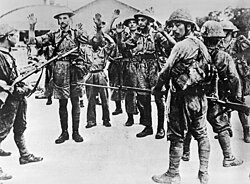
The Process of Surrender
The terms of a surrender generally fall into two categories: conditional and unconditional.
Conditional Surrender
In a conditional surrender, the surrendering party agrees to submit only after the victor makes specific promises. Leaders negotiate privileges or compensation, arguing that the cessation of resistance saves the victor time, expense, and loss of life.
Unconditional Surrender
A surrender at discretion, or unconditional surrender, occurs when the victor makes no promises and unilaterally determines the treatment of the vanquished. An early historical example is the Roman Empire's defeat of Carthage at the end of the Second Punic War. Today, such surrenders typically occur only when a belligerent is completely incapable of continuing hostilities.
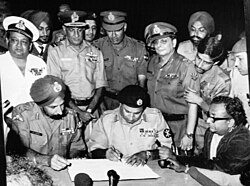
Modern surrenders are governed by the Hague Convention of 1907 and the Geneva Conventions. The Third Geneva Convention specifically prohibits the mistreatment of prisoners of war. For instance, US Army policy requires that surrendered persons be secured and safeguarded during evacuation from the battlefield.
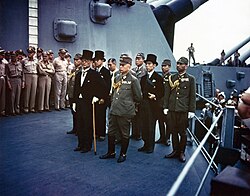
Ethics and Legal Boundaries
While international law protects those who surrender, military codes often emphasize resistance. The Code of the US Fighting Force, for example, states that surrender should only occur when all reasonable means of resistance are exhausted and death is the only alternative.
False Surrender and Perfidy
False surrender is a form of perfidy—the act of deceiving the enemy by pretending to surrender to lure them out of cover for an attack. This is strictly prohibited and classified as a war crime under Protocol I of the Geneva Convention.
Summary of Military Surrender Terms
| Term | Definition | Key Characteristic |
|---|---|---|
| Capitulation | An agreement for the surrender of troops, a town, or territory. | Formal agreement. |
| Debellatio | The end of a war due to the complete destruction of a state. | Total collapse of the belligerent. |
| No Quarter | The refusal to spare the lives of the vanquished. | Forbidden under laws of war. |
| Unconditional Surrender | Surrender without conditions, except those provided by law. | Victor defines all terms. |
Frequently Asked Questions
Does a white flag always mean a formal surrender?
No. In international law, a white flag indicates a desire for a parley (discussion), which may lead to a surrender but is not a formal surrender in itself.
What is the difference between conditional and unconditional surrender?
Conditional surrender involves negotiated terms and promises from the victor, whereas unconditional surrender leaves all treatment and terms entirely to the victor's discretion.
Is it legal to refuse to take prisoners?
No. Declaring that "no quarter" will be given—meaning the victor will not spare the lives of those who surrender—is expressly forbidden under the laws of war.
What constitutes a war crime regarding surrender?
False surrender is considered a war crime. Using the pretense of surrender to trick the enemy into a vulnerable position is defined as perfidy under the Geneva Convention.
How are prisoners of war protected?
Under the Third Geneva Convention, prisoners of war must be protected from abuse and mistreatment, and must be safeguarded during their evacuation from the battlefield.