Megasiphon thylakos: A Window into Early Tunicate Evolution
Deep in the fossil record of the Middle Cambrian period lies Megasiphon thylakos, an extinct species of tunicate that provides critical clues about the early history of chordates. Dating back approximately 500 million years to the Guzhangian stage, this organism offers a glimpse into how the complex body plans of modern sea squirts and their relatives first emerged.
Key Facts
- Species: Megasiphon thylakos
- Age: Approximately 500 million years old (Middle Cambrian, Guzhangian stage).
- Classification: Phylum Chordata, Subphylum Tunicata.
- Defining Feature: Barrel-shaped body with two long siphons and specialized muscle bands.
- Significance: Suggests that the sea squirt-like body plan may be ancestral to all tunicates.
Morphology and Anatomy
The physical structure of Megasiphon thylakos is characterized by a barrel-shaped main body. Extending from the top (apically) are two long siphons of similar size, which are inclined at an angle of roughly 25° relative to the organism's longitudinal axis. These siphons are reinforced by millimetric circular transverse muscle bands and longitudinal muscular bands.
Researchers believe one of these siphons served as the oral siphon (where water enters) and the other as the auricular siphon (where water exits), though the holotype specimen makes it difficult to distinguish them with absolute certainty. The oral siphon is thought to be the one with thicker muscle bands and more disaggregated fibers.
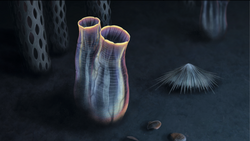
The presence of these circular and longitudinal muscles is highly significant. In modern ascidians (sea squirts), these muscles allow the animal to shrink or squirt water to expel predators or debris. The fact that Megasiphon possessed these structures indicates that these behavioral traits had already evolved by 500 million years ago.
Comparative Analysis
When compared to other prehistoric and modern organisms, Megasiphon shares a strong morphological similarity with phlebobranchs. However, it differs significantly from Shankouclava and shows no clear resemblance to motile thaliaceans, stalked stolidobranchs, or the tadpole-like appendiculars.
| Group/Species | Morphological Similarity to Megasiphon | Key Distinctions |
|---|---|---|
| Phlebobranchs | High | Similar general body plan |
| Appendiculars | Low | Tadpole-like motile form |
| Thaliaceans | Low | Motile lifestyle |
| Shankouclava | Low | Lacks defined atrial siphon; has tentacle-like structures |
Evolutionary Implications for Olfactores
The placement of Megasiphon within the Olfactores (the clade containing tunicates and vertebrates) leads to two primary evolutionary hypotheses regarding the origin of the tunicate body plan.
Hypothesis 1: The Crown Tunicate Model
If Megasiphon is a crown tunicate (a sister group to the clade uniting modern Ascidiacea and Taliacea), it would suggest that the divergence between appendicularians and other tunicates happened roughly 50 million years earlier than the 450-million-year estimate provided by molecular clocks. This model posits that the common ancestor was motile, and the sessile (fixed-in-place) nature of sea squirts evolved later.
Hypothesis 2: The Stem-Tunicate Model
Alternatively, Megasiphon may be a stem-tunicate. This suggests that the sea squirt-like body plan is actually the ancestral state for all tunicates, and the motile, tadpole-like form of appendicularians is a derived trait. This is supported by developmental biology and evidence of massive gene loss in appendicularians.
The authors of the Megasiphon study argue that the stem-tunicate model is more plausible. It aligns better with other evidence suggesting that the common ancestor of Olfactores was a sedentary-pelagic organism—meaning it had a two-phase life cycle with a motile larva and a sedentary adult.
Frequently Asked Questions
What is Megasiphon thylakos?
It is an extinct species of tunicate from the Middle Cambrian period, characterized by a barrel-shaped body and two siphons used for water filtration.
How old is the Megasiphon fossil?
The fossil dates back approximately 500 million years to the Guzhangian stage of the Middle Cambrian.
Why are the muscle bands in Megasiphon important?
The circular and longitudinal muscle bands indicate that the ability to contract the body—a trait used by modern sea squirts to "squirt" water—was already present 500 million years ago.
What is the difference between a stem-tunicate and a crown tunicate?
A stem-tunicate represents a lineage that branched off before the common ancestor of all living tunicates, while a crown tunicate is part of the group that includes the common ancestor of all extant species.
How does Megasiphon change our understanding of evolution?
It suggests that the sedentary, sea squirt-like body plan might be the original form for all tunicates, rather than a later adaptation, potentially shifting the timeline of how chordates evolved.