Metaspriggina: The Cambrian Link to Early Vertebrates
In the depths of the Middle Cambrian period, a small but pivotal creature swam through the ancient oceans. Metaspriggina, a genus of primitive chordates, provides scientists with a critical window into the evolution of the vertebrate body plan. While it may have looked simple, this organism possesses anatomical features that hint at the distant origins of complex jawed animals.
Initially identified from two specimens in the famous Burgess Shale, the understanding of Metaspriggina expanded significantly in 2012 with the discovery of 44 additional specimens at the Marble Canyon bed in Kootenay National Park. Although its name suggests a relationship with the Ediacaran organism Spriggina, research has confirmed that the two are entirely unrelated.
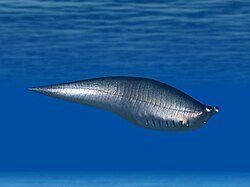
Key Facts
- Temporal Range: Middle Cambrian.
- Maximum Size: Approximately 10 centimeters (3.9 inches) in length.
- Defining Feature: The oldest known animal to possess pharyngeal bars (gill bars).
- Locomotion: Side-to-side swimming motion driven by W-shaped muscle arrangements.
- Dietary Habit: Likely a filter-feeder swimming above the sea floor.
Anatomy and Physical Characteristics
Metaspriggina represents a primitive chordate, potentially serving as a transitional form between cephalochordates (lancelets) and the earliest vertebrates. It lacked fins and possessed a weakly developed cranium, yet it featured two well-developed, upward-facing eyes with nostrils positioned behind them.
One of its most significant internal features was the notochord, a flexible rod that provides structural support. Additionally, it possessed seven pairs of pharyngeal bars, which were likely composed of cartilage. Unlike many other organisms, these bars were not formed from a single bone but from multiple separate pairs. The first two pairs were enlarged and did not appear to support gills, a trait that suggests a distant evolutionary link to gnathostomatans (jawed vertebrates).
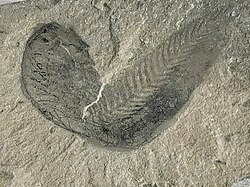
Muscle Structure and Movement
Exceptional preservation at Marble Canyon has allowed paleontologists to study the animal's muscle detail. The myomeral configuration—the arrangement of muscle segments—includes an additional ventral chevron and a clear dorsal bend. This creates a W-shaped arrangement directly comparable to that found in modern fish, enabling a side-to-side swimming motion.
The Evolution of the Jaw
The discovery of pharyngeal bars in Metaspriggina is a landmark finding in evolutionary biology. These gill bars are the precursors to critical vertebrate structures. Specifically, the first pair of pharyngeal bars eventually evolved into the upper and lower jaws of vertebrates, while the second pair evolved into the hyoid arch, which supports the jaws and anchors the base of the tongue.
This discovery complicates the relationship between Metaspriggina and its contemporary, Pikaia. Because Pikaia lacked gill bars, scientists have proposed different phylogenetic paths. One theory suggests that the chordate phylum split early, placing Metaspriggina as a direct ancestor to all gnathostomatans. Another theory suggested Pikaia was the ancestor of cephalochordates, but this is largely discounted because conodonts (extinct jawless fish) appeared roughly 20 million years before the Burgess Shale fossils.
Current phylogenetic analysis classifies Metaspriggiidae as stem-vertebrates. Along with Haikouella and the Myllokunmingiids, they lead toward crown vertebrates, which eventually diverged into jawless fishes (like conodonts and Cyclostomi) and armored jawless fishes (Cephalaspidomorph) that eventually became gnathostomes.
Summary of Metaspriggina Characteristics
| Feature | Description | Evolutionary Significance |
|---|---|---|
| Pharyngeal Bars | Seven pairs of cartilage-like bars | Precursors to vertebrate jaws and hyoid arch |
| Eyes/Nostrils | Upward-facing eyes; nostrils behind | Indicates filter-feeding behavior above sea floor |
| Muscle Shape | W-shaped myomeral arrangement | Comparable to the swimming motion of fish |
| Cranium | Weakly developed | Primitive state of the vertebrate skull |
Frequently Asked Questions
What is Metaspriggina?
Metaspriggina is a genus of primitive chordates from the Middle Cambrian period, known for being one of the earliest animals to possess pharyngeal bars.
How did Metaspriggina move?
It moved with a side-to-side swimming motion, facilitated by a W-shaped muscle arrangement similar to that of modern fish.
Why are the pharyngeal bars important?
These bars are evolutionary precursors; the first pair eventually evolved into the jaws of vertebrates, and the second pair became the hyoid arch that supports the tongue and jaw.
Where were the fossils of Metaspriggina found?
Specimens have been recovered from the Burgess Shale and the Marble Canyon bed in Kootenay National Park.
Is Metaspriggina related to Spriggina?
No. Despite the similarity in name, later scientific work has shown that Metaspriggina and the Ediacaran organism Spriggina are unrelated.