Pikaia gracilens: The Primitive Chordate of the Burgess Shale
In the depths of the Middle Cambrian period, a small, unassuming creature swam through the ancient oceans of what is now British Columbia. This creature, known as Pikaia gracilens, represents one of the most significant discoveries in paleontology. As a primitive member of the phylum Chordata, Pikaia provides a critical window into the early evolution of the body plan that eventually led to all vertebrates, including humans.
Initially overlooked or misclassified, Pikaia has undergone several scientific reinterpretations. From being viewed as a simple worm-like organism to being recognized as a stem-group chordate, its journey through scientific literature mirrors our growing understanding of early animal life.
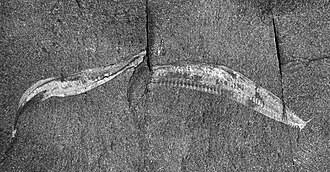
Key Facts
- Scientific Name: Pikaia gracilens
- Temporal Range: Middle Cambrian (Wuliuan stage)
- Phylum: Chordata
- Average Length: 4 centimeters (range of 1.5 to 6 cm)
- Key Features: Notochord and muscle blocks (myomeres)
- Location: Burgess Shale, British Columbia, Canada
Discovery and Early Classification
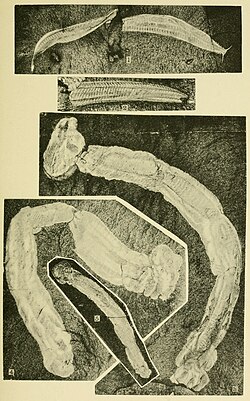
The fossils of Pikaia were first described by Charles Doolittle Walcott in 1911. However, it wasn't until much later that the animal's true biological significance was realized. University of Cambridge palaeontologist Harry B. Whittington and his student Simon Conway Morris re-examined the Burgess Shale fauna, noting anatomical details that had previously been missed.
They identified features such as a notochord (a flexible, rod-like structure that provides skeletal support) and distinct muscle blocks. These are fundamental characteristics of chordates, distinguishing Pikaia from annelids (segmented worms). By 1979, Conway Morris and Whittington were convinced that Pikaia was a chordate, marking a pivotal shift in how the species was categorized.
Anatomical Description
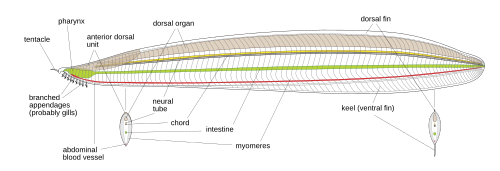
A comprehensive study published in 2012 by Conway Morris and Jean-Bernard Caron, based on 114 fossil specimens, confirmed Pikaia's classification as a primitive chordate. The animal possessed a fusiform body—meaning it tapered at both ends—and was laterally compressed, making it taller than it was wide.
On average, Pikaia measured 4 centimeters in length, though specimens ranged from 1.5 to 6 centimeters. Its height was typically twice its width throughout the body, a shape well-suited for swimming in a marine environment.
Modern Reinterpretations
Scientific understanding continues to evolve. A 2024 study by Mussini et al. provided a new interpretation of Pikaia's anatomy, further refining our understanding of the origins of the chordate body plan and how it compares to other early organisms like Yunnanozoon.
![Anatomical reconstruction of Pikaia gracilens (F, G) compared to Yunnanozoon (E) after Mussini et al. (2024)[a]](/images/08/ea/08ea946b07142d0e6be4823b66892144164d387ce64fbf9dfed85232aa80db28.png)
Evolutionary Importance
Pikaia is often discussed in the context of evolutionary contingency—the idea that the course of evolution is heavily influenced by chance events. The renowned paleontologist Stephen Jay Gould cited Pikaia in 1988 to illustrate this concept. He argued that if the "tape of life" were replayed, the survival of a small, obscure creature like Pikaia—which eventually led to the rise of vertebrates—might not have happened, potentially resulting in a completely different biological world.
While Pikaia is a relative of early vertebrates, researchers clarify that it is a stem-group chordate rather than the direct genetic ancestor of all vertebrates. It represents a successful early experiment in the chordate body plan, showcasing the development of the head and the structural foundations necessary for complex swimming.
Summary of Pikaia gracilens
| Attribute | Details |
|---|---|
| Kingdom | Animalia |
| Phylum | Chordata |
| Family | Pikaiidae |
| Body Shape | Fusiform and laterally compressed |
| Size | 1.5 to 6 cm (Avg. 4 cm) |
| Geological Period | Middle Cambrian |
Frequently Asked Questions
What makes Pikaia a chordate?
Pikaia is classified as a chordate because it possesses a notochord and muscle blocks, which are defining structural characteristics of the phylum Chordata.
How large was Pikaia gracilens?
Most Pikaia fossils range from 1.5 to 6 centimeters in length, with an average size of approximately 4 centimeters.
Is Pikaia the direct ancestor of humans?
While Pikaia is a primitive relative and a stem-group chordate that shares a common body plan with vertebrates, it is considered a relative rather than the direct genetic ancestor of all vertebrates.
Where were Pikaia fossils discovered?
Pikaia fossils were discovered in the Burgess Shale, a famous fossil-bearing deposit in British Columbia, Canada.
What is the significance of the "fusiform" body shape?
A fusiform body is tapered at both ends, which reduces drag and is an adaptation typically found in animals that swim efficiently through water.