Megapodes: The Fascinating Mound-Building Birds of Australasia
In the diverse landscapes of the Australasian region, there exists a group of birds that defy traditional avian parenting. Known as megapodes, or incubator birds, these stocky, chicken-like birds have evolved a remarkable way of raising their young that mirrors the behavior of reptiles more than other birds. From the forests of New Guinea to the gardens of Australia, these "large-footed" birds are masters of environmental engineering.
The name megapode is derived from the Greek words mégas (great) and poús (foot), a direct reference to the powerful legs and sharp claws these birds use to manipulate their environment. Unlike most birds, megapodes do not sit on their eggs to provide warmth; instead, they utilize external heat sources to incubate their offspring.
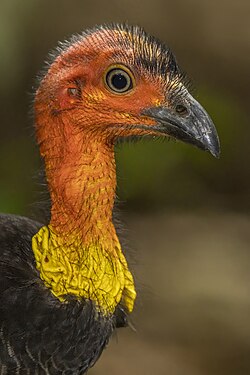
Key Facts
- Incubation: They use decaying vegetation, geothermal heat, or solar warmth instead of body heat.
- Development: They are superprecocial, meaning chicks hatch fully feathered and independent.
- Anatomy: Characterized by large feet and a high yolk-to-white ratio in their eggs (50–70% yolk).
- Distribution: Found across Australia, New Guinea, Indonesia, and various Pacific islands.
- Conservation: Nine species are currently considered at risk of extinction.
Physical Characteristics and Classification
Megapodes belong to the family Megapodiidae within the order Galliformes. They are generally medium to large terrestrial birds with small heads, short beaks, and rounded wings. While their flying abilities vary, they are primarily ground-dwellers.
The family is divided into three main morphological groups: the scrubfowl, the brushturkeys, and the mallee fowl (also known as lowan). The largest of these are the Alectura and Talegalla species, while the smallest include the Moluccan and Micronesian scrubfowl.
The Art of the Mound: Unique Incubation Strategies
The most defining characteristic of the megapode is its refusal to brood. Instead, they employ three primary methods of incubation:
- Mound-Building: About 13 species create massive mounds of decaying vegetation. Microbial decomposition generates heat, which the male regulates by adding or removing litter.
- Environmental Heat: Three species utilize geothermal heat (volcanic soil) or the heat of the sun warming the sand.
- Hybrid Strategies: Six species use a combination of these methods depending on their specific local environment.
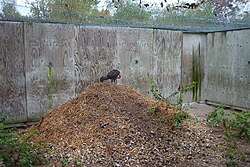
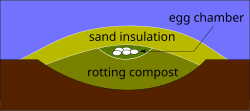
The internal structure of these mounds is a feat of biological engineering. A typical mound consists of a thick layer of sand for insulation and a lower layer of rotting compost to provide heat. The parent bird maintains a constant temperature—approximately 33 °C (91 °F)—by opening and closing air vents in the insulation layer.
Superprecocial Life Cycle
Megapodes are superprecocial, hatching in the most mature condition of any bird species. Because they lack an egg tooth, they use their powerful claws to break through the shell and tunnel upward through the mound, often lying on their backs to scratch through the sand.
By the time they reach the surface, these chicks are fully feathered, have open eyes, and possess the strength and coordination to run, hunt prey, and in some cases, fly on their very first day. This independence is a stark contrast to other Galliformes, as megapode chicks receive no parental care after hatching.
Distribution and Human Interaction
Megapodes are distributed across the broader Australasian region, including the western Pacific, Australia, New Guinea, and Indonesia east of the Wallace Line. However, human arrival has led to a contraction of their range, with many species disappearing from Fiji, Tonga, and New Caledonia.
Humans have long valued megapode eggs as delicacies due to their massive yolks, which are roughly four times the size of a chicken's yolk. In some cultures, these eggs were traditionally gifted as symbols of respect and friendship. However, unregulated harvesting since the 1950s has devastated populations. In some areas, such as Pokili, millions of eggs were harvested annually during the 1970s, leading to the abandonment of numerous nesting sites.
Summary of Megapode Groups
| Group | Key Genera | Notable Species | Primary Habitat |
|---|---|---|---|
| Brushturkeys | Alectura, Talegalla, Aepypodius | Australian Brushturkey | Wooded habitats/Gardens |
| Malleefowl | Leipoa | Malleefowl | Arid/Mallee scrub |
| Scrubfowl | Megapodius, Macrocephalon, Eulipoa | Maleo, Nicobar Megapode | Islands/Forests |
Frequently Asked Questions
How do megapodes keep their eggs warm without sitting on them?
They use external heat sources. Most build mounds of decaying organic matter that generate heat through microbial decomposition, while others use volcanic geothermal heat or sun-warmed sand.
What does "superprecocial" mean in the context of megapodes?
It means the chicks hatch in an extremely advanced state. They are born with full wing and downy feathers, open eyes, and the ability to fly and forage independently from the moment they emerge from the mound.
Why are megapode eggs considered a delicacy?
Megapode eggs are significantly larger than chicken eggs and have a very high yolk-to-white ratio, with the yolk making up 50% to 70% of the egg's total weight.
Do megapode parents teach their chicks how to survive?
No. Because they are superprecocial and the incubation is non-social, there is no parental care. Research suggests chicks use instinctive visual recognition of movement patterns to identify other members of their species.
Are megapodes endangered?
Yes, several species are under threat. Nine species are currently considered at risk of extinction, largely due to habitat loss and the over-harvesting of their eggs by humans.