Little Owl: The Symbol of Wisdom and Its Natural History
The little owl (Athene noctua), famously known as the owl of Athena or the owl of Minerva, is a compact bird of prey found across the temperate and warmer regions of Europe, North Africa, and the Palearctic east to Korea. Renowned for its association with wisdom in classical antiquity, this resilient species has adapted to a vast array of environments, from the stony semi-deserts of Africa to the rolling countryside of the United Kingdom.
While native to a broad stretch of the Old World, the little owl has also been introduced to other regions. It arrived in Britain at the end of the 19th century and was brought to the South Island of New Zealand in the early 20th century, where it is now widespread and partially protected under the Wildlife Act 1953.
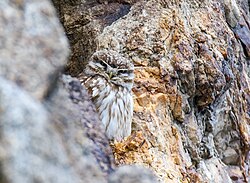
Key Facts
- Scientific Name: Athene noctua
- Conservation Status: Least Concern (IUCN 3.1)
- Average Size: 22 cm in length with a 56 cm wingspan
- Average Weight: Approximately 180 g
- Diet: Primarily insects, earthworms, and small vertebrates
- Lifespan: Up to 16 years, though average survival is often around 3 years due to environmental pressures
Taxonomy and Classification
Formally described in 1769 by Italian naturalist Giovanni Antonio Scopoli, the little owl was originally named Strix noctua. In 1822, German zoologist Friedrich Boie introduced the genus Athene, which commemorates the Greek goddess Athena. The species name noctua refers to the Latin name for an owl sacred to Minerva, Athena's Roman counterpart.
Taxonomists recognize thirteen subspecies of the little owl, reflecting its wide geographic range. Some experts suggest that southeastern races, such as the Syrian little owl (A. n. lilith), should be classified as a separate species, Athene glaux (Lilith's owl), based on DNA evidence and distinct vocal patterns.
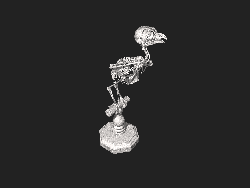
Physical Description
The little owl is characterized by its plump, compact body, short tail, and a distinctive flat-topped head. Its facial disc is flattened above the eyes, which, combined with white "eyebrows," gives the bird a stern or frowning expression. The plumage is primarily greyish-brown, featuring a complex pattern of white spots, streaks, and bars.
Adults of the nominate subspecies (A. n. noctua) possess bright yellow eyes and white-speckled brown upperparts. Juveniles are generally duller and lack the white spots on the crown. In flight, the little owl exhibits a bounding motion similar to that of a woodpecker.
Distribution and Habitat
The little owl is a sedentary species, meaning it does not migrate, and is found in a diverse range of open countryside habitats. These include:
- Agricultural lands with hedgerows, orchards, and woodland verges
- Parks, gardens, and suburban areas
- Steppes, dunes, and stony semi-deserts
- Rocky outcrops, quarries, and ruins
While typically found in lowlands below 500 meters in the UK, the species can survive at much higher altitudes in Asia; a single record exists of an individual at 3,600 meters in Tibet.
Behavior and Ecology
The little owl is partly diurnal (active during the day) and often perches boldly in elevated positions to spot prey. Its diet is opportunistic, consisting of insects (such as beetles and flies), earthworms, and small vertebrates including amphibians, reptiles, and mammals like mice, voles, and shrews. To manage food shortages, the owl caches surplus prey in holes or hiding places.
Territoriality is a strong trait in this species. Males typically maintain a single territory for life, though the size of this area varies based on habitat quality. In diverse habitats, home ranges may be smaller than 2 hectares, whereas in monotonous farmland, they can exceed 12 hectares. Little owls can recognize their neighbors by their voices and will aggressively defend their boundaries against strangers.
Breeding and Life Cycle
Breeding begins in late spring, marked by increased nocturnal vocalizations. The little owl is flexible in its nesting choices, utilizing tree hollows, cliff crevices, old buildings, rabbit burrows, and river banks.
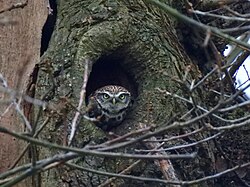
A typical clutch consists of three to five white, elliptical eggs, which are incubated by the female for 28 to 29 days. The male provides food for the female during this period. Once the chicks hatch, both parents contribute to hunting and feeding. The young typically leave the nest at around seven weeks and achieve flight shortly thereafter. Most young owls disperse within 20 kilometers of their birth site.
| Feature | Detail |
|---|---|
| Average Length | 22 cm |
| Wingspan | 56 cm |
| Weight | ~180 g |
| Clutch Size | Typically 3–5 eggs |
| Incubation Period | 28–29 days |
| Conservation Status | Least Concern |
Cultural Significance and Human Interaction
Due to its link with Athena and Minerva, the little owl has long symbolized wisdom and knowledge. It appeared on the Greek tetradrachm coin around 500 BC and in 5th-century BC bronze statues. In later history, the birds were sometimes kept as ornamental pets or used in "cottage hunting" in Italy and Germany, where their tendency to be mobbed (attacked by other birds) was used to flush out prey like skylarks.
In the UK, the little owl initially suffered a poor reputation among game breeders who believed they preyed on game bird chicks. However, a 1935 study by Alice Hibbert-Ware proved that their diet consisted almost entirely of insects and small mammals, exonerating them from the charge of significantly impacting game bird populations.
Frequently Asked Questions
What does the little owl eat?
The little owl feeds on a variety of small creatures, primarily insects (such as Coleoptera and Lepidoptera) and earthworms. It also hunts small vertebrates, including mice, voles, shrews, amphibians, and small birds.
Why is it called the Owl of Athena?
The bird is closely associated with the Greek goddess Athena (and the Roman goddess Minerva), serving as a symbol of wisdom and knowledge in classical antiquity.
Where does the little owl live?
It is widespread across Europe, North Africa, and Asia (up to Korea). It inhabits open country, including farmland, orchards, steppes, and rocky areas, and has been introduced to the UK and New Zealand.
Is the little owl an endangered species?
No, the IUCN classifies the little owl as "Least Concern." With an estimated global population between 5 million and 15 million birds, the population is considered stable.
How long do little owls live?
While their maximum life expectancy is about 16 years, the average lifespan is often closer to 3 years due to threats such as severe winters and road traffic accidents.