Lesser Celandine
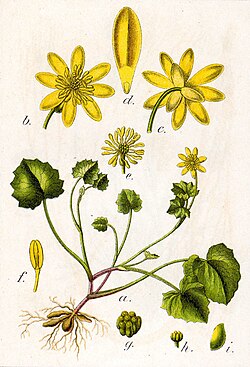
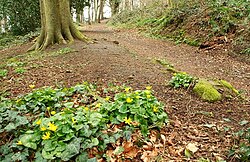
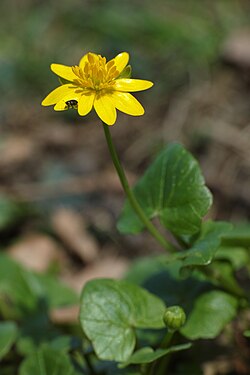
Lesser celandine (Ficaria verna) is a hairless perennial plant known for its glossy yellow blooms that signal the arrival of early spring. Reaching heights of up to 25 cm, this member of the buttercup family (Ranunculaceae) is characterized by its ability to form dense, carpet-like colonies. While cherished by some gardeners for its ornamental value, it is recognized as a formidable invasive species in various parts of the world.
Key Facts
- Scientific Name: Ficaria verna
- Bloom Period: March to May (UK)
- Native Range: Central Europe, North Africa, and the Caucasus
- Propagation: Primarily vegetative via root tubers and bulbils
- Ecological Status: Highly invasive in the Eastern and Northwestern US and Canada
- Distinctive Feature: Glossy yellow, radially symmetrical flowers
Botanical Description
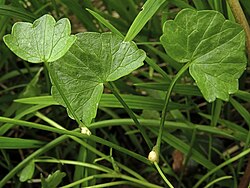
Lesser celandine typically grows in clumps of 4 to 10 short stems. Its leaves are cordate (heart-shaped), measuring 1–4 cm across, and feature a distinctive mottled or variegated pattern on the dark-green upper surface. Some varieties exhibit purple foliage. The leaf margins may be rounded or weakly lobed, ending in hydathodes (pores that secrete water).
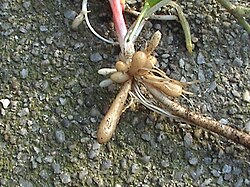
The plant's root system consists of dense clusters of thick, pale-colored elongated tubers. Additionally, some clumps produce stolons—horizontal stems—that can extend 10 cm or more, facilitating the rapid spread of the plant across the forest floor.
Flowers and Fruit
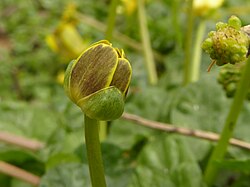
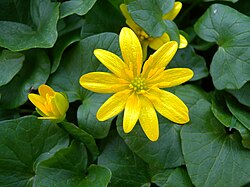
The flowers are actinomorphic (radially symmetrical), reaching diameters of 3–5 cm. They consist of 3 sepaloid tepals and 7 to 12 glossy yellow petaloid tepals, which may have purple or grey tinges on the reverse. The fruit is a single-seeded, shortly hairy achene.
Life Cycle and Distribution
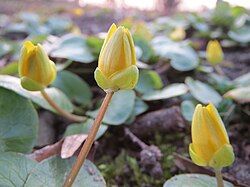
Native to central Europe, North Africa, and the Caucasus, Ficaria verna has been introduced to North America and Iceland. It thrives in seasonally wet or flooded sandy soils, though it avoids permanently waterlogged sites.
The plant begins its growth cycle in winter during periods of low temperature and short days. While some subspecies can produce up to 73 seeds per flower, the species primarily spreads vegetatively. Seedlings typically remain small for their first year, producing only one or two leaves.
Genetic Variations
The species exists in two forms: diploid (2n=16) and tetraploid (2n=32). Tetraploid types, such as subspecies F. verna ssp. verna and F. verna ssp. ficariiformis, are more aggressive colonizers because they produce bulbils (small aerial bulbs) in their leaf axils in addition to root tubers.
Ecological Impact and Invasiveness
In the Eastern and Northwestern United States and Canada, lesser celandine is a significant invasive species. Because it emerges earlier than most native spring ephemerals (flowers with a short spring lifecycle), it gains a developmental advantage, allowing it to dominate natural areas and displace native wildflowers.
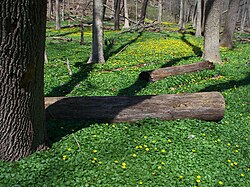
This displacement is particularly problematic in forested floodplains. Once the plant enters its six-month dormancy phase from June to February, the ground is often left barren, increasing the risk of soil erosion. In the US, the USDA APHIS considers it a high-risk weed that could potentially spread across 79% of the country, threatening endangered riparian species.
Horticultural Use
Despite its invasive nature in the wild, lesser celandine is used in gardening. The Royal Horticultural Society (RHS) and various horticulturists have noted the appeal of double-flowered cultivars. The "RHS Plant Finder" lists approximately 220 named cultivars.
| Cultivar/Group | Flower Characteristics | Foliage Characteristics |
|---|---|---|
| Alba Group | Cream to white | Green or silver-mottled |
| Brambling | Yellow | Silver-grey and purple-brown mottled |
| Brazen Hussy | Bright yellow | Glossy dark bronze |
| Coppernob | Bright orange (single) | Glossy dark bronze |
| Flore Pleno Group | Fully double yellow | Pale green or silver-dappled |
| Green Petal | Greenish-yellow double | Silver, purple, and bronze splashed |
Historical and Cultural Context
Historically, the plant has appeared in herbal lore. Nicholas Culpepper reportedly used it to treat scrofula. In Germany, the name Skorbutkraut ("scurvy herb") refers to the use of its vitamin C-rich young leaves to prevent scurvy, though this may be a result of its similarity to common scurvygrass (Cochlearia officinalis).
The plant has also inspired literature, appearing in the poetry of Edward Thomas and the stories of Tove Jansson.
Frequently Asked Questions
Why is lesser celandine considered invasive in North America?
It emerges earlier in the spring than native wildflowers, allowing it to monopolize sunlight and space. It forms dense mats that displace native species and leave soil exposed to erosion during its summer dormancy.
How does the plant spread so quickly?
It utilizes multiple methods of vegetative propagation, including root tubers, stolons, and, in tetraploid subspecies, bulbils that form in the leaf axils.
What are the best native alternatives to planting lesser celandine?
The U.S. National Park Service recommends native ephemeral wildflowers such as bloodroot, Asarum canadense, Jeffersonia diphylla (native twinleaf), and various Trillium species.
Is lesser celandine used for medicinal purposes today?
While historically used for scurvy due to vitamin C content and by herbalists like Culpepper, modern use is limited, and caution is advised due to potential toxicity associated with the Ranunculus genus.