Lasioglossum: A Deep Dive into the World's Largest Bee Genus
In the vast world of insects, few groups exhibit as much diversity and complexity as the genus Lasioglossum. Commonly known as sweat bees, this genus is the largest of all bee groups, boasting over 1,800 species distributed across the globe. From solitary nesters to complex social colonies, these bees represent a fascinating spectrum of evolutionary strategies.
Belonging to the family Halictidae and the order Hymenoptera, Lasioglossum species are highly variable. They differ significantly in their size, coloration, and physical sculpture. While most species prefer to nest in the ground, some have adapted to life in rotten logs. Their ecological roles are equally diverse; while many are pollinators, some are oligolectic (specializing in specific pollen types), some are nocturnal, and others act as kleptoparasites—species that survive by stealing resources from the nests of other bees.
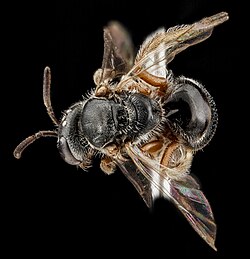
female Lasioglossum birkmani
Key Facts
- Genus Size: Contains over 1,800 species.
- Nesting Habits: Primarily ground-nesting, though some use rotten logs.
- Social Diversity: Ranges from solitary nesting to complex eusociality.
- Classification: Divided into two informal series based on wing vein strength.
- Unique Species: Lasioglossum marginatum is the only halictine bee with perennial colonies.
Taxonomic Classification and Diversity
The scientific classification of Lasioglossum places it within the kingdom Animalia, phylum Arthropoda, and class Insecta. Within the family Halictidae, the genus is further organized into various subgenera, though the exact subgeneric classification remains a subject of debate among entomologists.
The Two Major Series
Taxonomists often divide the genus into two informal series based on the strength of the distal veins in their forewings:
- Series Lasioglossum (Strong-veined): This group is mostly composed of solitary or communal species. However, some members, such as L. aegyptiellum, show signs of a division of labor that indicates eusociality (social behavior involving cooperative brood care and a division of roles).
- Series Hemihalictus (Weak-veined): This series displays a much wider range of social structures. It includes solitary, communal, primitively eusocial, and even socially parasitic species.
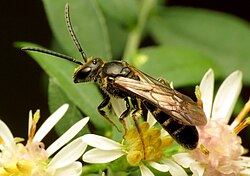
Lasioglossum sp. male
Social Behavior and Colony Structures
One of the most remarkable aspects of Lasioglossum is the extraordinary variation in social behavior. Unlike many insect groups that follow a strict social template, these bees exhibit everything from solitary living to primitive eusociality.
Colony sizes are not uniform. Some small colonies consist of just a single queen and four or fewer workers. In contrast, larger colonies can exceed 400 workers. A standout example is Lasioglossum marginatum, which forms perennial colonies that can last five or six years. This species is unique among halictine bees for its ability to maintain such long-lived, multi-year colonies.
| Feature | Description |
|---|---|
| Total Species | Over 1,800 |
| Primary Nesting Site | Ground |
| Social Range | Solitary to Eusocial |
| Wing Vein Types | Strong-veined and Weak-veined |
| Max Colony Size | Over 400 workers |
Subgeneric Classifications
While experts disagree on the exact number of subgenera, the following lists represent the classification modified from Michener's Bees of the World:
Series Lasioglossum Subgenera
- Australictus, Callalictus, Chilalictus, Ctenonomia, Echthralictus, Glossalictus, Homalictus, Ipomalictus, Lasioglossum s. str., Leuchalictus, Oxyhalictus, Parasphecodes, Pseudochilalictus, Rubrihalictus, Urohalictus.
Series Hemihalictus Subgenera
- Acanthalictus, Austrevylaeus, Biennilaeus, Capalictus, Dialictus, Eickwortia, Evylaeus, Hemihalictus, Rostrohalictus, Pyghalictus, Sphecodogastra.
Frequently Asked Questions
What are sweat bees?
Sweat bees is a common name used for bees in the family Halictidae, which includes the massive genus Lasioglossum.
How do Lasioglossum bees differ in social structure?
They exhibit a massive range of behaviors, including solitary nesting (living alone), communal nesting (multiple individuals sharing a nest), and eusociality (organized colonies with workers and queens).
Are all Lasioglossum species the same size?
No, the genus is highly variable in size, coloration, and physical structure.
What is a kleptoparasite in the context of these bees?
A kleptoparasite is a species that does not build its own nest or gather its own food, but instead steals resources from the nests of other bee species.
Which species is known for perennial colonies?
Lasioglossum marginatum is the only halictine bee known to form perennial colonies that can last for five to six years.