Eusociality: The Complex Biology of Superorganisms
In the natural world, most animals live for themselves or in simple groups. However, a remarkable phenomenon exists known as eusociality. Derived from the Greek words for "true social," eusociality represents the highest level of social organization found in the animal kingdom. At this level, individual organisms function so closely together that the entire colony can be viewed as a single superorganism.
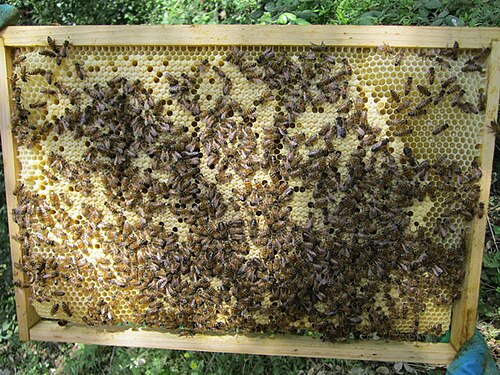
Eusociality is not merely about living together; it is defined by three specific biological criteria: cooperative brood care (where individuals care for offspring that are not their own), overlapping generations (where parents and adult offspring live together), and a clear division of labor into reproductive and non-reproductive groups.
Key Facts
- Eusociality is defined by cooperative brood care, overlapping generations, and division of labor.
- The division of labor often results in specialized groups known as castes.
- It is most common among insects, particularly Hymenoptera (ants, bees, and wasps) and termites.
- Beyond insects, eusociality has evolved in mammals like the naked mole-rat and certain crustaceans.
- Queens often use pheromones—chemical signals—to maintain colony structure and reproductive dominance.
The Mechanics of Social Organization
The defining feature of a eusocial society is the division of labor. This creates specialized behavioral groups, or castes, within the colony. In many species, individuals in one caste lose the ability to perform the behaviors characteristic of another. For example, while queens focus entirely on reproduction, other members of the colony serve as workers or soldiers.
![Suzanne Batra introduced the term "eusocial"[1] after studying nesting in Halictid bees including Halictus latisignatus,[5] pictured.](/images/c1/10/c110897bc73b6d42030fed069a85df415f7432ce3d8b0a0c892fcb2372f315dd.jpg)
In many insect colonies, this division is highly visible. Workers and soldiers collaborate to maintain a living environment that is optimal for the developing brood. In some species, such as the honeypot ant, certain workers undergo physiological changes to serve specific roles, such as storing food.
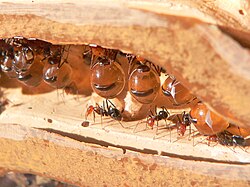
Castes and Specialization
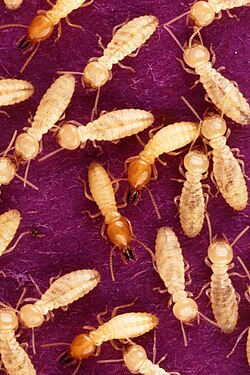
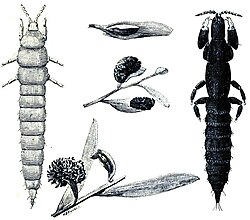
Specialization can take many forms. In termites, for instance, the colony is divided into queens, kings, soldiers, and workers. In other species, like the gall-forming thrips, a dedicated soldier caste exists specifically to defend the colony's fortress.
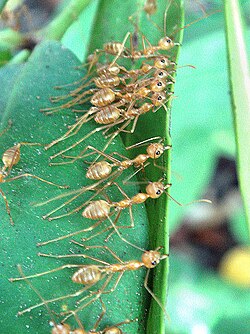
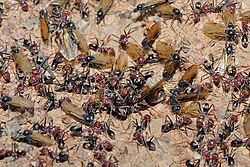
Diversity Across Species
While we often associate eusociality with bees and ants, it has evolved independently across a wide variety of biological groups.
Insects and Crustaceans
The Hymenoptera order—which includes ants, bees, and wasps—is the most prominent group of eusocial organisms. However, termites and certain beetles also exhibit these traits. Even in the ocean, some species of shrimp, such as Synalpheus regalis, have evolved eusocial structures.
Mammals and Plants
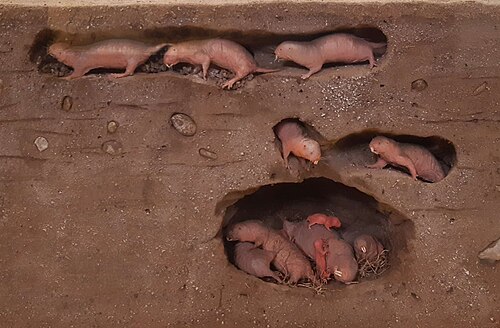
Eusociality is not limited to invertebrates. Among mammals, the naked mole-rat and the Damaraland mole-rat are the only known eusocial rodents. Their social structures, involving queens and various worker/soldier castes, mirror those of highly organized insect colonies.
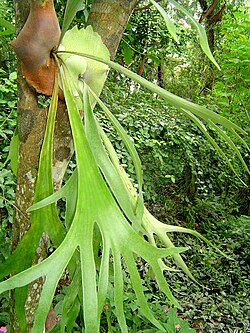
Interestingly, even some plants may exhibit primitive forms of eusociality. The staghorn fern, Platycerium bifurcatum, is suggested to utilize a simple form of division of labor.
The Role of Pheromones and Physiology
How does a colony stay organized? Much of the control is chemical. Queens produce various pheromones—chemical substances used for communication—to maintain the eusocial state. These chemicals can regulate the development of other colony members or suppress the reproductive capabilities of others.
![Physiology of eusociality in fire ants: three queen pheromones help to create and maintain the eusocial state of the colony. Loss of a primer pheromone triggers the development of replacement queens (dashed lines).[99][100]](/images/9c/d1/9cd1deeb2593c6dcb9f9446cb57c3eec4c8fb8e68f359049398b17cb7391301d.webp)
Summary of Eusocial Characteristics
| Feature | Description | Common Examples |
|---|---|---|
| Cooperative Brood Care | Members care for offspring not their own | Honeybees, Ants, Termites |
| Overlapping Generations | Adult offspring live with parents | Naked mole-rats, Wasps |
| Division of Labor | Specialized castes (Workers, Soldiers, Queens) | Hymenoptera, Termites |
Frequently Asked Questions
What is the main difference between social and eusocial animals?
While social animals live in groups, eusocial animals are distinguished by cooperative brood care, overlapping generations, and a specialized division of labor into reproductive and non-reproductive castes.
Are humans considered eusocial?
Some researchers, including E.O. Wilson, have suggested that humans may have evolved a weak form of eusociality, though this remains a subject of scientific discussion.
What are pheromones in a colony?
Pheromones are chemical signals used by individuals, particularly queens, to communicate and maintain the social structure and reproductive state of the colony.
Do all eusocial insects have a queen?
Most eusocial colonies feature a queen or queens that serve as the primary reproducers, supported by workers and soldiers who maintain the colony.
Is haplodiploidy required for eusociality?
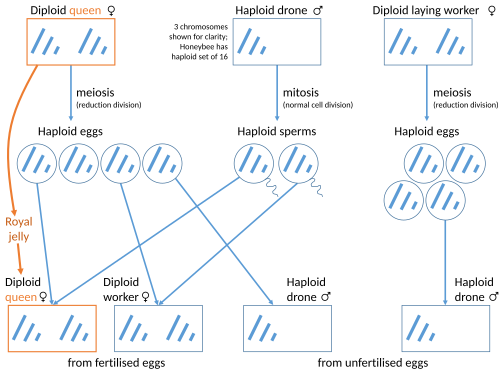
No. While haplodiploidy (a system where males are haploid and females are diploid) is found in many eusocial Hymenoptera and may favor its evolution, it is neither a necessary nor a sufficient condition for eusociality to emerge.