Lamprey: The Ancient Jawless Vertebrates
Lampreys are primitive, eel-like creatures that represent some of the oldest surviving lineages of vertebrates. Belonging to the class Petromyzontida, these jawless fish (Agnatha) provide a critical evolutionary link between simple chordates and the more complex jawed vertebrates that dominate the modern world. From their unique parasitic feeding habits to their complex life cycles, lampreys are as biologically fascinating as they are ancient.
These creatures are characterized by a lack of jaws, scales, and paired fins, relying instead on a specialized suction-cup mouth to attach to hosts or filter nutrients from the environment. Their existence spans from the Late Devonian period to the present day, making them a living window into the early history of animal life.

Key Facts
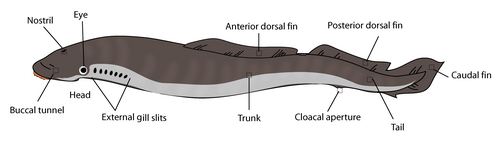
- Classification: Part of the superclass Cyclostomi and the infraphylum Agnatha (jawless vertebrates).
- Anatomy: Lack jaws and scales; possess a cartilaginous skeleton.
- Feeding: Many species are parasitic, using a circular mouth to attach to other fish.
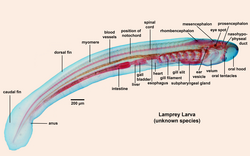
- Life Cycle: Includes a larval stage known as the ammocoetes.
- Evolutionary Significance: They exhibit key chordate synapomorphies (shared derived traits) such as the notochord and dorsal hollow nerve cord.
Anatomy and Biological Characteristics
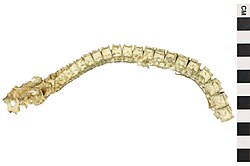
The anatomy of a lamprey is a study in evolutionary efficiency. Unlike most fish, lampreys possess a cartilaginous skeleton rather than a bony one. Their external form is streamlined, often featuring countershading—a camouflage technique where a darker back and lighter underside allow them to blend in whether viewed from above or below.
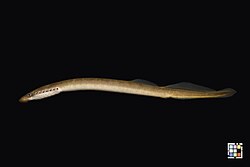
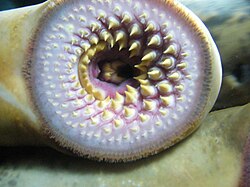
The most striking feature of the adult lamprey is the buccal apparatus. The mouth is a disc-like structure equipped with oral fimbriae and papillae, allowing the animal to create a powerful vacuum to attach to prey. Once attached, they use a rasping tongue to penetrate the skin of the host.
Internal Systems and Senses
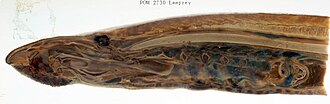
Internally, lampreys maintain several foundational vertebrate traits. They possess a notochord (a flexible rod supporting the body), a dorsal hollow nerve cord, and pharyngeal slits. Their sensory systems are highly developed; for instance, their olfactory sensory neurons are critical for navigating and locating hosts through chemical cues.
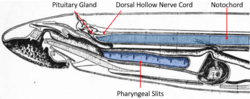
Interestingly, lampreys also possess a pineal gland that acts as a median third eye, helping them detect light changes, which is a trait linked to the early evolution of vertebrate photoreceptive organs.
Life Cycle and Development
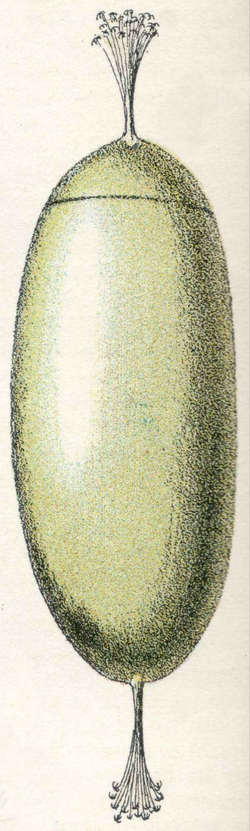
The lamprey life cycle is marked by a dramatic metamorphosis. It begins with the ammocoetes larva, which lives buried in silt or sand, filtering organic particles from the water. This larval stage can last for several years before the animal undergoes a transformation into the adult form.
Following metamorphosis, many species become haematophagous (blood-feeding). Anadromous species, such as the sea lamprey (Petromyzon marinus), migrate from the ocean into freshwater rivers to spawn. During this migration, they often cease feeding and rely on stored energy reserves.
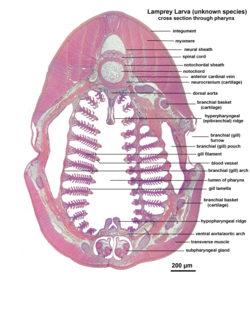
Classification and Evolutionary History
![Stimulation of the olfactory sensory neurons in the periphery activates neurons in the olfactory bulb of a sea lamprey[84]](/images/fa/60/fa60fb775e719a3d474765a22c3dd147835c4623fdf4bcab0258640f88fa2626.png)
Lampreys are classified under the order Petromyzontiformes. Their phylogeny is complex, with various extinct taxa such as Yanliaomyzon providing clues about the rise of predation in Jurassic lampreys. They are closely related to hagfish, together forming the group known as Cyclostomes.
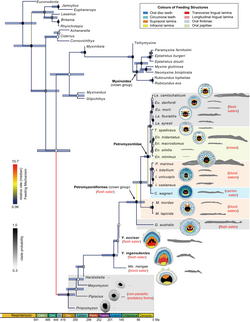
Because they lack the complex jaw structures of Gnathostomes, lampreys are used extensively in research to study the origin of the neural crest and the development of the vertebrate brain and spinal cord.
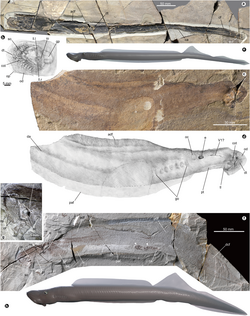
Human Interaction: Pests, Food, and Folklore
The relationship between humans and lampreys is multifaceted. In some regions, they are viewed as destructive pests. In the Great Lakes of North America, sea lampreys have caused significant damage to lake trout populations by attaching to them and feeding on their blood and tissues.
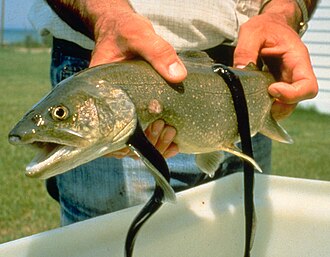
Conversely, lampreys have been a culinary delicacy in various cultures for centuries. In Portugal, they are used in traditional lamprey rice dishes, and in Japan, Yatsume kabayaki (grilled lamprey) is a prized specialty. Historical records, including 15th-century illustrations from the Tacuinum Sanitatis, show that they have been recognized as a food source for generations.

| Feature | Description |
|---|---|
| Scientific Class | Petromyzontida |
| Skeleton | Cartilaginous |
| Larval Stage | Ammocoetes (filter feeder) |
| Feeding Method | Suction/Rasping (Parasitic in adults) |
| Key Traits | Notochord, dorsal hollow nerve cord, no jaws |
Frequently Asked Questions
Are lampreys the same as eels?
No. While they look similar due to their elongated bodies, lampreys are jawless vertebrates (Agnatha), whereas eels are bony fish (Osteichthyes) with jaws and scales.
How do lampreys attach to their prey?
Lampreys use a specialized circular mouth that acts as a suction cup. Once attached, they use a rasping tongue to wear through the host's scales and skin to feed on blood and tissue.
What is an ammocoete?
An ammocoete is the larval stage of a lamprey. Unlike the parasitic adult, the ammocoete is a sedentary filter feeder that lives buried in the substrate of stream beds.
Why are lampreys important for science?
They serve as a model for vertebrate evolutionary research because they retain primitive characteristics that help scientists understand how the vertebrate nervous system, immune system, and skeletal structures first evolved.
Are lampreys dangerous to humans?
Lampreys generally do not target humans. Their parasitic behavior is directed toward other fish and occasionally marine mammals, such as minke whales.