Hagfish: The Slime-Producing Survivors of the Deep
The hagfish is one of nature's most unusual survivors. Often referred to as slime eels, these creatures belong to the class Myxini and are among the most primitive vertebrates on Earth. Lacking jaws and a traditional bony skeleton, hagfish have thrived in the ocean's depths for millions of years, utilizing a unique biological defense mechanism that baffles predators and fascinates scientists alike.
From their ancient lineage dating back to the Pennsylvanian period to their role as deep-sea scavengers, hagfish represent a critical link in the evolution of the Agnatha (jawless fish) and the broader chordate phylum.
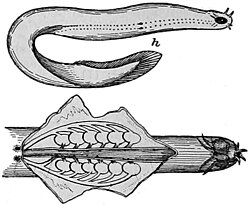
Key Facts
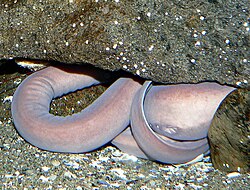
- Classification: Jawless vertebrates in the class Myxini.
- Temporal Range: Present from the Pennsylvanian period (311 Ma) to the Holocene.
- Primary Defense: Production of massive amounts of expanding slime to deter predators.
- Skeletal Structure: The notochord is the only skeletal element present.
- Diet: Primarily scavengers that feed on dead organic matter.
- Size Range: Typically around 50 cm, though Eptatretus goliath can reach 127 cm.
Physical Characteristics and Anatomy
Body Features and Size
Hagfish are elongated, eel-like creatures. While the average length is approximately 50 cm (19.7 in), there is significant diversity in size across species. The largest known species, Eptatretus goliath, has been recorded at 127 cm (4 ft 2 in), whereas smaller species like Myxine kuoi and Myxine pequenoi rarely exceed 18 cm (7.1 in). Some individuals have been observed as small as 4 cm (1.6 in).
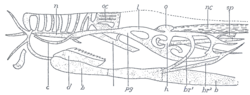
The Musculoskeletal System
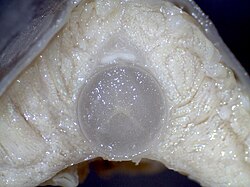
Unlike most vertebrates, hagfish lack a vertebral column. Instead, they possess a notochord—a flexible, rod-like structure that provides primary skeletal support. Their musculature is unique in that it lacks a septum, meaning there is no horizontal or vertical dividing wall within the muscle tissue.
Nervous System and Sensory Organs
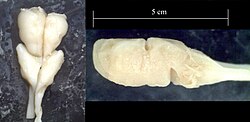
The hagfish brain is relatively simple, and their nervous system is notable for the absence of myelin (the insulating layer around nerves found in most vertebrates). Their eyes are largely degenerate, reflecting their adaptation to the dark, high-pressure environments of the deep ocean.
The Science of Hagfish Slime
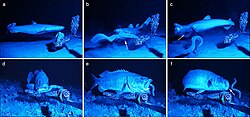
The most famous attribute of the hagfish is its ability to produce an extraordinary amount of slime. This defense mechanism is triggered when the fish is stressed or attacked. The slime consists of mucin and protein threads that expand rapidly—up to 10,000 times their original size in a fraction of a second—when they contact seawater.
This slime is so effective that it can clog the gills of predatory fish, such as sharks, forcing them to release the hagfish to avoid suffocation. The potency of this substance was illustrated in a 2017 road accident on U.S. Highway 101, where a spill of 7,500 pounds (3,400 kg) of hagfish produced enough slime to cover the road and a nearby vehicle.
Feeding and Ecology
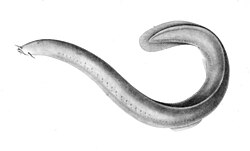
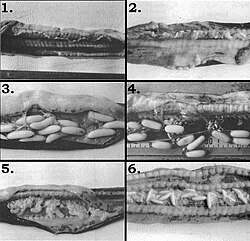
Hagfish are primarily scavengers. They use their specialized mouthparts to burrow into the carcasses of dead fish and other marine organisms, consuming the tissue from the inside out. This role makes them essential for nutrient cycling on the ocean floor.
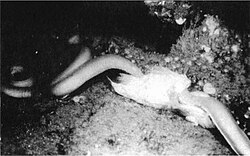
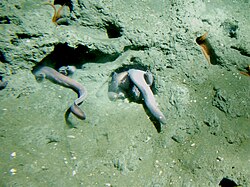
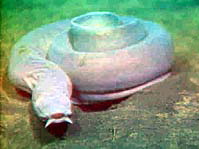
They are typically found at significant depths; for example, Pacific hagfish have been observed resting on the ocean bottom at depths of 280 m (920 ft) off the Oregon coast.
Classification and Evolution

Hagfish are classified under the superclass Cyclostomi, which they share with lampreys. Their evolutionary history is long, with fossil records such as Myxinikela dating back to the Pennsylvanian period. While they were once thought to be more primitive than lampreys, molecular evidence suggests they form a natural group together.
| Category | Details |
|---|---|
| Kingdom | Animalia |
| Phylum | Chordata |
| Class | Myxini |
| Order | Myxiniformes |
| Type Species | Myxine glutinosa |
| Skeletal Element | Notochord only |
Commercial and Human Use
Beyond scientific study, hagfish have practical applications. In South Korea, the species Eptatretus burgeri is used in a popular stir-fried dish known as Kkomjangeo bokkeum.

Additionally, the unique properties of hagfish slime have attracted interest from the textile and materials science industries. Researchers have explored the use of hagfish protein fibers to create ultra-stiff materials and have even investigated the potential for creating bulletproof body armor based on the slime's mechanical properties.
Frequently Asked Questions
Do hagfish have bones?
No, hagfish do not have a bony skeleton or a vertebral column. Their only skeletal support is the notochord, a flexible rod that runs the length of their body.
How does hagfish slime protect them?
The slime expands rapidly in water, creating a thick gel that can clog the gills of predators, such as sharks, making it difficult for the predator to breathe and forcing it to let go.
Are hagfish related to eels?
Despite their appearance and the nickname "slime eels," hagfish are not true eels. They are jawless vertebrates (Agnatha) and are more closely related to lampreys.
What do hagfish eat?
Hagfish are primarily scavengers that feed on dead or dying fish and other organic matter found on the ocean floor.
Can hagfish slime be used for human technology?
Yes, scientists are studying the protein fibers in hagfish slime to develop high-performance textiles and ultra-stiff materials, including potential applications for protective armor.